
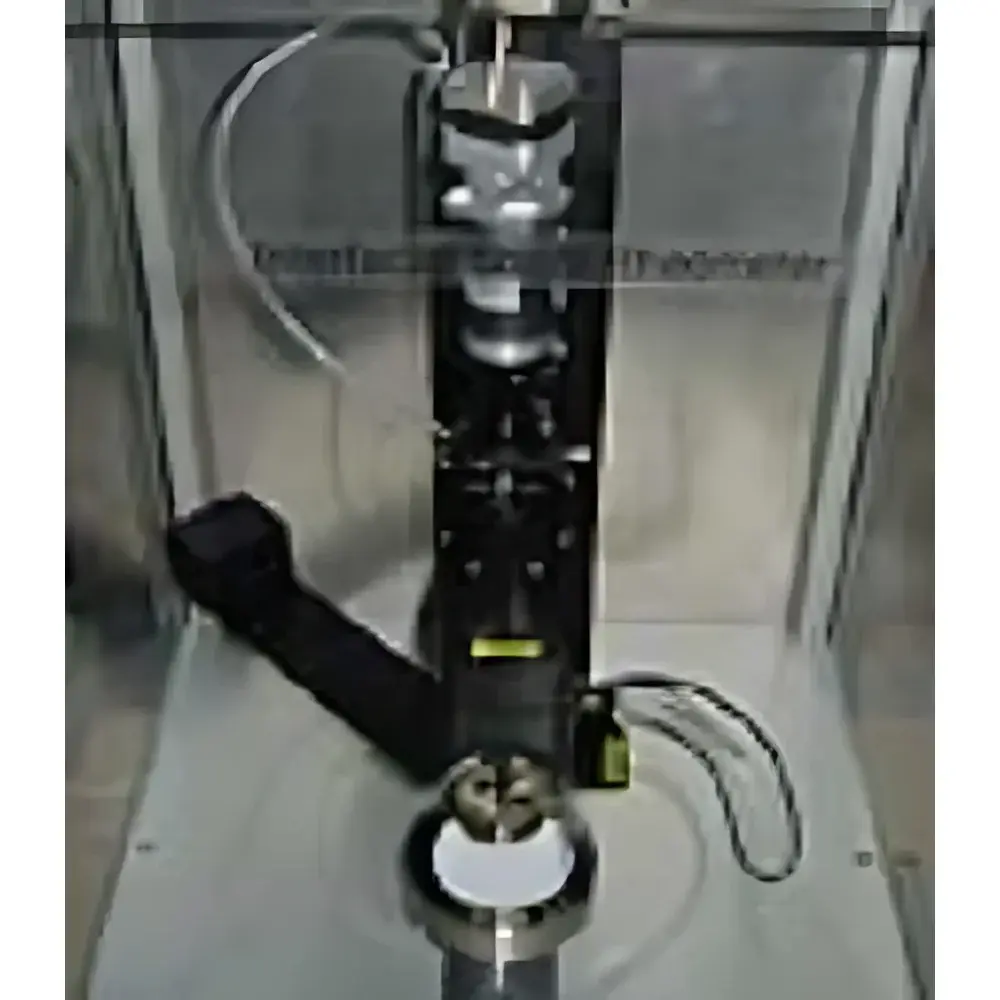
SINTERFACE ISR-1 Interfacial Shear Rheometer
| Brand | SINTERFACE |
|---|---|
| Origin | Germany |
| Model | ISR-1 |
| Interface Shear Viscosity Range | 1 µN·s/m to 100 mN·s/m |
| Interface Shear Elasticity Range | 1 µPa·m to 100 mPa·m |
| Frequency Range | 0.02–0.2 Hz |
| Torsion Angle Resolution | 0.01° |
| Position Sensor Angular Resolution | 0.01° |
| Temperature Control Range | 10–50 °C |
| Dimensions (L×W×H) | 500 × 500 × 700 mm |
| Weight | 50 kg |
| Power Supply | 100–240 V AC, 50–60 Hz, 110 W |
| Data Interface | RS-232 |
| DAQ Hardware | National Instruments high-fidelity I/O board |
| Operating System | Windows-compatible software |
| Sample Interfaces | Air/liquid and liquid/liquid interfaces |
| Optional Accessory | Liquid/liquid interface trough |
Overview
The SINTERFACE ISR-1 Interfacial Shear Rheometer is a precision-engineered instrument designed for the quantitative characterization of mechanical properties at fluid interfaces—specifically, the interfacial shear elasticity (G’) and interfacial shear viscosity (G”). It operates on the torsional oscillation principle (torsion pendulum method), where a geometrically defined probe—typically a magnetic rod or double-ring geometry—is immersed at the interface and subjected to controlled sinusoidal rotational displacement. The resulting torque response is measured via high-resolution angular sensors and calibrated torsion wires, enabling direct calculation of interfacial rheological moduli in accordance with the Boussinesq–Scriven constitutive framework. This methodology is uniquely suited for probing Gibbs adsorption layers (e.g., surfactant monolayers at air/water interfaces) and Langmuir-type spread films (e.g., phospholipid or polymer films at oil/water interfaces), where bulk contributions are negligible and surface-specific viscoelasticity governs interfacial stability, foam/film lifetime, and emulsion coalescence behavior.
Key Features
- High-sensitivity torsional detection system with dual 0.01° angular resolution—both for actuator twist and position feedback—ensuring robust signal-to-noise performance across low-frequency regimes.
- Programmable frequency sweep capability from 0.02 Hz to 0.2 Hz, optimized for slow-relaxing interfacial structures (e.g., protein aggregates, polymer brushes, or fibrillar networks) where time-dependent relaxation spectra span minutes to hours.
- Integrated Peltier-based temperature control (10–50 °C) with ±0.1 °C stability, enabling thermorheological studies of temperature-sensitive monolayers such as thermoresponsive polymers or lipid phase transitions.
- Dedicated measurement cells compatible with both air/liquid (e.g., water surface) and liquid/liquid (e.g., decane/water) interfaces; optional trough accessory provides standardized geometry and lateral confinement for reproducible liquid/liquid film formation.
- Modular electronics architecture featuring an NI-certified high-fidelity data acquisition board, synchronized RS-232 communication, and real-time torque/angle digitization at ≥1 kHz sampling rate—supporting accurate phase lag determination essential for complex modulus separation.
Sample Compatibility & Compliance
The ISR-1 supports a broad spectrum of interfacial systems relevant to colloid science, pharmaceutical formulation, food emulsification, and biomembrane research. Validated applications include small-molecule surfactants (e.g., SDS, CTAB), amphiphilic peptides, recombinant proteins (e.g., β-lactoglobulin), polysaccharide derivatives (e.g., hyaluronic acid), and synthetic block copolymers. All measurements adhere to the theoretical formalism outlined in ISO 16131:2016 (Determination of interfacial rheological properties using oscillatory methods) and align with ASTM D7978-15 guidelines for interfacial viscoelasticity assessment. The instrument’s hardware design and software audit trail functionality support GLP-compliant workflows, including user access logs, parameter versioning, and raw data immutability—facilitating regulatory submissions under FDA 21 CFR Part 11 where electronic records are required.
Software & Data Management
The included Windows-native application provides full experimental control, real-time visualization of stress-strain Lissajous plots, and automated calculation of G’, G”, loss tangent (tan δ), and interfacial damping ratio. Data export is supported in CSV, HDF5, and MATLAB-compatible formats. Each measurement session is timestamped and annotated with environmental metadata (temperature, ambient humidity if logged externally, operator ID). Software architecture includes built-in calibration wizards for torsion constant verification and interfacial area normalization, ensuring traceability to SI units. Batch processing tools enable comparative analysis across multiple films or aging time points—critical for kinetic studies of interfacial aging, oxidative crosslinking, or enzymatic degradation.
Applications
- Stability prediction of protein-stabilized foams and emulsions in food and biopharmaceutical manufacturing.
- Structure–function correlation of pulmonary surfactant analogs in respiratory drug delivery research.
- Quality-by-Design (QbD) characterization of interfacial films during liposome or nanoemulsion development.
- Fundamental investigation of Marangoni elasticity effects in thin-film drainage dynamics.
- Evaluation of interfacial healing kinetics following mechanical perturbation (e.g., drop impact or shear cessation).
FAQ
What types of interfaces can the ISR-1 measure?
The ISR-1 is validated for air/liquid (e.g., air/water, air/silicone oil) and liquid/liquid (e.g., n-hexadecane/water, squalane/phosphate buffer) interfaces. A dedicated trough accessory is available to ensure consistent geometry and minimize edge effects in liquid/liquid configurations.
Is temperature control mandatory for all measurements?
While ambient-temperature operation is possible, the integrated Peltier stage is recommended for any study requiring thermal control or comparative assessment across temperatures—especially for systems exhibiting phase transitions (e.g., DPPC monolayers) or Arrhenius-type relaxation behavior.
How is interfacial area determined during analysis?
Interfacial area is defined by the physical geometry of the probe (e.g., ring perimeter or rod circumference) and must be entered manually prior to analysis. Calibration protocols using standard Newtonian subphases (e.g., glycerol/water mixtures) are provided to verify effective area assignment.
Can the ISR-1 be integrated into automated lab environments?
Yes—the RS-232 interface supports SCPI-like command syntax, and DLL libraries are available for integration with LabVIEW, Python (via PySerial), or MATLAB for custom automation sequences and high-throughput screening.
Does the system comply with 21 CFR Part 11 requirements?
The software supports electronic signatures, audit trails, and role-based access control. Full Part 11 compliance requires site-specific validation documentation and IT infrastructure alignment (e.g., secure network storage, backup policies), which are outlined in the Instrument Qualification Package supplied with each unit.



