
Sinusoidal Mechanical Shock Tester OK-S-100
| Brand | Other Brands |
|---|---|
| Origin | Imported |
| Manufacturer Type | General Distributor |
| Price | USD 14,000 (approx.) |
| Max Test Load | 100 kg |
| Pulse Repetition Rate | 0–80 min⁻¹ |
| Pulse Duration | 6–180 ms |
| Peak Acceleration | 50–1000 m/s² |
| Waveform | Half-Sine |
| Table Dimensions | 500 mm × 700 mm |
| Table Mass | ~1200 kg |
| Overall Dimensions (L×H×W) | 700 mm × 900 mm × 1200 mm |
| Controller Model | KP-100 |
| Power Supply | 220 V ±10%, 50 Hz |
| Controller Mass | 15 kg |
| Controller Dimensions (L×H×W) | 500 mm × 280 mm × 400 mm |
| Power Consumption | 1.3 kVA |
| Data Acquisition Unit | CC-1A |
| Compliance | GB/T 2423.5–1995, GB/T 2423.6–1995, JB/T 9391–1999, IEC 60068-2-27, IEC 60068-2-29, JJG 498–1987 |
| Input Channels | 1 standard (expandable to 2), differential, >500 kΩ impedance |
| Gain Selection | ×1 / ×10 / ×100 |
| Signal Coupling | AC/DC, single-ended or differential |
| Connector | BNC |
| Anti-Aliasing Filter | Analog + 160 dB/oct digital filter |
| Input Range | ±10 V |
| Signal Conditioning | Voltage input, built-in IEPE constant-current source, charge amplifier |
| ADC Resolution | Multi-bit |
| Dynamic Range | 110 dB |
| SNR | >100 dB |
| Target Spectrum Definition | Tabular entry of acceleration (or velocity/displacement) amplitude and slope per breakpoint |
| Control Method | Sinusoidal waveform amplitude control |
| Frequency Range | 1.0–5000 Hz |
| Control Dynamic Range | 95 dB |
| Closed-Loop Update Interval | 10 ms |
| Control Accuracy | ±0.5 dB |
| Sweep Modes | Linear (0–6000 Hz/min), Logarithmic (0–100 oct/min) |
| Operation Modes | Sweep, Fixed-Frequency |
Overview
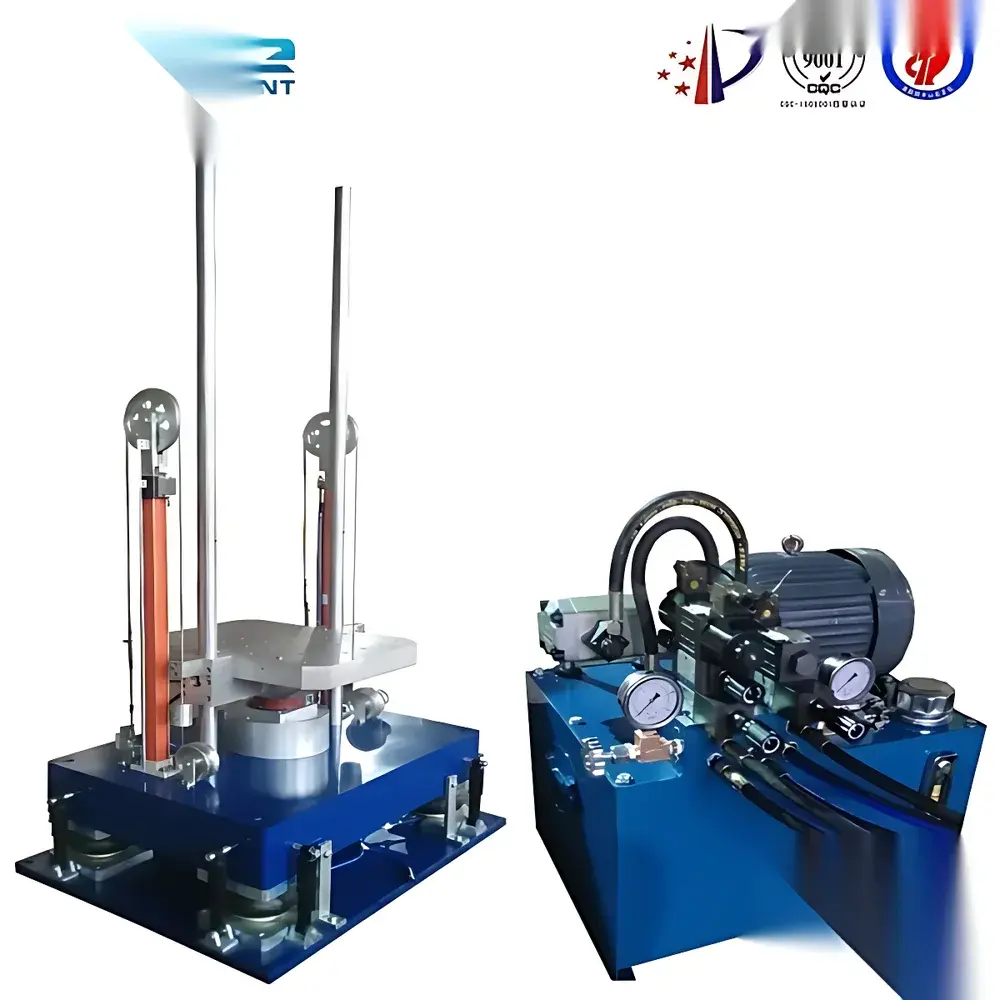
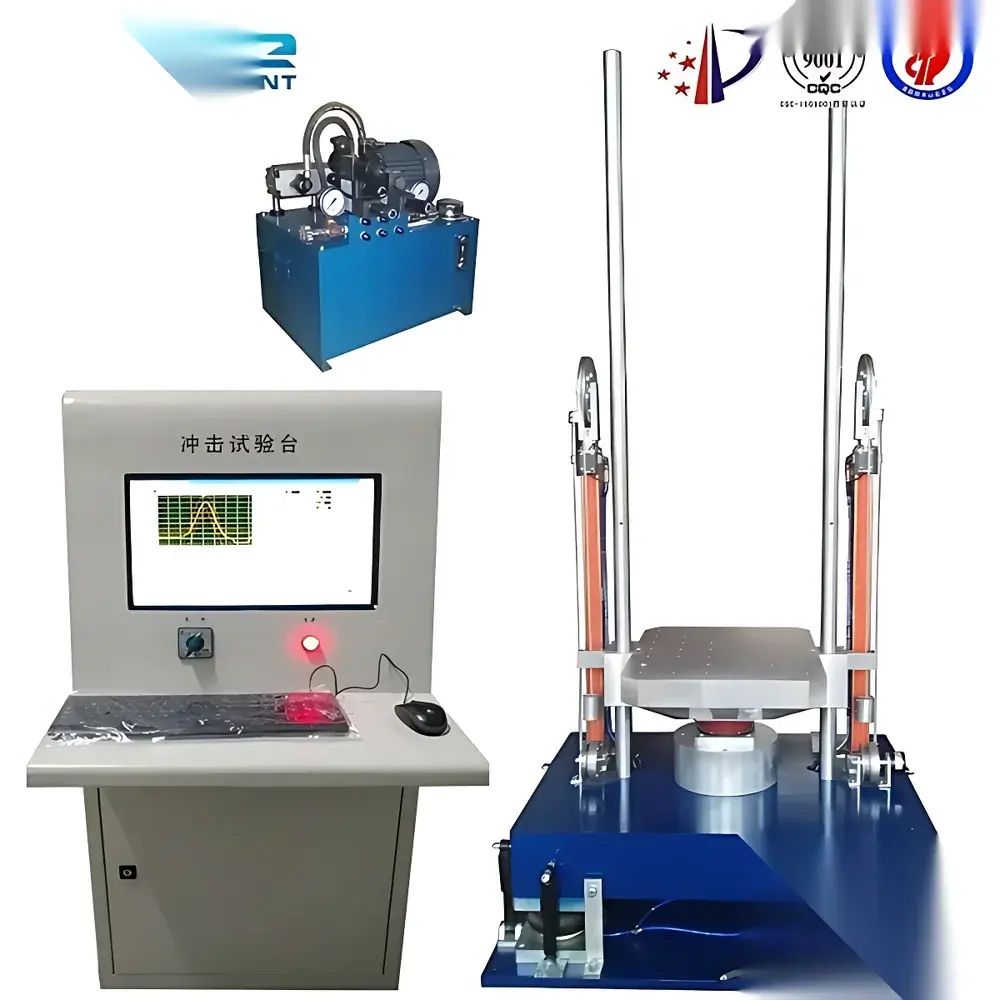
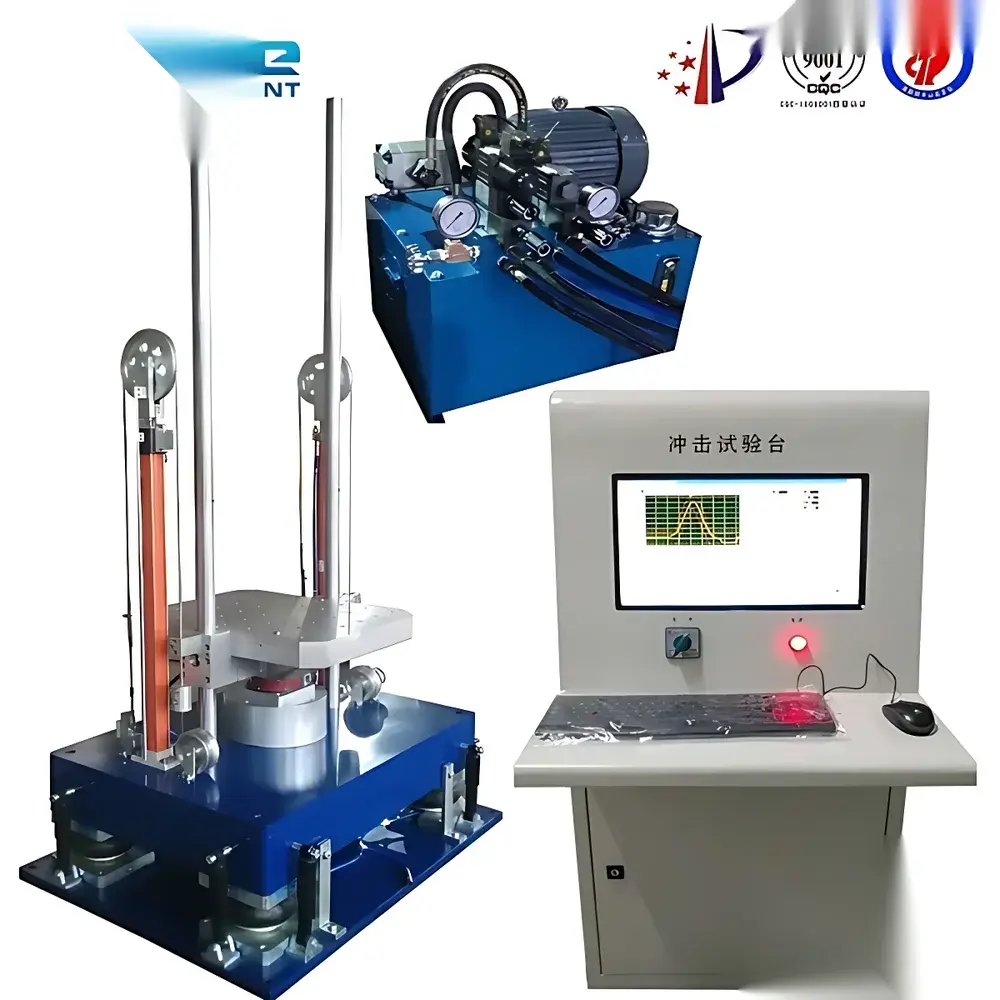
The Sinusoidal Mechanical Shock Tester OK-S-100 is a precision-engineered electro-mechanical shock testing system designed for controlled half-sine pulse generation and high-fidelity transient response acquisition. It operates on the principle of electromagnetic inertial mass impact—where a moving armature driven by a controlled current pulse strikes a compliant stop, generating a repeatable, time-limited acceleration pulse on the test table. Unlike drop-tower or pendulum-based impact systems, this tester delivers programmable, closed-loop-controlled sinusoidal (half-sine) shock pulses with precisely adjustable peak acceleration, duration, and repetition rate—enabling rigorous simulation of transport-related mechanical shocks, handling drops, and operational jolts encountered in automotive, aerospace, industrial equipment, and consumer electronics supply chains.
Key Features
- Programmable half-sine shock pulse generation with peak acceleration range of 50–1000 m/s² and pulse duration tunable from 6 ms to 180 ms—covering MIL-STD-810G Method 516.6, ISO 16750-3, and IEC 60068-2-27 severity levels.
- Closed-loop real-time control architecture with 10 ms update interval and ±0.5 dB amplitude accuracy ensures waveform fidelity and repeatability across multiple test cycles.
- Dual-domain spectrum definition capability: users define target shock spectra via tabular breakpoints specifying acceleration amplitude and spectral slope—supporting both linear (0–6000 Hz/min) and logarithmic (0–100 oct/min) sweep modes.
- Integrated data acquisition unit (CC-1A) featuring 1-channel differential analog input (expandable to 2), programmable gain (×1/×10/×100), IEPE sensor excitation, and 110 dB dynamic range with >100 dB signal-to-noise ratio.
- Robust mechanical design: 1200 kg reinforced steel base structure, 500 mm × 700 mm rigid aluminum test table, and optimized suspension damping to minimize residual vibration and ensure clean pulse isolation.
- Comprehensive anti-aliasing architecture combining analog filtering with 160 dB/oct digital decimation filters—eliminating phase distortion and spectral leakage during high-speed transient capture.
Sample Compatibility & Compliance
The OK-S-100 accommodates test specimens up to 100 kg mounted directly on its horizontal test table or via custom fixtures. Its mechanical interface supports standard ISO 2247 and ASTM D999 mounting configurations. The system complies with international shock testing standards including IEC 60068-2-27 (Shock), IEC 60068-2-29 (Bump), GB/T 2423.5–1995 and GB/T 2423.6–1995 (Chinese equivalents of IEC 60068), JB/T 9391–1999 (mechanical shock test equipment specification), and JJG 498–1987 (verification regulation for shock testers). All measurement channels are traceable to national metrological standards, and the controller firmware supports audit-ready operation logs required under GLP and GMP environments.
Software & Data Management
The embedded control software provides intuitive graphical configuration of shock profiles, real-time waveform monitoring, and post-test analysis tools—including time-domain pulse parameter extraction (peak g, duration, Δv), tolerance band overlay per IEC 60068-2-27 Annex A, and pass/fail auto-judgment against user-defined acceptance criteria. Export formats include CSV, MATLAB (.mat), and universal HDF5 for integration into enterprise quality management systems (QMS) and statistical process control (SPC) platforms. The system supports optional FDA 21 CFR Part 11-compliant electronic signatures and audit trail functionality when deployed in regulated pharmaceutical or medical device manufacturing settings.
Applications
- Structural integrity validation of automotive ECUs, sensors, and infotainment modules subjected to road-induced shock events.
- Qualification testing of avionics enclosures per DO-160 Section 7 (Shock and Crash Safety).
- Design verification of industrial robotics joints and end-effectors under repetitive mechanical loading.
- Reliability screening of printed circuit board assemblies (PCBAs) for solder joint fatigue resistance.
- Transport simulation for packaged goods—aligning with ISTA 3A and ASTM D4169 protocols through calibrated half-sine pulse replication.
- Research-grade characterization of viscoelastic material response under high-strain-rate loading conditions.
FAQ
What shock waveforms does the OK-S-100 generate?
It generates programmable half-sine acceleration pulses—fully compliant with IEC 60068-2-27 and MIL-STD-810G Method 516.6 requirements.
Can the system perform multi-axis shock testing?
No—the OK-S-100 is a single-axis (vertical) shock tester. For multi-axis qualification, sequential orthogonal testing or integration with a triaxial shaker system is recommended.
Is the controller compatible with third-party sensors?
Yes—it accepts IEPE-accelerometers, charge-mode transducers (with external charge amplifier), and voltage-output sensors via BNC interface with configurable gain and coupling mode.
Does the system support automated test sequencing?
Yes—test programs can be scripted with conditional logic, loop counts, and pass/fail branching based on real-time pulse metrics.
What maintenance is required for long-term calibration stability?
Annual verification of table acceleration response using NIST-traceable reference accelerometers and periodic mechanical inspection of impact mechanism wear surfaces are recommended per manufacturer guidelines.



