
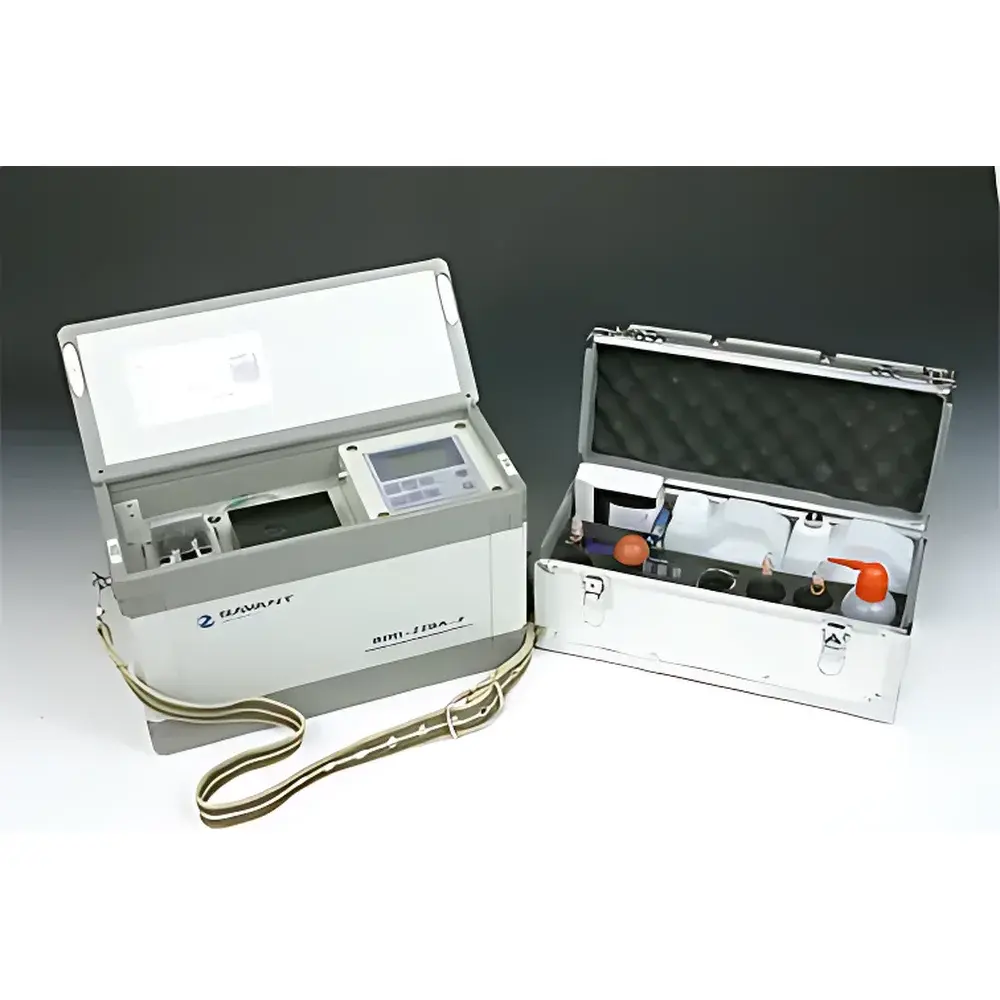
Sipo Environment BOD-220A-2 Portable Biochemical Oxygen Demand Analyzer
| Brand | Sipo Environment |
|---|---|
| Origin | Tianjin, China |
| Model | BOD-220A-2 |
| Instrument Type | Portable BOD Analyzer |
| Measurement Principle | Microbial Membrane Electrode Method |
| Measuring Range | 2–4000 mg/L |
| Sample Measurement Time | 8 min |
| RSD | ≤5% |
| Temperature Control Accuracy | ±0.1°C |
| Power Supply | AC 110–220 V / DC 12 V (automotive cigarette lighter compatible) |
| Dimensions | 260 × 400 × 180 mm |
| Weight | ~12 kg |
| Power Consumption | <50 W |
| Operating Ambient Temperature | 5–40°C |
| Sensor Configuration | Integrated 3-electrode microbial sensor with reference electrode (Patent ZL 00 257536.1) |
| Incubation System | Reflective thermostatic chamber with heating/cooling (Patent ZL 01 267798.1) |
| Microbial Membrane | Dry-layer immobilized BOD₅-specific strain (InterBio™, EPA-certified) |
| Membrane Shelf Life | >12 months (dry storage at room temperature) |
| Sample Volume Required | >20 mL |
| Buffer Consumption | 150 mL/h |
| Data Storage Capacity | 99 test records |
| Interface | External thermal mini-printer support |
| Inlet Mode | Peristaltic pump-driven continuous flow |
| Housing | Lightweight extruded aluminum frame with shock-absorbing mounting |
Overview
The Sipo Environment BOD-220A-2 Portable Biochemical Oxygen Demand Analyzer is an engineered field-deployable instrument designed for rapid, on-site determination of biochemical oxygen demand (BOD) in water and wastewater samples. It operates on the microbial membrane electrode principle—where a metabolically active, immobilized BOD₅-specific bacterial consortium (certified by the U.S. EPA under InterBio™ technology) consumes dissolved oxygen in proportion to organic biodegradable content. This consumption generates a measurable current signal (0–20 µA) across a three-electrode integrated sensor—including working, counter, and reference electrodes—enabling direct electrochemical quantification without dilution or incubation delays. Unlike traditional 5-day BOD₅ methods (e.g., ASTM D5210, ISO 5815-1), the BOD-220A-2 delivers results in just 8 minutes while maintaining compliance with HJ/T 86–2002, China’s standard method for rapid BOD analysis. Its reflective thermostatic chamber ensures precise temperature control (±0.1°C) across ambient conditions from 5°C to 40°C—critical for kinetic consistency—and supports both heating and cooling functions via solid-state thermoelectric elements.
Key Features
- Integrated three-electrode microbial sensor with built-in reference electrode (Patent ZL 00 257536.1), eliminating calibration drift and enabling stable baseline response.
- Single-chamber flow-through design merges sample measurement and sensor cleaning into one compact cell—reducing carryover and enabling rapid sequential analysis.
- Dry-layer immobilized microbial membrane using EPA-validated InterBio™ BOD₅-specific strains; non-toxic, shelf-stable (>12 months at ambient dry storage), and activated for ≥30 days of continuous operation.
- Reflective thermostatic incubation system (Patent ZL 01 267798.1) with bidirectional temperature regulation—ensuring enzymatic reaction fidelity regardless of external fluctuations.
- Automotive-grade power architecture: dual-mode input (AC 110–220 V / DC 12 V), allowing direct integration with vehicle electrical systems via cigarette lighter socket—ideal for mobile environmental monitoring units.
- Shock-resistant mechanical construction: lightweight extruded aluminum chassis with vibration-dampened internal mounting for all optical, electrochemical, and fluidic components.
- Low buffer consumption (150 mL/h) and minimal sample requirement (>20 mL), reducing operational cost and logistical burden during extended field campaigns.
Sample Compatibility & Compliance
The BOD-220A-2 is validated for use with raw sewage, treated effluent, surface water, groundwater, and industrial process water—provided samples are free of cytotoxic inhibitors (e.g., heavy metals, chlorinated disinfectants) above threshold concentrations defined in HJ/T 86–2002. Sample turbidity and suspended solids do not interfere due to the flow-through sensor geometry and continuous rinsing cycle. The analyzer conforms to national regulatory requirements for rapid BOD assessment in China and supports data traceability aligned with GLP principles. While not inherently 21 CFR Part 11 compliant out-of-the-box, its audit-ready data log (99-record internal memory with timestamp and operator ID fields) provides foundational structure for laboratory quality system integration.
Software & Data Management
Data acquisition and reporting are handled via embedded firmware with real-time signal processing algorithms optimized for microbial respiration kinetics. Each measurement includes automatic temperature compensation, background current subtraction, and linear range validation. Stored records contain BOD concentration (mg/L), measurement time, ambient temperature, sensor status flag, and user-defined sample ID. Export is supported through RS-232 interface to external thermal mini-printers for hard-copy field reports. Firmware updates are performed via USB port using manufacturer-provided configuration utilities—no cloud dependency or proprietary software installation required.
Applications
- Rapid screening of wastewater treatment plant influent/effluent for process optimization and regulatory reporting.
- Field-based environmental impact assessments (EIAs) requiring immediate BOD data at discharge points or receiving waters.
- Emergency response monitoring following spills or infrastructure failures where time-critical oxygen demand profiling is essential.
- Educational and training deployments—its portability, intuitive interface, and self-contained operation make it suitable for university environmental science labs and field practicums.
- Mobile laboratories deployed in remote or off-grid locations where grid power is unavailable but vehicle-based power is accessible.
FAQ
What is the minimum and maximum BOD concentration this instrument can measure?
The BOD-220A-2 has a linear dynamic range of 2–4000 mg/L, as verified per HJ/T 86–2002 protocol using glucose-glutamic acid (GGA) standard solutions.
How often must the microbial membrane be replaced?
Under continuous field use, the activated dry-layer membrane maintains functional stability for ≥30 days; replacement is recommended after each 30-day activation cycle or if signal drift exceeds ±5% of initial response.
Can the instrument operate unattended overnight?
Yes—the sleep-mode function places the microbial membrane into metabolic stasis between measurements, preserving viability and extending operational readiness without refrigeration.
Is calibration required before each use?
A two-point verification (zero and span) using deionized water and 200 mg/L GGA standard is recommended prior to daily operation; full calibration is required only after membrane replacement or sensor maintenance.
Does the device meet international standards such as ISO or ASTM?
While primarily designed to meet HJ/T 86–2002, its measurement principle and performance characteristics align with the technical basis of ISO 10260 (biosensor-based BOD) and ASTM D8083 (rapid BOD by microbial sensor), though formal certification under those standards requires third-party validation.
Related Products







