
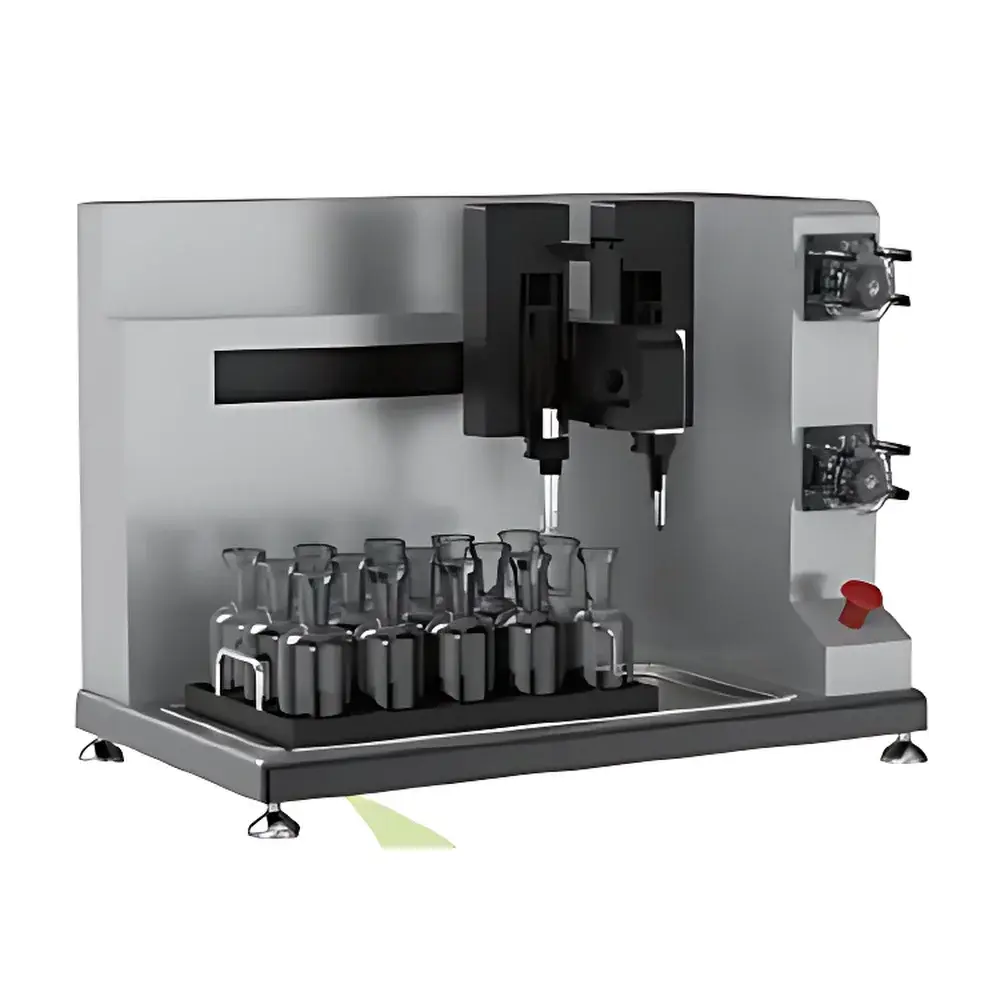
Sipo Environment BODAuto™1000 BOD₅ Automated Robotic Analyzer
| Brand | Sipo Environment |
|---|---|
| Origin | Tianjin, China |
| Model | BODAuto™1000 |
| Instrument Type | Laboratory BOD Analyzer |
| Principle | Dissolved Oxygen (DO) Depletion Method (Standard 5-day Incubation) |
| Measurement Range | 2–6000 mg/L |
| Detection Limit | < 0.5 mg/L |
| Accuracy | ±0.1 mg/L (for 0–20 mg/L range) |
| Single-Sample Measurement Time | < 30 s (at 25°C, 90% response) |
| Repeatability | < 0.1 mg/L |
| Sample Capacity | 18 positions |
| DO Electrode | Imported German electrochemical sensor (0–20.00 mg/L, 0–200.0 % saturation |
| resolution | 0.01 mg/L / 0.1 %) |
| Temperature Compensation | 0–45 °C |
| Salinity Compensation | 0–45 ppt |
| Barometric Pressure Compensation | 80–105 kPa |
| Peristaltic Pump Flow Rate | 1.2 L/min |
| Incubation Vessel | 300 mL borosilicate glass bottle with water-seal PVC cap |
| Positioning Accuracy | < 0.1 mm (Hall-effect servo feedback) |
| Motor System | MOONS (Japan) stepper-servo motors |
| Power Supply | AC 220 V, 50 Hz |
| Power Consumption | 350 W |
| Dimensions (W×D×H) | 1000 × 420 × 500 mm |
| Weight | Approx. 48 kg |
Overview
The Sipo Environment BODAuto™1000 BOD₅ Automated Robotic Analyzer is an ISO/EN 1899-1 and ASTM D5210-compliant laboratory instrument engineered for precise, unattended determination of biochemical oxygen demand (BOD₅) in environmental water samples. It implements the standard 5-day dissolved oxygen depletion method—measuring the difference in dissolved oxygen concentration before and after aerobic incubation at 20 °C—to quantify the biodegradable organic load in wastewater, surface water, drinking water sources, and effluent streams. Unlike manual or semi-automated BOD analyzers, the BODAuto™1000 integrates robotic sample handling, electrochemical DO sensing, and full-cycle process automation—including pre-incubation dilution, vial capping/sealing, magnetic stirring, probe cleaning, and post-incubation measurement—within a single compact platform. Its architecture eliminates operator-dependent variability while ensuring traceable, auditable, and GLP-aligned data generation across regulatory testing workflows.
Key Features
- Fully robotic 18-position sample processing: Integrated 7-axis electric motion modules enable independent or synchronized operation for dilution, lid actuation, stirring, DO measurement, and electrode cleaning—no compressed air or pneumatic components required.
- High-fidelity electrochemical DO measurement: German-sourced Clark-type sensor with dual-range output (0–20.00 mg/L and 0–200.0 % saturation), temperature/salinity/barometric compensation, and <0.1 mg/L repeatability per measurement cycle.
- Water-seal compliant incubation: Dedicated 300 mL borosilicate glass bottles with integrated PVC caps featuring standardized water-seal geometry to prevent atmospheric oxygen ingress during 5-day incubation—fully aligned with APHA 5210B and ISO 5815-1 requirements.
- Real-time audit trail & power-resilient operation: All measurement events, parameter changes, and robotic actions are timestamped and stored locally on internal SSD storage; system resumes from last valid position after unexpected power interruption.
- HMI + Windows-based software suite: Touch-enabled interface with embedded BOD₅ calculation engine, automatic unit conversion, QC flagging (e.g., DO drift >0.1 mg/L/h), and configurable reporting templates compliant with EPA 40 CFR Part 136 and EU Water Framework Directive Annex V reporting formats.
Sample Compatibility & Compliance
The BODAuto™1000 accommodates raw wastewater, treated effluent, river/lake water, groundwater, and industrial process streams—with optional nitrification inhibition (allylthiourea) support for carbonaceous BOD-only analysis. Sample matrix compatibility extends to turbid, suspended-solid-laden, and mildly colored waters due to non-optical (electrochemical) detection. The system meets functional equivalency criteria under ISO 5815-1:2019, EN 1899-1:2000, and ASTM D5210-19. Full electronic records comply with FDA 21 CFR Part 11 requirements when operated with validated software configuration and user access controls. All hardware components—including DO probe calibration logs, incubation temperature validation reports, and mechanical positioning diagnostics—are exportable as CSV/PDF for internal QA review or external accreditation audits (e.g., ISO/IEC 17025).
Software & Data Management
The proprietary BODControl™ software provides role-based user authentication (administrator/operator/auditor), electronic signature capture, and version-controlled method templates. Each assay generates a structured dataset containing raw DO values, temperature-compensated saturation percentages, calculated BOD₅ concentrations (mg/L), confidence indicators (e.g., residual DO ≥2 mg/L, depletion ≥2 mg/L), and deviation alerts. Data export supports direct integration with LIMS via ASTM E1384-compliant XML or HL7 messaging. Audit trails record all parameter modifications, recalibrations, and manual overrides with user ID, timestamp, and reason code—enabling full forensic reconstruction of analytical history per GLP and GMP documentation standards.
Applications
- Regulatory compliance testing for municipal wastewater treatment plants (WWTPs) under national discharge permits.
- Environmental monitoring programs for surface water quality assessment (e.g., EPA STORET, EEA WISE).
- Industrial pretreatment verification for food processing, pharmaceutical, and textile manufacturing facilities.
- Research laboratories conducting biodegradability screening of novel organic compounds or wastewater treatment optimization studies.
- Academic teaching labs requiring reproducible, hands-off BOD₅ demonstration with real-time data visualization and error diagnostics.
FAQ
Does the BODAuto™1000 support nitrification inhibition for carbonaceous BOD measurement?
Yes—software-configurable addition of allylthiourea (ATU) during sample preparation is supported via programmable peristaltic dosing module.
Can the system validate incubation temperature stability across all 18 positions?
Temperature uniformity (±0.3 °C at 20 °C) is verified annually using NIST-traceable PT100 probes; validation report templates are included in the IQ/OQ package.
Is remote monitoring or cloud-based data backup available?
Local network connectivity (Ethernet) enables secure remote desktop access for troubleshooting; cloud sync requires on-premise IT policy approval and TLS 1.2+ encrypted gateway configuration.
What maintenance intervals are recommended for the DO probe and robotic subsystems?
DO sensor membrane replacement every 6 months; electrolyte refill every 3 months; Hall-effect encoder calibration annually; full robotic kinematic alignment every 24 months by certified field engineer.
How does the system handle samples requiring serial dilution beyond the built-in 1:1000 range?
Multi-step dilution protocols can be programmed within the software—each step executed autonomously with intermediate mixing and equilibration pauses prior to final measurement.
Related Products







