
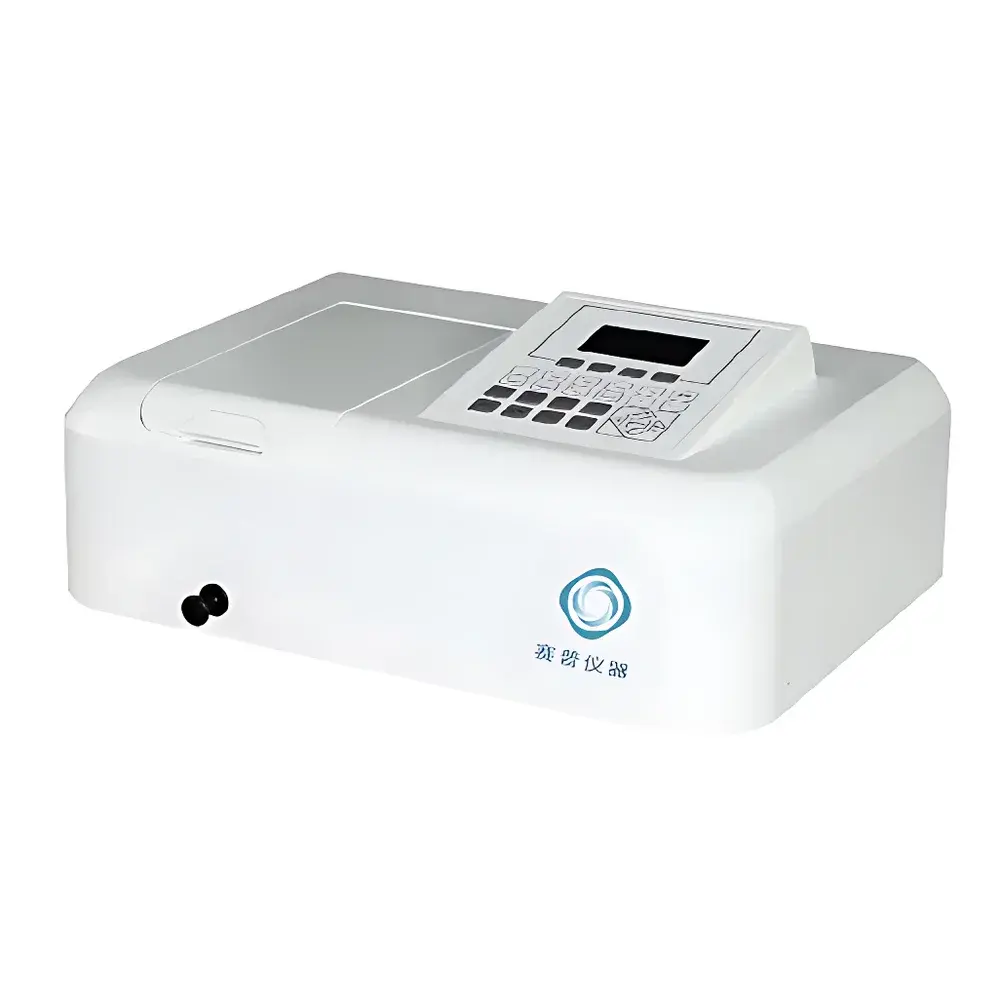
Sipo Environment OIL-UV-2100 UV Spectrophotometric Oil Content Analyzer
| Brand | Sipo Environment |
|---|---|
| Origin | Tianjin, China |
| Model | OIL-UV-2100 |
| Measurement Principle | UV Spectrophotometry |
| Measurement Range | 0–80 mg/L |
| Detection Limit | 0.005 mg/L |
| Accuracy | <2% |
| Wavelength Resolution | 1 nm |
| Sample Measurement Time | 15 s per sample |
| Wavelength Range | 190–1100 nm |
| Wavelength Accuracy | ±1 nm |
| Wavelength Repeatability | 0.2 nm |
| Spectral Bandwidth | 2 nm |
| Absorbance Range | −0.30 to 3.0 A |
| Absorbance Repeatability (RSD) | ≤1% |
| Correlation Coefficient | R > 0.999 |
| Transmittance Accuracy | ±0.3% T |
| Stray Light | ≤0.2% T |
| Baseline Drift | ±0.002 A/h |
| Extraction Method | n-Hexane Extraction (Compliant with HJ 970–2018) |
Overview
The Sipo Environment OIL-UV-2100 is a dedicated UV spectrophotometric oil content analyzer engineered for precise, trace-level quantification of petroleum hydrocarbons in aqueous matrices. It operates on the principle of ultraviolet absorption spectroscopy at the characteristic 225 nm wavelength—where aliphatic and aromatic hydrocarbons exhibit strong, selective absorbance following n-hexane extraction. Designed in full compliance with China’s environmental standard HJ 970–2018 (“Determination of Petroleum Hydrocarbons in Water by Ultraviolet Spectrophotometry”), the instrument delivers laboratory-grade reproducibility for regulatory monitoring of surface water, groundwater, and seawater. Its optical architecture integrates a high-stability dual-source system (tungsten and deuterium lamps), a custom-blazed holographic grating optimized for 225 nm, and real-time zero-point baseline correction—ensuring long-term photometric stability and minimizing drift-induced uncertainty in low-concentration measurements.
Key Features
- Automated spectral workflow: One-touch measurement initiates automatic standard curve selection, extraction ratio application, and direct concentration readout—eliminating manual calculation and operator-dependent error.
- Factory-calibrated wavelength validation: Integrated 225 nm certified UV oil reference filter enables rapid, interference-resistant single-point calibration; validated curves remain stable over instrument lifetime without re-standardization.
- Triple embedded calibration protocols: Pre-loaded calibration curves traceable to three independently certified reference materials—National Marine Environmental Monitoring Center (NMEMC), Chinese Academy of Environmental Sciences (CAES) Environmental Reference Materials Institute, and Tanmo Certified Reference Materials—supporting method cross-validation and inter-laboratory comparability.
- Real-time n-hexane quality control: Simultaneous transmittance assessment at 225 nm verifies solvent purity prior to each analysis, preventing false positives from solvent impurities.
- High-speed spectral acquisition: Full 225 nm peak scan completed in ≤15 seconds; single-wavelength absorbance capture achieved in <1 second—enabling rapid throughput without compromising spectral fidelity.
- Modular automation readiness: Compatible with optional fully automated liquid handling and n-hexane extraction modules, supporting quantitative dosing, phase separation, dehydration, and adsorption—all without manual contact with hazardous solvents.
- Integrated 2 cm auto-switching quad-cell holder: Enables seamless transition between blank, calibration standards, and up to three unknown samples—reducing carryover and improving analytical efficiency.
- Embedded industrial touch-computer running Windows OS: Supports local data processing, secure storage, PDF report generation, and USB/ethernet export; fully compatible with external desktop systems for centralized LIMS integration.
Sample Compatibility & Compliance
The OIL-UV-2100 is validated for use with raw and filtered water samples meeting HJ 970–2018 specifications—including turbid surface waters, saline seawaters, and low-conductivity groundwater. Sample preparation requires n-hexane extraction followed by phase separation and optional silica gel cleanup (per standard protocol). The instrument meets essential performance criteria for environmental laboratories operating under GLP frameworks: wavelength accuracy (±1 nm), absorbance repeatability (RSD ≤1%), correlation coefficient (R > 0.999), and detection limit (0.005 mg/L)—all verified against NIST-traceable reference materials. While not FDA 21 CFR Part 11–certified out-of-the-box, audit trails, user access logs, and electronic signature support can be enabled via optional software configuration for regulated QA/QC environments.
Software & Data Management
Bundled analysis software (copyright-registered in China) provides full method management, including multi-curve selection, background subtraction, peak identification, and QC flagging. All raw spectra, calibration logs, and measurement metadata are timestamped and stored in encrypted binary format. Export options include CSV (for Excel or statistical packages), XML (for LIMS ingestion), and print-ready PDF reports containing instrument ID, operator name, sample ID, date/time stamp, and spectral overlays. Software supports audit trail review with immutable records of parameter changes, calibration events, and result modifications—meeting minimum requirements for ISO/IEC 17025–accredited environmental testing laboratories.
Applications
- Regulatory compliance monitoring for municipal wastewater discharge permits (e.g., Class I–III surface water limits per GB 3838–2002)
- Offshore platform effluent verification in marine environmental impact assessments
- Groundwater plume characterization at legacy petroleum-contaminated sites
- Quality control of drinking water source protection zones
- Method validation and interlaboratory comparison studies for petroleum hydrocarbon analysis
- Educational training in environmental analytical chemistry curricula
FAQ
Does the OIL-UV-2100 comply with international standards such as ISO 9377-2 or ASTM D7066?
The instrument implements the core UV absorption methodology aligned with ISO 9377-2 (petroleum hydrocarbons in water) and ASTM D7066 (oil & grease by IR/UV), though formal certification requires third-party validation per jurisdictional requirements.
Can the built-in calibration curves be modified or extended by the user?
Yes—users may import custom calibration datasets or generate new curves using certified reference materials; all modifications are logged with operator ID and timestamp.
Is n-hexane the only approved extraction solvent?
Per HJ 970–2018, n-hexane is the mandated solvent; alternative solvents (e.g., cyclohexane) require method validation and are not supported by factory calibration curves.
What maintenance is required for long-term wavelength accuracy?
Annual verification using the supplied 225 nm reference filter is recommended; no lamp or grating alignment is required due to rigid optical bench construction.
How is data integrity ensured during power interruption or system crash?
All active measurements are auto-saved every 2 seconds to non-volatile memory; unsaved spectral buffers are recovered upon restart without data loss.
Related Products







