
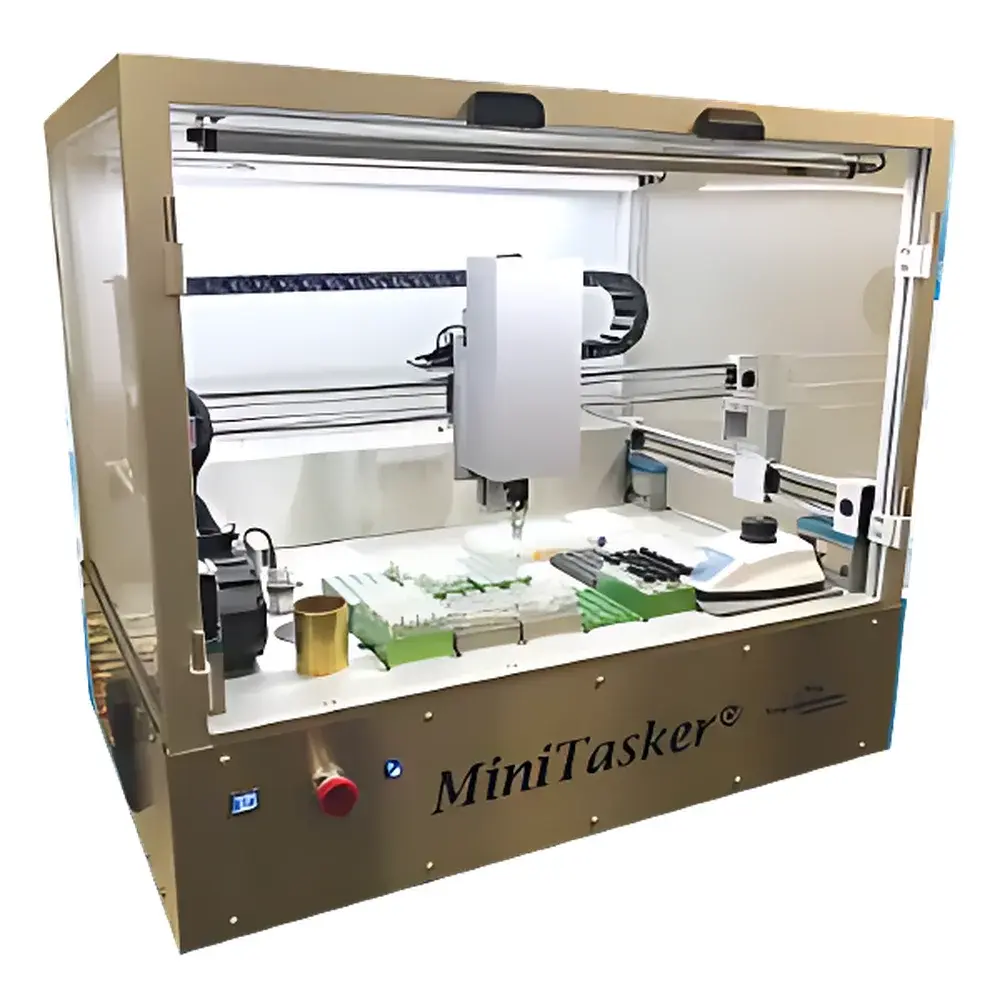
Sirius Automation Smart Multifunctional Sample Preparation Platform
| Brand | Sirius |
|---|---|
| Origin | USA |
| Manufacturer Type | Authorized Distributor |
| Product Category | Imported Instrument |
| Model | Sirius Automation |
| Pricing | Available Upon Request |
Overview
The Sirius Automation Smart Multifunctional Sample Preparation Platform is an engineered laboratory automation system designed to standardize, accelerate, and audit-trail sample preparation workflows across regulated and high-throughput environments. Built on a modular robotic architecture, it integrates precision liquid handling, gravimetric dispensing, barcode-driven sample identification (1D/2D), automated tube capping/decapping, vortex mixing, and plate staging—all under centralized control. The platform operates on the principle of deterministic robotic motion coupled with real-time sensor feedback, ensuring repeatability in tasks governed by Good Laboratory Practice (GLP) and FDA 21 CFR Part 11 requirements. It is not a standalone instrument but a scalable workflow engine—deployed as MicroTasker® for benchtop micro-volume applications, MiniTasker® for mid-scale QC labs, OmniTasker® for full-protocol automation, and MultiTasker II® for high-density plate-based processing (up to 20 × 96-well plate carriers). Its core function is to replace manual, error-prone sample prep steps with traceable, time-stamped, and role-based actions—reducing transcription errors, minimizing analyst exposure, and enabling seamless data continuity from sample intake to analytical instrumentation.
Key Features
- Modular task integration: Select and combine modules including high-precision balance (0.01 mg or 0.1 mg readability), positive-displacement pipetting (±1 µL accuracy at volumes ≥10 µL), dual-mode barcode readers (supporting GS1, DataMatrix, Code 128), motorized gripper with torque-sensing cap actuation, and programmable vortex units with variable speed and dwell time.
- Deterministic cycle performance: Scan cycle completed in ≤3 seconds per tube or plate; gravimetric weighing cycle in ≤6 seconds per sample—achievable via synchronized gantry motion, adaptive load-cell sampling, and optimized path planning.
- Mechanical precision: Robotic arm positional repeatability <0.1 mm (ISO 9283 compliant); pipette tip alignment tolerance maintained within ±0.05 mm across full working envelope.
- FDA 21 CFR Part 11 compliance: Full electronic signature support, user-role-based access control (RBAC), immutable audit trail (timestamped action logs with operator ID, parameter set, and outcome status), and secure data encryption (AES-256) for all local storage and network transfers.
- Enclosed safety architecture: Fully sealed workspace with integrated active exhaust (HEPA-filtered, ≥20 ACH), interlocked access doors, and vapor containment design suitable for volatile organic solvents and low-toxicity reagents.
Sample Compatibility & Compliance
The platform accommodates diverse primary containers—including 0.5–50 mL screw-cap tubes, 1.5 mL microcentrifuge tubes, 24-, 48-, and 96-well plates (deep-well and shallow), and custom vial racks—with automatic detection via barcode or physical fiducial markers. All modules are validated per ISO/IEC 17025:2017 principles for measurement uncertainty estimation. System qualification documentation (IQ/OQ/PQ protocols) is provided for GxP-regulated deployments. The software meets GLP requirements for raw data integrity, metadata capture (e.g., ambient temperature, humidity, balance calibration status), and retention policies aligned with 21 CFR Part 11 Subpart B.
Software & Data Management
Controlled by Sirius ControlSuite™ v4.x—a Windows-based application supporting method scripting (Python API available), drag-and-drop protocol builder, and live dashboard monitoring. All sample metadata, weight values, pipette volumes, and barcode reads are exported in ASTM E1384-compliant .csv or .xml formats. Native LIMS integration is achieved via HL7 ADT/ORM messages or RESTful webhooks, enabling bidirectional synchronization of sample IDs, container locations, and result flags. Audit trails are exportable as PDF/A-1b or encrypted SQLite archives with SHA-256 hash verification.
Applications
- Pharmaceutical QC: Standard solution preparation, reference standard dilution, stability sample aliquoting, and assay plate setup under USP guidance.
- Food & Environmental Testing: Homogenate subsampling, pesticide residue extraction prep, and microbiological media dispensing compliant with ISO 17025 and AOAC standards.
- Chemical R&D: Catalyst precursor weighing, reaction mixture assembly, and high-throughput screening plate replication with full traceability.
- Clinical Research: Biobank sample reformatting (tube-to-plate transfer), DNA/RNA quantification prep, and cryovial inventory reconciliation.
FAQ
Does the platform support third-party balance or pipette integration?
Yes—via standardized RS-232/USB-HID protocols and vendor-provided SDKs; however, full 21 CFR Part 11 audit trail coverage requires Sirius-certified modules.
Can protocols be version-controlled and recalled for re-execution?
Yes—each protocol is assigned a unique UUID, stored with digital signature, and retrievable with full change history and approval metadata.
What validation support is included out-of-the-box?
Factory-issued IQ/OQ test scripts, calibration certificates for balance and pipettes, and a risk-based PQ template aligned with Annex 11 and ASTM E2500.
Is remote monitoring or troubleshooting supported?
Yes—through optional Secure Remote Access Module (SRAM), enabling encrypted VNC sessions with session logging and multi-factor authentication.
How is data backup and disaster recovery handled?
Automatic daily encrypted backups to network shares or cloud S3-compatible endpoints; configurable retention policies and point-in-time restore capability.



