
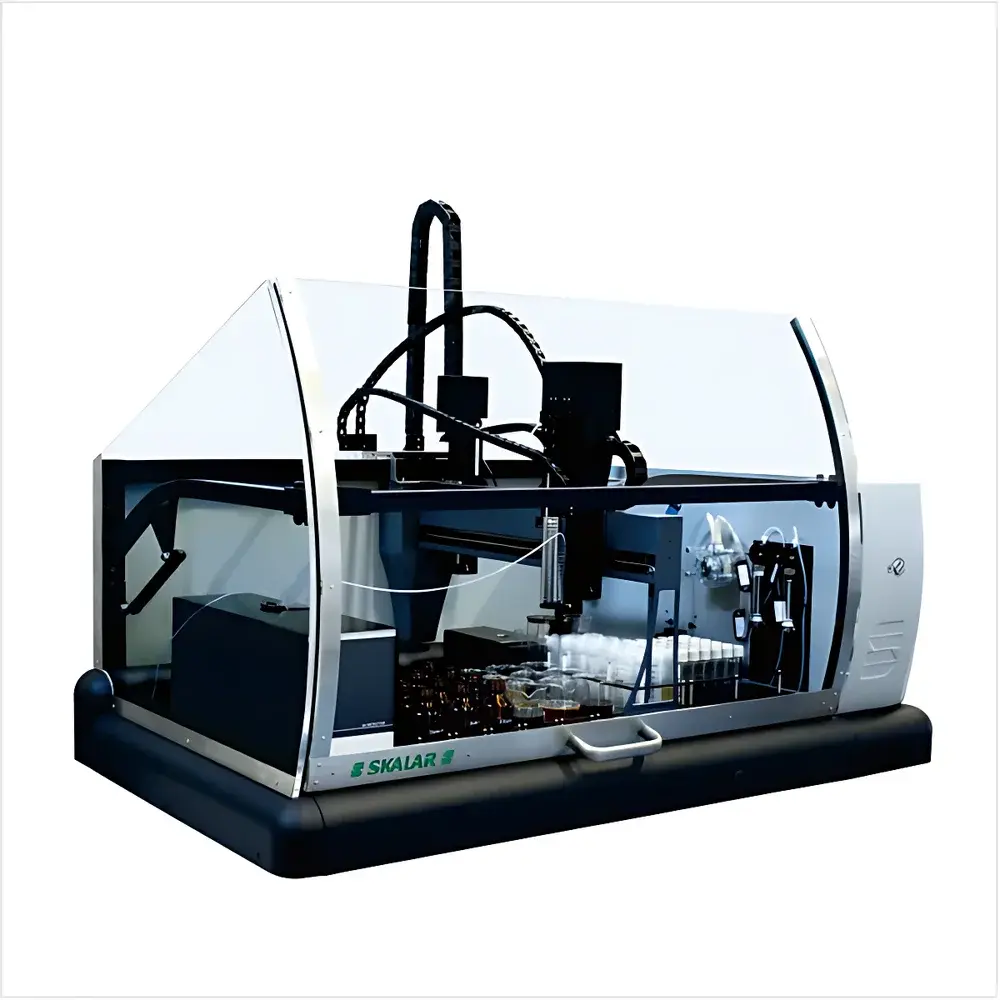
Skalar SP2000 Beer and Wort Bitterness Robotic Analyzer
| Brand | Skalar |
|---|---|
| Origin | Shanghai, China |
| Manufacturer Type | Authorized Distributor |
| Regional Classification | Domestic (China) |
| Model | SP2000 Beer |
| Instrument Category | Beer-Specific Analyzer |
| Application Environment | Laboratory |
| Cycle Time per Sample | 8 min |
| Alcohol Content Detection | Not Applicable |
| pH Range | –2.0 to +16.0 |
| Dimensions (L × W × H) | 75 × 70 × 121 cm |
| Weight | 90 kg |
Overview
The Skalar SP2000 Beer and Wort Bitterness Robotic Analyzer is a fully automated, walk-away analytical platform engineered for precise, high-throughput quantification of iso-α-acids—the primary contributors to beer bitterness—in finished beer and wort samples. Based on the internationally recognized spectrophotometric method (e.g., ASBC Beer-10A, EBC 7.10, ISO 11293), the system performs standardized extraction using hydrochloric acid and iso-octane, followed by UV absorbance measurement at 275 nm. Unlike manual or semi-automated approaches, the SP2000 integrates robotic sample handling, reagent dispensing, phase separation, and optical detection into a single, reproducible workflow—minimizing operator variability and ensuring compliance with GLP and GMP laboratory practices.
Key Features
- Fully robotic sample processing: automatic degassing, cap opening/closing, dilution, reagent addition (HCl and iso-octane), vortex-assisted liquid–liquid extraction, and UV absorbance measurement.
- Dual integrated oscillators for consistent, controlled extraction kinetics across all sample positions.
- Modular sample carousel accommodating up to 15 × 250 mL beakers (beer/wort) and 16 test vials—enabling unattended batch analysis.
- Transparent polycarbonate safety shield with interlocked access control, meeting IEC 61000-6-2/6-4 electromagnetic compatibility and functional safety requirements.
- Integrated temperature-stabilized UV photometer with 275 nm fixed-wavelength detection and calibrated quartz flow cell for long-term signal stability.
- Robust mechanical architecture designed for continuous operation in brewery QC laboratories, with maintenance intervals aligned to ISO 9001 preventive maintenance schedules.
Sample Compatibility & Compliance
The SP2000 is validated for use with clarified, filtered, and carbonated beer; hopped wort; and unhopped wort matrices. It supports pH measurement (–2.0 to +16.0) via integrated electrode interface, enabling concurrent acidity profiling during bitterness workflows. All analytical procedures comply with ASBC Method Beer-10A (2022), EBC Chapter 7.10 (2023), and ISO 11293:2017. The instrument’s audit trail, electronic signature capability, and user-access-level controls align with FDA 21 CFR Part 11 requirements for regulated environments. Calibration verification, blank tracking, and spike recovery protocols are embedded in every application method.
Software & Data Management
Controlled exclusively through RoboticAccess™ software—a Windows-based, SQL-server-backed platform—the SP2000 delivers method-driven automation with full traceability. Each bitterness assay includes pre-programmed QC checks (e.g., reagent blank validation, wavelength verification, linearity assessment over 0–100 IBU range). Data export conforms to ASTM E1384 and ISO/IEC 17025 reporting standards, supporting CSV, PDF, and LIMS-compatible XML formats. Version-controlled method libraries, electronic logbooks, and configurable report templates facilitate internal audits and regulatory submissions.
Applications
Beyond routine bitterness (IBU) determination, the SP2000 serves as a modular platform for multi-parameter beer quality assessment. Validated extensions include: color (EBC/ASBC), free amino nitrogen (FAN) via o-phthaldialdehyde (OPA) assay, β-glucan (using enzymatic hydrolysis and glucose oxidase detection), total SO₂ (iodometric titration mode), polyphenol index (Folin–Ciocalteu), anthocyanin content (pH-differential method), and thiobarbituric acid reactive substances (TBARS) for oxidative stability evaluation. Its open architecture allows integration with third-party modules for dissolved CO₂ or ethanol (via enzymatic or NIR coupling).
FAQ
What standard methods does the SP2000 implement for bitterness analysis?
It follows ASBC Beer-10A, EBC 7.10, and ISO 11293 for iso-α-acid quantification via UV absorbance at 275 nm after acidified iso-octane extraction.
Can the system analyze non-carbonated wort without modification?
Yes—degassing is programmable per sample type; wort analysis bypasses vacuum degassing steps while retaining full method fidelity.
Is pH measurement performed in the same run as bitterness testing?
No—pH is measured separately using an optional integrated electrode module; concurrent analysis requires sequential method scheduling within RoboticAccess™.
How is data integrity ensured for regulatory submissions?
All raw absorbance values, timestamps, operator IDs, calibration records, and QC flags are stored immutably with SHA-256 hashing; audit logs meet 21 CFR Part 11 and EU Annex 11 requirements.
What maintenance is required to sustain measurement accuracy?
Daily optical path cleaning, biweekly solvent line purge, and quarterly photometer wavelength verification using NIST-traceable filters—documented automatically in the service log.







