
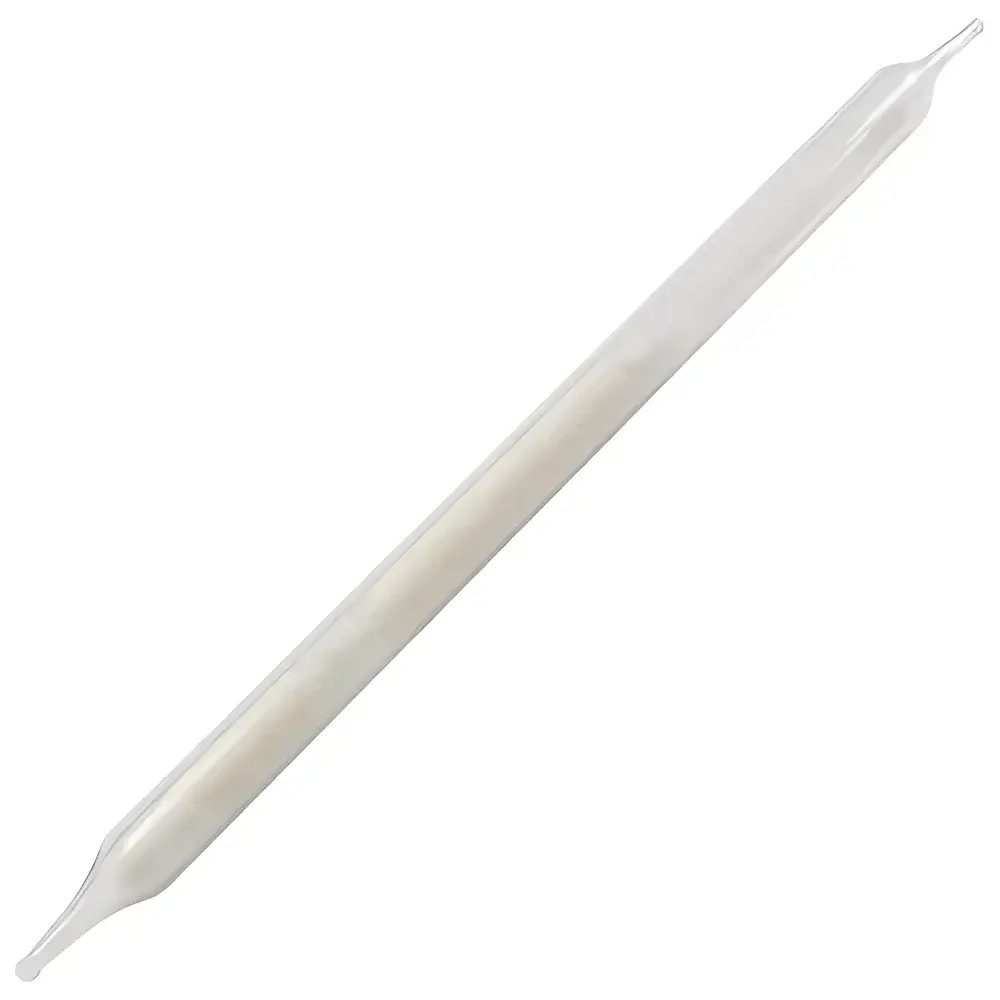
SKC Porapak Sorbent Tubes
| Brand | SKC |
|---|---|
| Origin | USA |
| Product Line | Porapak Series |
| Tube Dimensions (OD × Length) | 6 mm × 40–110 mm |
| Sorbent Mass | 35–175 mg per section |
| Dual-Bed Configuration | Yes (e.g., 88/44 mg, 100/50 mg, 150/75 mg) |
| End Caps | Glass Wool or Polyethylene Frit |
| Separator | Stainless Steel or Glass |
| Packaging | Individually sealed in foil pouches, 10 tubes per pack |
| Part Numbers | 50226-59-01, 50226-114, 50226-115, 50226-59-03, 50226-59-04, 50226-116A |
| Compliance | Compatible with EPA Methods TO-1, TO-2, TO-14A, TO-15, and ISO 16017-1 |
Overview
The SKC Porapak Sorbent Tubes are precision-engineered passive and active air sampling devices designed for the quantitative collection and pre-concentration of volatile organic compounds (VOCs) and semi-volatile organic compounds (SVOCs) from ambient, workplace, or indoor air matrices. Based on the principle of adsorption chromatography, these tubes utilize thermally stable, porous polymer sorbents—each tailored to specific polarity ranges—to retain target analytes during sampling. Upon thermal desorption or solvent extraction, analytes are released quantitatively for downstream analysis via gas chromatography (GC) or GC-mass spectrometry (GC-MS). The Porapak series is widely recognized in regulatory environmental monitoring due to its reproducible breakthrough volumes, low blank levels, and compatibility with standardized U.S. EPA and international methods.
Key Features
- Multi-sorbent architecture: Available in single-bed and dual-bed configurations (e.g., Porapak-N, -P, -Q, -R, -T), enabling broad-spectrum capture across polarity gradients—from highly volatile nitriles (Porapak-N) to moderately polar aldehydes and ketones (Porapak-Q) and non-polar hydrocarbons (Porapak-T).
- Consistent geometry and packing: All tubes feature a uniform 6 mm outer diameter and precisely controlled bed lengths (40 mm, 70 mm, or 110 mm), ensuring repeatable flow dynamics and validated sampling rates per NIOSH and ISO protocols.
- Low-background construction: Manufactured under cleanroom conditions using high-purity glass tubing, inert stainless steel frits or polyethylene end caps, and rigorously tested for residual organics—blank levels consistently below 5 ng for common VOCs such as benzene, toluene, and xylene.
- Thermal desorption compatibility: Designed for direct insertion into automated thermal desorption (TD) systems (e.g., Markes UNITY, Gerstel CIS, Thermo Scientific TD-100), supporting both single- and multi-stage desorption profiles without tube degradation.
- Regulatory traceability: Each lot undergoes QC verification including retention time indexing, breakthrough testing at 0.05–1.0 L/min flow rates, and certificate of conformance aligned with ISO/IEC 17025-accredited practices.
Sample Compatibility & Compliance
SKC Porapak Sorbent Tubes support sampling of gaseous-phase analytes in concentrations ranging from sub-ppbv to ppmv levels across diverse environmental and occupational settings. They are validated for use in compliance with U.S. EPA Methods TO-1 (canister-based screening), TO-2 (high-volume charcoal tube), TO-14A (VOCs by GC-FID/ECD), TO-15 (VOCs by GC-MS), and Method 325 (fenceline monitoring). Internationally, they meet requirements of ISO 16017-1 (indoor air—determination of VOCs—sorbent tube/thermal desorption/GC-MS) and EN 14662 (ambient air quality—determination of benzene). Tubes are suitable for personal, area, and stack sampling applications, and their inert surface chemistry minimizes analyte degradation or catalytic reaction during storage (up to 14 days at 4 °C post-sampling, per EPA guidance).
Software & Data Management
While Porapak tubes themselves are passive consumables, their integration into analytical workflows is fully supported by industry-standard software platforms. When used with thermal desorption autosamplers, instrument control and sequence management are handled via vendor-specific software (e.g., Thermo Fisher Chromeleon, Agilent OpenLab CDS, Shimadzu GCsolution), which enables audit-trail-enabled method storage, calibration curve generation, and electronic signature compliance. For laboratory information management systems (LIMS), SKC provides batch-level Certificates of Analysis (CoA) and lot-specific performance data—including breakthrough volume tables and desorption efficiency reports—in PDF and CSV formats, facilitating GLP/GMP-aligned data archiving and FDA 21 CFR Part 11-compliant record retention where required.
Applications
- Ambient air quality monitoring for regulatory reporting (e.g., State Implementation Plans, EU Air Quality Directive)
- Workplace exposure assessment per OSHA 29 CFR 1910.1200 (Hazard Communication Standard) and ACGIH TLV® guidelines
- Indoor air quality investigations in schools, offices, and healthcare facilities
- Industrial hygiene surveys for fugitive emissions near chemical processing units or storage tanks
- Method validation and reference material preparation in accredited environmental testing laboratories
- Research studies on atmospheric chemistry, odor profiling, and emerging contaminants (e.g., fluorotelomer alcohols, certain PFAS precursors)
FAQ
What is the maximum recommended sampling flow rate for Porapak-Q tubes?
For dual-bed Porapak-Q (6 mm × 110 mm), the optimal flow range is 0.01–0.2 L/min; higher flows may reduce breakthrough volume and compromise quantitative recovery.
Can Porapak tubes be reused after thermal desorption?
No—SKC Porapak tubes are single-use, disposable sampling media. Reuse risks carryover contamination, inconsistent bed integrity, and non-compliance with EPA and ISO validation criteria.
How should Porapak tubes be stored before and after sampling?
Unopened tubes should be stored at room temperature in original sealed foil packaging. Post-sampling, cap both ends immediately and refrigerate at 4 °C; analysis should occur within 14 days to prevent analyte loss or oxidation.
Are Porapak tubes compatible with cryogenic trapping systems?
Yes—when coupled with appropriate inlet conditioning (e.g., moisture removal), Porapak sorbents maintain structural integrity and adsorption capacity during cryo-focused GC injection, particularly for C2–C12 hydrocarbons and oxygenated VOCs.
Do SKC Porapak tubes require conditioning prior to use?
Conditioning is not mandatory but recommended for ultra-low-level applications: heat at 300 °C under inert gas flow for 30 minutes to remove trace volatiles and stabilize baseline response.







