
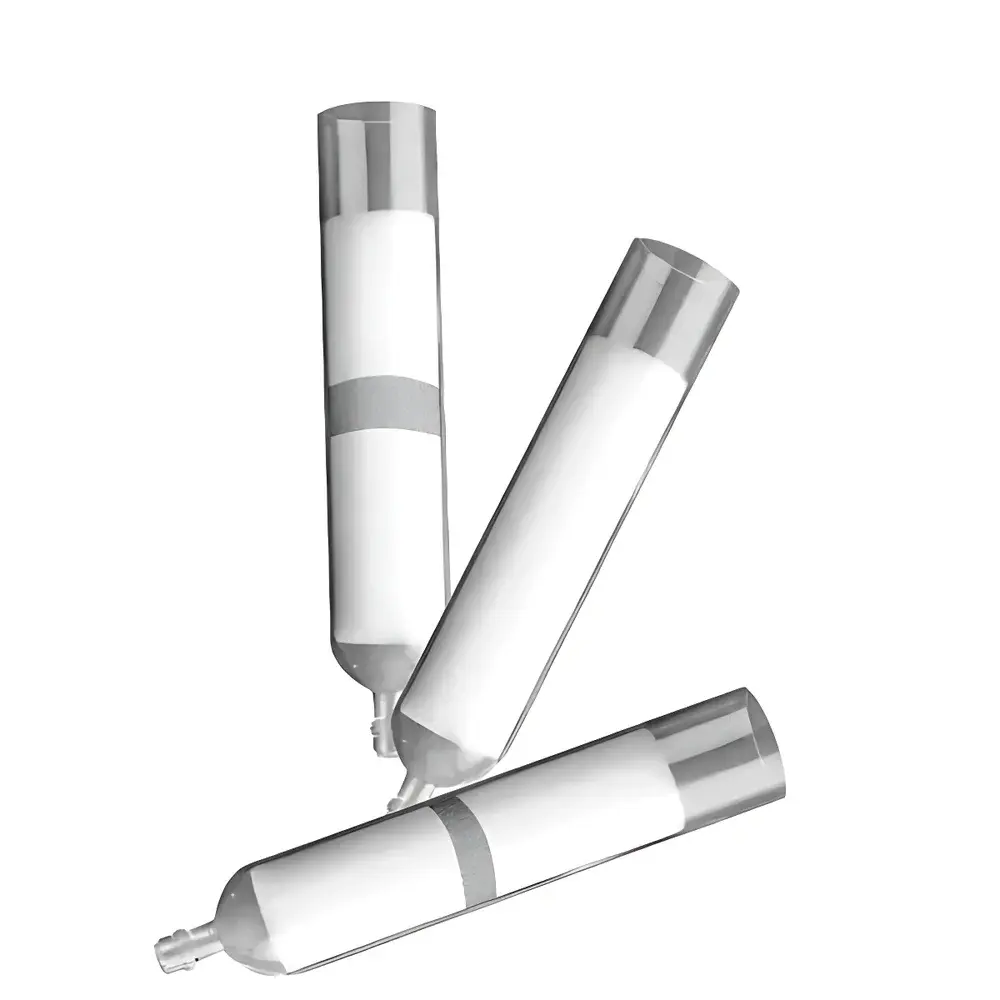
SKC PUF Sampling Tubes for Environmental Air Monitoring
| Brand | SKC |
|---|---|
| Origin | USA |
| Model | PUF Tube |
| Compliance | EPA TO-10A, EPA IP-8, ASTM D4861, ASTM D4947, ASTM D6209, EPA IP-7, EPA TO-4A, TO-9A, TO-13A, EPA Method 600/8-80-038 |
| Dimensions (Small) | 22 mm OD × 100 mm L |
| Dimensions (Large) | 65 mm OD × 125 mm L |
| Flow Rate Range (Small) | 1–5 L/min |
| Sampling Duration (Small) | Up to 24 h |
| Adsorbent Configuration | Pure PUF, PUF/Glass Fiber, PUF/Tenax/PUF, PUF/XAD-2/PUF |
| Pre-cleaned Adsorbent | Yes |
| Background Performance | Low-blank, solvent-rinsed |
| Packaging | Individually sealed in inert foil pouches |
Overview
SKC PUF Sampling Tubes are precision-engineered passive and active air sampling devices designed for the quantitative collection and stabilization of semi-volatile organic compounds (SVOCs) from ambient, workplace, or indoor air matrices. Constructed with high-purity polyurethane foam (PUF) as the primary adsorbent, these tubes operate on the principle of physical adsorption—retaining target analytes via hydrophobic interactions and surface area affinity under controlled airflow conditions. Unlike thermal desorption tubes relying on carbon-based sorbents, PUF tubes offer superior retention efficiency for polarizable, non-polar, and moderately polar SVOCs—including organochlorine pesticides (OCPs), polychlorinated biphenyls (PCBs), polycyclic aromatic hydrocarbons (PAHs), brominated flame retardants (BFRs), and certain phthalate esters—without irreversible binding or catalytic degradation. Their performance is validated across multiple U.S. EPA and ASTM standard methods, making them integral components in regulatory-grade environmental monitoring programs compliant with NIOSH, OSHA, and ISO 16000-22 frameworks.
Key Features
- Two standardized formats: Small-volume (22 × 100 mm) for personal or short-term monitoring; large-volume (65 × 125 mm) for high-flow, long-duration ambient air sampling.
- Pre-cleaned, solvent-rinsed PUF adsorbent ensures ultra-low background levels—critical for trace-level analysis by GC-MS/MS or HPLC-MS/MS.
- Modular configurations include pure PUF, PUF/glass fiber (for particulate co-collection), PUF/Tenax/PUF (dual-bed for volatile + semi-volatile fractionation), and PUF/XAD-2/PUF (enhanced recovery of mid-polarity analytes).
- Consistent wall thickness and open-cell structure guarantee reproducible breakthrough volumes and linear flow profiles across batch lots.
- Individually sealed in aluminum-laminated foil pouches to prevent ambient contamination during storage and field deployment.
- Traceable lot documentation provided with each shipment, including certificate of analysis (CoA) confirming blank levels per EPA Method 502.2 and ISO 16000-22 validation criteria.
Sample Compatibility & Compliance
SKC PUF Tubes meet or exceed the physical and chemical requirements specified in EPA Methods TO-10A (PAHs), TO-4A (pesticides), TO-9A (PCBs), TO-13A (dioxins/furans), and IP-7/IP-8 (ambient organic vapor monitoring). They are also referenced in ASTM D4861 (PAH determination in air), ASTM D4947 (chlorinated pesticide sampling), and ASTM D6209 (SVOC monitoring in indoor air). The PUF/XAD-2/PUF configuration complies with EPA Method 600/8-80-038 for multi-analyte SVOC profiling. All tubes undergo rigorous QC screening for extractable impurities using GC-MS prior to release, ensuring compatibility with GLP-compliant laboratories performing method validation per 40 CFR Part 136 and ISO/IEC 17025:2017.
Software & Data Management
While PUF tubes themselves are passive hardware components, their integration into analytical workflows is supported through SKC’s proprietary MethodLink™ digital platform—a secure, cloud-accessible database that links tube lot numbers to certified blank data, calibration history, and method-specific SOPs. Laboratories using LIMS systems can import batch metadata via CSV or API endpoints. All SKC PUF tube documentation—including CoAs, stability studies (validated up to 30 days post-sampling at 4 °C), and chain-of-custody templates—conforms to FDA 21 CFR Part 11 electronic record requirements when used in regulated environmental testing environments.
Applications
- Ambient air monitoring for PAHs near industrial zones, traffic corridors, and waste incineration facilities.
- Workplace exposure assessment of PCBs in transformer maintenance or capacitor reclamation sites.
- Indoor air quality surveys targeting legacy pesticides (e.g., chlordane, dieldrin) in residential buildings.
- Source apportionment studies using congener-specific PCB or PAH fingerprints.
- Validation of air cleaning technologies (e.g., activated carbon filters, photocatalytic reactors) via pre-/post-treatment sampling.
- Long-term trend analysis under national air toxics monitoring programs (NATMP) and European Union’s Air Quality Directive (2008/50/EC).
FAQ
What is the recommended storage condition for unused PUF tubes?
Store unopened tubes at 4 °C in original packaging; avoid exposure to ozone, UV light, or solvent vapors.
Can PUF tubes be reused after thermal desorption?
No—PUF is a single-use, non-regenerable adsorbent due to irreversible analyte penetration and potential polymer degradation above 150 °C.
How is breakthrough volume determined for a given analyte?
Breakthrough is empirically established per EPA TO-10A Section 8.2 using spiked challenge tests at defined flow rates and concentrations; typical values range from 1,200–5,000 L for PAHs at 2 L/min.
Are SKC PUF tubes compatible with automated thermal desorption systems?
Yes—standard 6.35 mm OD format fits all major TD autosamplers (e.g., Gerstel, Markes, CDS), including those with cryo-focusing and splitless injection capabilities.
Do you provide method validation support for laboratory accreditation?
Yes—SKC offers application notes, interlaboratory study reports, and technical consultation aligned with ISO/IEC 17025 method validation parameters (precision, LOD/LOQ, linearity, robustness).







