
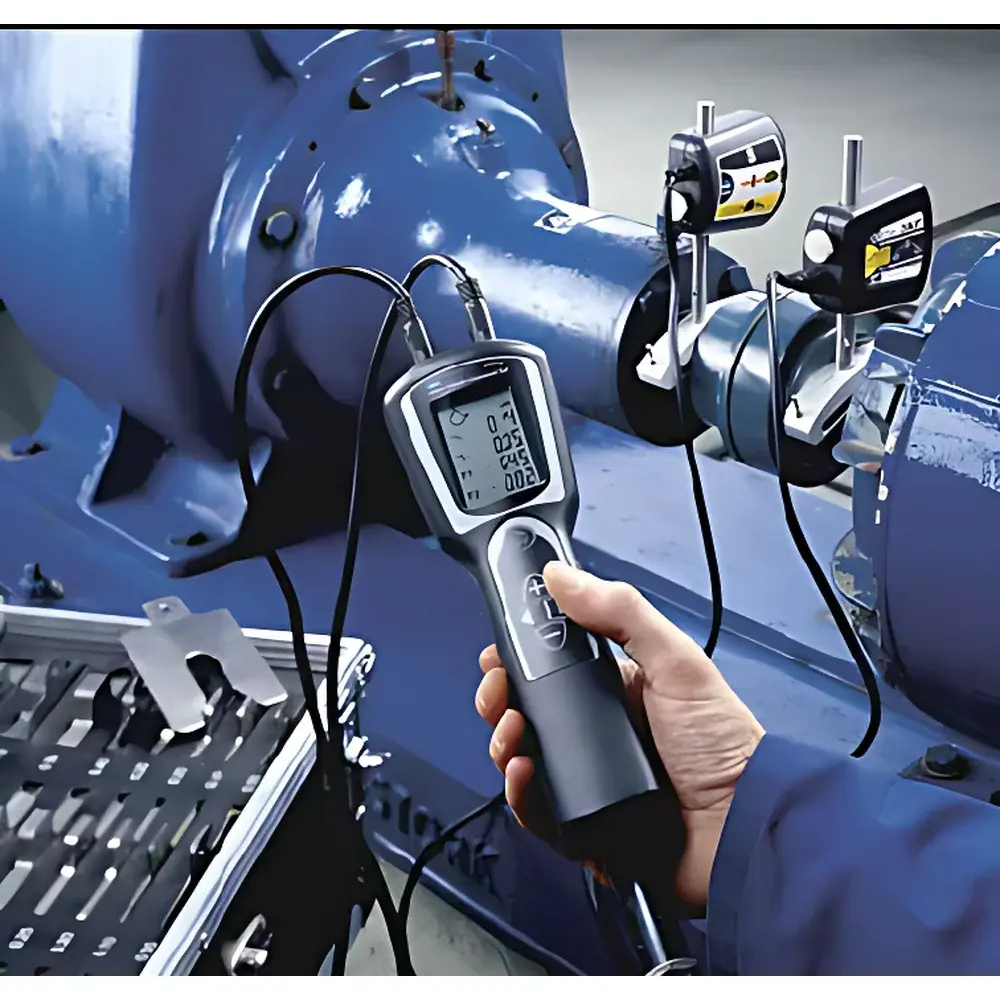
SKF TMEA 2 Rotational Shaft Laser Alignment System
| Origin | Imported |
|---|---|
| Manufacturer Type | Authorized Distributor |
| Model | TMEA 2 |
| Laser Class | Class 2 Semiconductor Diode, 670–675 nm, ≤1 mW |
| Measurement Range | Up to 850 mm |
| System Accuracy | ±0.01 mm |
| Power Supply | Two 1.5 V LR14 Alkaline Batteries (20 h continuous operation) |
| Total Weight | 3.7 kg |
Overview
The SKF TMEA 2 Rotational Shaft Laser Alignment System is an industrial-grade, portable laser-based metrology instrument engineered for high-precision geometric alignment of rotating machinery shafts. It operates on the principle of dual-laser plane referencing—employing two synchronized Class 2 semiconductor diode lasers (670–675 nm, ≤1 mW) mounted on independent measurement units to establish a stable optical baseline between coupled shaft ends. By capturing positional deviations across multiple rotational positions (typically 0°, 90°, 180°, and 270°), the system calculates both parallel (offset) and angular (gap) misalignment components in real time using trigonometric interpolation and least-squares fitting algorithms. Designed for use in pump-motor, gearbox-generator, and compressor-turbine train installations, the TMEA 2 delivers traceable, repeatable alignment data compliant with ISO 8578 (Mechanical vibration — Guidelines for the measurement and evaluation of machine vibration) and ANSI/ASA S2.17 (Mechanical vibration — Shaft alignment tolerance guidelines). Its compact, battery-powered architecture enables deployment in confined spaces, hazardous zones (non-intrinsically safe but Class 2 laser-compliant), and environments where external power or network connectivity is unavailable.
Key Features
- Real-time dynamic alignment feedback during machine adjustment—displays horizontal/vertical movement vectors as millimeters of correction per foot (mm/ft) or mils, with directional arrow indicators.
- Integrated soft foot detection algorithm: automatically identifies frame distortion by measuring baseplate deflection under sequential bolt tightening sequences, reporting individual foot lift values with pass/fail thresholds per ISO 10816-3.
- Automated correction calculation: computes precise shimming thicknesses and lateral translation distances for both drive and driven machine feet, minimizing iterative trial-and-error procedures.
- Ruggedized mechanical design: IP54-rated housing, shock-absorbing rubber overmold, and corrosion-resistant aluminum alloy chassis suitable for workshop, offshore, and field service environments.
- Intuitive single-button interface with backlit LCD display—no PC or software installation required for basic alignment tasks.
- Self-calibrating optical path: built-in reference geometry ensures long-term stability without periodic factory recalibration under normal handling conditions.
Sample Compatibility & Compliance
The TMEA 2 is compatible with all standard rigid and flexible couplings (gear, grid, disc, and elastomeric types) across shaft diameters from 25 mm to 600 mm. It supports both horizontal and vertical machine arrangements, including overhung and cantilevered configurations. The system meets IEC 60825-1:2014 for Class 2 laser safety, EN 61000-6-2 (immunity) and EN 61000-6-4 (emissions), and carries CE marking for machinery directive compliance. While not certified for SIL or ATEX applications, its non-sparking construction and low-power laser classification permit use in Zone 2 classified areas when operated per manufacturer’s safety instructions. Documentation includes traceable calibration records aligned with ISO/IEC 17025 requirements for accredited metrology laboratories.
Software & Data Management
Although fully functional as a standalone instrument, the TMEA 2 supports optional USB data export to SKF @ptitude™ Machinery Health Manager and third-party CMMS platforms via CSV-formatted alignment reports. Each report includes timestamped measurement sets, raw angular/offset values, calculated corrections, soft foot analysis matrices, and annotated alignment diagrams. Audit trails preserve operator ID, date/time stamps, and firmware version—supporting GLP/GMP documentation workflows and FDA 21 CFR Part 11 compliance when used with validated electronic signature protocols. Report templates conform to ISO 5389 (Coupling alignment — Recommended practice) and include space for maintenance technician sign-off and QA verification.
Applications
- Predictive maintenance programs for rotating equipment in petrochemical, power generation, water/wastewater, and pulp & paper facilities.
- New installation commissioning and post-repair re-alignment of centrifugal pumps, electric motors, steam turbines, and reciprocating compressors.
- Root cause analysis of premature bearing failure, coupling wear, and seal leakage attributed to misalignment-induced cyclic stress.
- Training and competency assessment for mechanical technicians under ISO 18436-2 Category II vibration analyst certification pathways.
- Baseline alignment validation prior to laser tracker or coordinate measuring machine (CMM) verification in precision manufacturing cells.
FAQ
Is the TMEA 2 suitable for high-speed machinery alignment (e.g., >3600 RPM)?
Yes—its sampling rate and angular position resolution support alignment verification up to 10,000 RPM when used with optional high-speed encoder accessories.
Does the system require annual recalibration?
No scheduled recalibration is mandated; however, users are advised to perform a field verification check using the included reference shim set before each critical alignment task.
Can it measure thermal growth effects during machine warm-up?
While not a continuous monitoring device, the TMEA 2 allows pre- and post-warm-up comparative measurements to quantify thermal expansion-induced misalignment shifts.
What is the maximum allowable ambient temperature range?
Operational range: –10 °C to +50 °C; storage range: –20 °C to +60 °C.
Is Bluetooth or Wi-Fi connectivity available?
No—wireless interfaces are intentionally omitted to ensure electromagnetic compatibility in electrically noisy industrial settings and maintain intrinsic operational reliability.



