
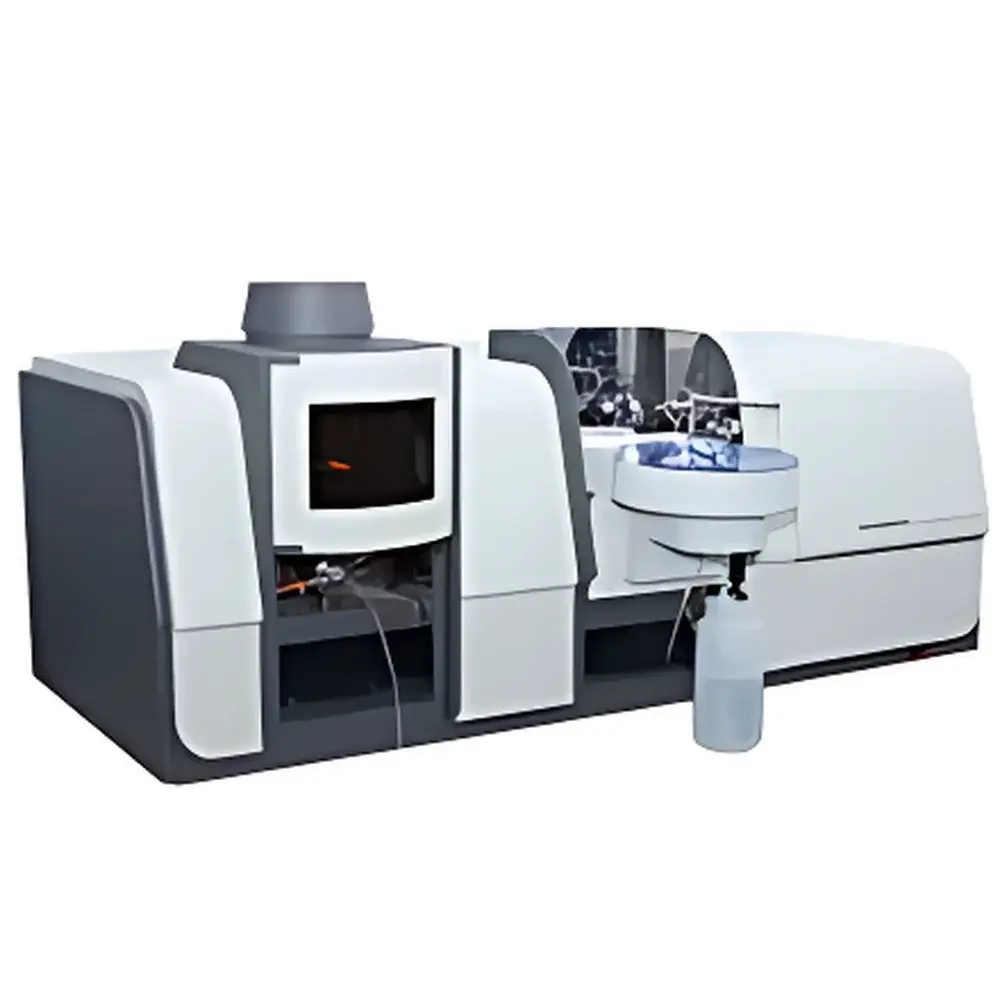
SkyRay AAS9000 Flame-GF AAS Integrated Atomic Absorption Spectrometer
| Brand | SkyRay Instrument |
|---|---|
| Origin | Jiangsu, China |
| Manufacturer Type | Direct Manufacturer |
| Country of Origin | China |
| Model | AAS9000 |
| Instrument Type | Integrated Flame/GF AAS |
| Monochromator | Czerny-Turner with 1800 lines/mm grating, 230 nm blaze |
| Optical System | Double-beam |
| Detector | Solid-state CCD array |
| Background Correction | D₂ lamp + Self-absorption (AAS) |
| Wavelength Range | 190–900 nm |
| Wavelength Accuracy | ±0.25 nm |
| Wavelength Repeatability | < 0.05 nm |
| Spectral Bandwidth | 0.1/0.2/0.4/0.7/1.4 nm (auto-switchable) |
| Flame Cu Detection Limit | < 0.006 µg/mL |
| GF Cd Detection Limit | ≤ 1.0 pg |
| Flame Cu Precision (RSD) | < 0.8% |
| GF Cd Precision (RSD) | ≤ 2% (auto-injection), ≤ 5% (manual) |
| Temperature Control Range (GF) | Room temp – 3000 °C |
| Max GF Ramp Rate | 3000 °C/s |
| Safety Compliance | Integrated gas leak, flame status, cooling water flow, and graphite furnace temperature monitoring per IEC 61010-1 |
Overview
The SkyRay AAS9000 is an integrated flame and graphite furnace atomic absorption spectrometer engineered for high-precision elemental quantification across environmental, clinical, pharmaceutical, food safety, and metallurgical laboratories. Based on the fundamental principle of atomic absorption spectroscopy—where ground-state free atoms in a vaporized sample absorb characteristic radiation from hollow cathode lamps—the AAS9000 employs a double-beam optical architecture to compensate for source drift and lamp intensity fluctuations, ensuring long-term photometric stability. Its integrated design eliminates mechanical switching between atomization modes: flame and graphite furnace share a single, thermally stabilized optical path via a serial Czerny-Turner monochromator equipped with an 1800 lines/mm holographic grating (blazed at 230 nm), delivering consistent spectral resolution across the full 190–900 nm working range. The instrument’s all-reflective, chromatic-aberration-corrected optical system uses toroidal mirrors instead of refractive lenses, eliminating focal shift across wavelengths and maximizing photon throughput—critical for trace-level detection where signal-to-noise ratio directly governs method sensitivity.
Key Features
- Integrated flame/graphite furnace atomization platform with shared optical train—no moving parts or alignment recalibration required during mode switching.
- Eight-lamp turret with independent power supplies; up to seven lamps preheated simultaneously to minimize element changeover time.
- Flame system features titanium雾化室 (nebulizer chamber) and titanium burner head for exceptional corrosion resistance against acidic matrices (e.g., HNO₃/HCl digests).
- Precision mass-flow-controlled acetylene delivery (±1 mL/min accuracy) with real-time pressure and leak monitoring per IEC 61010-1 safety requirements.
- Graphite furnace module with internal high-power transformer and optical pyrometry-based temperature feedback—achieving ±1% thermal control accuracy at peak temperatures up to 3000 °C and ramp rates exceeding 3000 °C/s.
- Dual background correction: deuterium arc lamp for broadband correction and self-absorption (HCL-based) for structured background near analytical lines—capable of correcting >30× background absorbance at 1.0 A.
- USB 2.0 interface compliant with Windows XP through Windows 11; fully driverless plug-and-play operation without legacy port dependencies.
Sample Compatibility & Compliance
The AAS9000 supports aqueous liquid samples, acid-digested environmental solids (EPA Method 200.7/200.8), biological tissues (AOAC 999.10), and food extracts (ISO 6870). Flame mode accommodates sample introduction volumes of 3–5 mL/min; graphite furnace mode enables analysis of 10–50 µL aliquots with matrix modifiers (e.g., Pd-Mg nitrate). All hardware and firmware comply with electromagnetic compatibility (EMC) directives (EN 61326-1) and electrical safety standards (IEC 61010-1). Software audit trail functionality—including user login timestamps, parameter change logs, and raw data versioning—supports GLP and GMP environments aligned with FDA 21 CFR Part 11 principles. Optional hydrogenation accessory extends capability to hydride-forming elements (As, Se, Sb, Bi, Te, Pb, Sn, Ge) per ISO 11969.
Software & Data Management
SkyRay’s proprietary AAS Workstation software provides a native Windows GUI supporting both English and Chinese language interfaces. It implements full workflow automation: method setup (wavelength, slit width, lamp current, GF temperature program), instrument initialization, calibration curve generation (linear/quadratic/logarithmic fitting), QC checks (duplicate analysis, spike recovery, bracketing standards), and report export (PDF, Excel, XML). Raw absorbance-time and absorbance-wavelength data are stored in vendor-neutral .csv format with metadata headers (date/time, operator ID, lamp ID, integration time). Audit trail records include operator name, action timestamp, parameter values before/after modification, and digital signature upon report finalization—enabling retrospective verification per ISO/IEC 17025 clause 7.7.
Applications
- Environmental testing: Quantification of Pb, Cd, Cr, As, Ni, Zn, Cu in drinking water (EPA 7000B), wastewater (ISO 11885), and soil leachates (TCLP).
- Clinical diagnostics: Measurement of Ca, Mg, Fe, Zn, Cu in serum and whole blood using flame AAS; ultra-trace Cd and Pb in urine via graphite furnace with Zeeman correction.
- Pharmaceutical quality control: USP heavy metals testing in APIs and excipients; residual catalyst analysis (Pd, Pt, Rh) in synthetic intermediates.
- Food safety: Screening for toxic elements (Cd, Pb, As) in rice, seafood, and infant formula per EU Commission Regulation (EU) No 1881/2006.
- Geochemical exploration: Multi-element analysis of rock digests (Li, Rb, Sr, Ba, rare earths) using high-temperature graphite furnace protocols.
FAQ
Does the AAS9000 support regulatory-compliant data integrity?
Yes—the software enforces role-based access control, electronic signatures, and immutable audit trails meeting core requirements of FDA 21 CFR Part 11 and ISO/IEC 17025.
Can the instrument operate without an external chiller or air compressor?
The flame system requires compressed air (oil-free, ≥6 bar); optional low-noise air compressors and recirculating chillers are available as bundled accessories.
What is the typical lifetime of the graphite tube under routine use?
With proper temperature programming and matrix modifier use, pyrolytic-coated graphite tubes achieve ≥500 firings for Cd/Pb analysis and ≥300 firings for high-ash samples like biological digests.
Is method transfer possible from older AAS platforms?
Wavelength settings, slit widths, and GF temperature programs are fully exportable/importable as XML templates—ensuring reproducible method migration across SkyRay AAS6000/AAS8000/AAS9000 generations.
How does the dual background correction improve accuracy in complex matrices?
Deuterium correction handles broad molecular absorption (e.g., CaOH in milk ash), while self-absorption correction targets narrow-line interferences (e.g., Fe lines overlapping Mn 279.5 nm)—providing orthogonal compensation validated per ASTM E1717.
Related Products





