
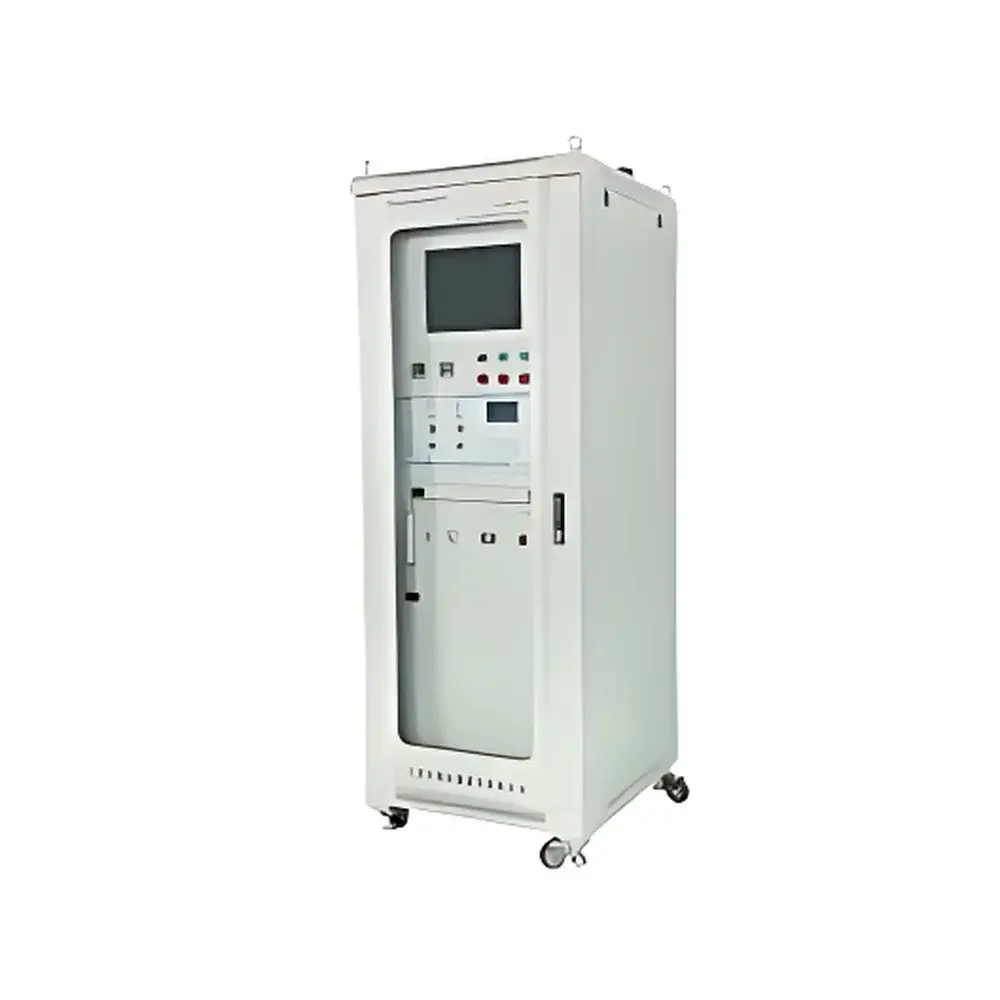
SkyRay CEMS-V100 Continuous Emissions Monitoring System for Non-Methane Hydrocarbons (NMHC)
| Brand | SkyRay Instrument |
|---|---|
| Origin | Jiangsu, China |
| Manufacturer Type | Direct Manufacturer |
| Product Category | Domestic |
| Model | CEMS-V100 |
| Price Range | USD 42,000–70,000 (FOB) |
| Instrument Type | Continuous Emission Monitoring System (CEMS) |
| Measurement Accuracy | ≤±5% F.S. (range >200 μmol/mol) |
| Repeatability | RSD ≤3% |
| Response Time | <5 min |
| Stability | ≤20% (emission standard ≥100 μmol/mol) |
| Analytes | Total Hydrocarbons (THC), Methane (CH₄), Non-Methane Total Hydrocarbons (NMHC), BTEX (Benzene, Toluene, Ethylbenzene, Xylenes), Volatile Organic Compounds (VOCs) |
| Detection Principle | Gas Chromatography with Flame Ionization Detection (GC-FID) |
| Detection Range | 0–50 / 500 / 5000 ppm (as CH₄, adjustable) |
| LOD | 0.05 ppm (0–50 ppm range) |
| Zero Drift | ±1% F.S. or 0.1 ppm |
| Span Drift | ±1% F.S. or 0.1 ppm |
| Analysis Cycle | 1 min (standard) |
| Sample Flow Rate | 600 mL/min (analysis) |
| Calibration Interval | User-configurable (e.g., daily, weekly, monthly) |
| Output Interface | Modbus TCP, 4–20 mA, RS232, RS485 |
| Operating Environment | 0–45 °C, <90% RH (non-condensing) |
| Storage | −20–60 °C, <90% RH |
| Required Gases | High-purity H₂, zero-air, N₂, CH₄ calibration gas |
| Power Supply | 220 V AC, 50/60 Hz, 1500 W |
| Enclosure | 19″ rack-mount industrial cabinet |
Overview
The SkyRay CEMS-V100 Continuous Emissions Monitoring System is a fully integrated, regulatory-grade solution designed for real-time, unattended quantification of volatile organic compounds (VOCs) in industrial flue gas and stack emissions. Engineered to meet the stringent performance requirements of national and regional air quality management frameworks—including China’s HJ 75-2017 and HJ 1013-2018 standards, as well as U.S. EPA Method 25A and Performance Specification 8 (PS-8)—the system employs gas chromatography coupled with flame ionization detection (GC-FID) as its primary analytical principle. This technique provides selective, linear, and highly reproducible quantification of total hydrocarbons (THC), methane (CH₄), non-methane total hydrocarbons (NMHC), BTEX compounds (benzene, toluene, ethylbenzene, xylenes), and broader VOC speciation profiles. Unlike optical or PID-based systems, GC-FID delivers compound-specific resolution and trace-level sensitivity without cross-interference from water vapor, CO₂, or common inorganic gases—critical for compliance reporting in high-humidity or high-dust exhaust streams.
Key Features
- Regulatory-compliant GC-FID architecture with optional detector modules (ECD for halogenated VOCs; FPD for sulfur/phosphorus species; TCD for permanent gases), enabling method flexibility across diverse emission matrices.
- Automated dual-range switching (low/high span) with independent limit of detection (LOD) per target analyte—0.05 ppm for NMHC at 0–50 ppm range—ensuring accuracy across both background and peak-emission conditions.
- Integrated high-temperature sample conditioning: heated sampling line (180 °C), hot-box GC oven (up to 250 °C), and FID detector (250 °C), minimizing condensation and adsorption losses for reactive or semi-volatile compounds.
- Self-diagnostic operation including automatic flame ignition/re-ignition, gas flow monitoring, column health assessment, and real-time pressure/temperature validation—reducing unscheduled downtime.
- Onboard calibration module with programmable schedule (user-defined intervals), multi-point span verification, and zero-gas validation using certified reference materials traceable to NIST or CNAS standards.
- Industrial-grade embedded controller with 10.1″ capacitive touchscreen, intuitive HMI interface, and full audit trail logging compliant with GLP/GMP data integrity principles (ALCOA+).
Sample Compatibility & Compliance
The CEMS-V100 accommodates complex, matrix-rich flue gas streams from thermal processes, catalytic oxidizers, solvent recovery units, and combustion sources. Its robust sample introduction subsystem includes particulate filtration (≤0.3 µm), moisture removal via Nafion™ membrane dryers or chilled condensers (configurable), and inertized stainless-steel flow paths to prevent catalytic degradation or surface adsorption. The system conforms to ISO 16000-6 for VOC sampling integrity, ASTM D6420 for GC-FID validation, and EU EN 15267-3 for CEMS type approval. It supports 21 CFR Part 11-compliant electronic records when deployed with optional secure user authentication and digital signature modules. All hardware and firmware are designed to operate continuously under Class A environmental conditions per IEC 61000-6-2/6-4, with IP54-rated enclosures available for outdoor or hazardous area deployment (ATEX/IECEx Zone 2 optional).
Software & Data Management
SkyRay’s CEMS Control Suite is a modular, Windows-based application built on a layered architecture: acquisition layer (real-time DAQ), processing layer (peak integration, retention time alignment, calibration curve fitting), and reporting layer (customizable dashboards, trend charts, compliance summaries). Data are stored locally in encrypted SQLite databases with automatic backup to network drives or cloud repositories via FTP/SFTP. Export formats include CSV, PDF, XML (for EMIS integration), and EPA-compatible .DAT files. Remote access is enabled via TLS-secured web interface or Modbus TCP protocol, allowing seamless ingestion into provincial or national environmental monitoring platforms (e.g., China’s National Pollutant Discharge Permit System). Audit logs record all parameter changes, calibration events, maintenance actions, and user logins with timestamps and operator IDs—fully traceable for regulatory inspections.
Applications
- Petrochemical refineries and olefin crackers requiring NMHC mass balance and fugitive emission tracking per LDAR protocols.
- Pharmaceutical manufacturing facilities subject to ICH Q5C and EU GMP Annex 1 VOC control thresholds.
- Electronics fabrication cleanrooms and semiconductor wet benches where isopropyl alcohol, acetone, and glycol ether emissions must be monitored below 10 ppmv.
- Automotive coating lines and composite manufacturing plants governed by local VOC mass emission limits (e.g., Shanghai DB31/843-2022).
- Printing and packaging operations using solvent-based inks, adhesives, or laminating agents.
- Third-party environmental testing laboratories accredited to CNAS ISO/IEC 17025:2017 for stack testing and CEMS verification services.
FAQ
Does the CEMS-V100 comply with China’s HJ 1013-2018 technical specification for NMHC CEMS?
Yes—the system satisfies all mandatory performance criteria including accuracy, drift, response time, and calibration frequency defined in HJ 1013-2018, and has undergone third-party verification by provincial EPB-accredited institutes.
Can the system operate in explosive atmospheres?
Standard configuration is for safe-area use; however, explosion-proof variants (Ex d IIB T4 Gb) with purged/pressurized cabinets and intrinsically safe sampling probes are available upon request.
Is remote diagnostics and software update supported?
Yes—via secure VPN or cellular LTE connection, authorized technicians can perform firmware updates, spectral review, and diagnostic troubleshooting without onsite visits.
What is the minimum required maintenance interval under continuous operation?
With scheduled quarterly preventive maintenance (column bake-out, FID nozzle cleaning, gas filter replacement), the system achieves >95% uptime over 12 months per ISO 13374 condition monitoring guidelines.
How does the system handle high-moisture or high-particulate flue gas?
It integrates heated probe filtration (180 °C), dynamic dilution (optional), and dual-stage moisture removal—ensuring stable chromatography and eliminating baseline drift caused by water condensation in the GC column.







