
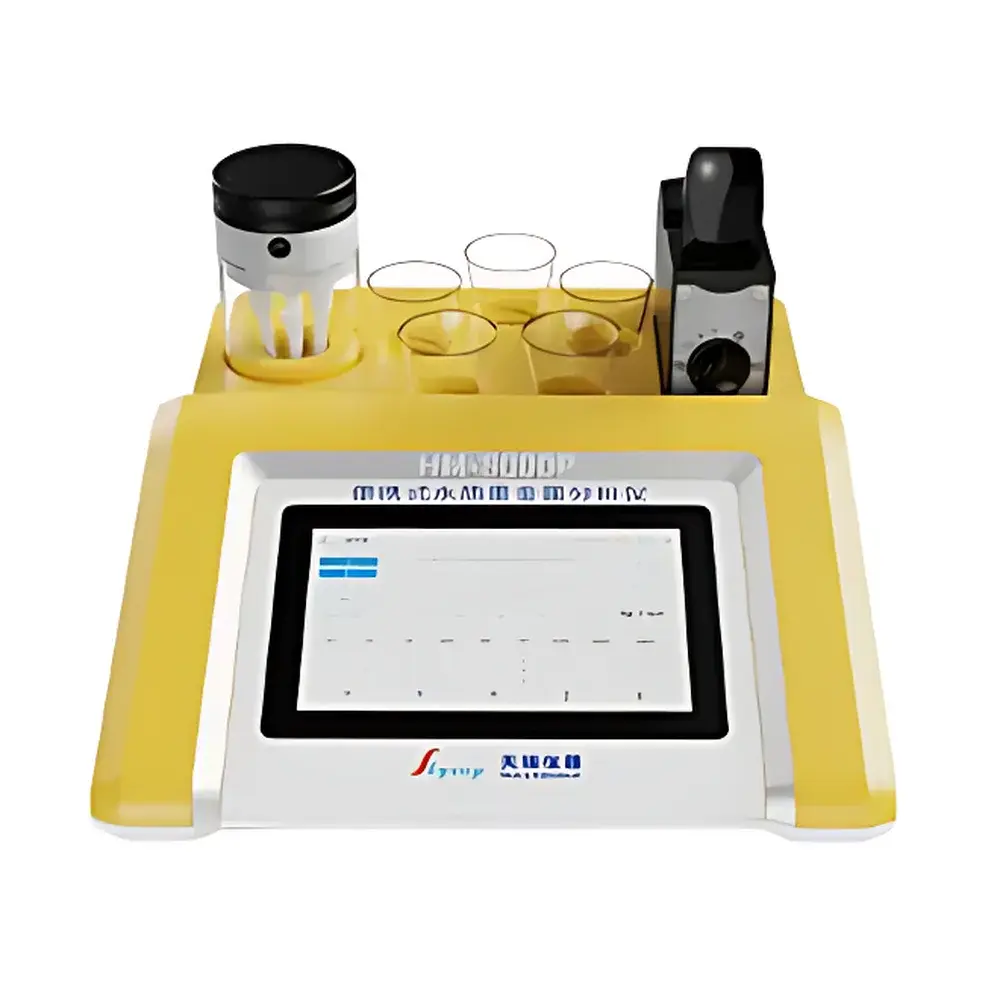
SkyRay HM-8000P Portable Heavy Metals Analyzer for Water
| Brand | SkyRay Instrument |
|---|---|
| Origin | Jiangsu, China |
| Manufacturer Type | Direct Manufacturer |
| Country of Origin | China |
| Model | HM-8000P |
| Instrument Type | Portable |
| Detection Methods | Anodic Stripping Voltammetry (ASV) & Colorimetric Spectrophotometry |
| Supported Elements | 9 standard (expandable to 12) |
| Electrochemical Scan Modes | Linear Sweep Voltammetry (LSV), Square Wave Voltammetry (SWV), Differential Pulse Voltammetry (DPV) |
| Operating System | Android-based embedded OS |
| Display | 7-inch capacitive touchscreen |
| Data Connectivity | Cloud synchronization, OTA firmware updates, wireless method library updates |
| Compliance | EPA Methods 7063, 7472 |
Overview
The SkyRay HM-8000P Portable Heavy Metals Analyzer is an engineered field-deployable instrument designed for quantitative determination of trace heavy metal ions in aqueous environmental matrices. It integrates two internationally recognized analytical principles—Anodic Stripping Voltammetry (ASV) and colorimetric spectrophotometry—within a single ruggedized platform. ASV provides sub-ppb detection sensitivity for electroactive metals (e.g., Pb, Cd, Cu, Zn, As(III), Hg, Ni, Cr(VI), Mn), while spectrophotometric modules deliver rapid, interference-resilient quantification for analytes such as Fe, Cu, and Cr(VI) under standardized conditions. Unlike benchtop atomic absorption (AAS) or ICP-MS systems, the HM-8000P achieves laboratory-grade accuracy (±5% relative standard deviation vs. reference methods) with significantly reduced operational cost, zero requirement for compressed gases or high-power infrastructure, and minimal consumables per test. Its core architecture complies with fundamental metrological requirements for field instrumentation: stable temperature-controlled electrochemical cell, calibrated optical path for absorbance measurement, and traceable electrode calibration protocols.
Key Features
- Field-ready dual-method platform: Simultaneous ASV and colorimetric capability enables method selection based on matrix complexity, regulatory context, and target analyte speciation.
- Triple electrochemical scan mode support: Linear Sweep Voltammetry (LSV), Square Wave Voltammetry (SWV), and Differential Pulse Voltammetry (DPV) are selectable per element to optimize signal-to-noise ratio and minimize intermetallic interference.
- Dedicated sample handling system: Integrated sample test station with magnetic stirrer, disposable electrode holder, and pre-calibrated working electrodes (Hg-film, Au-film, and carbon-based variants) ensures reproducible deposition and stripping kinetics.
- Android-based embedded operating system: 7-inch industrial-grade capacitive touchscreen with glove-compatible UI, offline operation capability, and responsive touch-driven workflow navigation.
- Cloud-enabled data management: Real-time synchronization of raw voltammograms, calibration curves, and final concentration reports to secure cloud storage; supports role-based access control and audit-ready export formats (CSV, PDF).
- Modular reagent and accessory case: Purpose-built transport case includes vacuum-sealed reagent vials, certified reference standards, electrode cleaning kits, and power bank—designed for >8 hours continuous operation in ambient temperatures from 5 °C to 40 °C.
Sample Compatibility & Compliance
The HM-8000P is validated for direct analysis of unfiltered or filtered natural waters (rivers, lakes, reservoirs, seawater), groundwater, drinking water distribution systems, municipal wastewater influents, and industrial effluents. Sample pretreatment is limited to pH adjustment (for ASV) or masking agent addition (for spectrophotometry), eliminating digestion or extraction steps. Method validation adheres to ISO/IEC 17025:2017 general requirements for competence of testing laboratories. ASV measurements align with U.S. EPA Methods 7063 (for Pb, Cd, Cu, Zn) and 7472 (for Hg), while spectrophotometric modules conform to Chinese national standards GB/T 5750.6–2023 (for Cr(VI)) and GB/T 7467–1987 (for total Cr). All onboard calibration routines include multi-point standard addition and blank subtraction algorithms to address matrix effects common in variable conductivity samples.
Software & Data Management
The proprietary HM-8000P Control Suite operates natively on the device’s Android 11-based firmware and supports over-the-air (OTA) software updates without external PC dependency. Each assay generates timestamped, user-annotated records containing raw current–potential curves, peak identification metadata, and uncertainty estimates derived from internal calibration verification. Data export complies with GLP/GMP documentation requirements: full audit trail (user login, method version, electrode ID, calibration history), electronic signature support, and 21 CFR Part 11–compliant optional configuration for regulated environments. Statistical functions include batch averaging, outlier detection (Dixon’s Q-test), and trend visualization across sequential field deployments. Remote method library updates ensure alignment with evolving national and international standard revisions.
Applications
- Environmental emergency response: Rapid screening during spill incidents or illegal discharge events, with results available within 12 minutes per element.
- Regulatory compliance monitoring: Field verification of discharge permits (e.g., NPDES), source water protection assessments, and routine surveillance of drinking water supply intakes.
- Industrial process control: On-site verification of pretreatment efficiency in electroplating, mining, and semiconductor wastewater streams.
- Academic and applied research: Speciation studies requiring portable electrochemical interrogation, long-term temporal monitoring campaigns, and method development for emerging contaminants.
- Third-party verification: Independent validation of lab-reported concentrations where chain-of-custody and real-time data capture are required.
FAQ
What heavy metals can the HM-8000P detect out-of-the-box?
The instrument ships with validated methods for Pb, Cd, Cu, Zn, As(III), Hg, Ni, Cr(VI), and Mn. Expansion to additional elements—including Co, Sn, and Sb—is supported via firmware update and electrode module replacement.
Is electrode calibration traceable to NIST or equivalent standards?
Yes. Each electrode batch undergoes factory calibration using NIST-traceable standard solutions (SRM 3198 for Pb, SRM 3199 for Cd, etc.), and calibration certificates are digitally embedded and accessible within the software.
Can the HM-8000P operate without cellular or Wi-Fi connectivity?
Absolutely. All core analytical functions, data logging, and report generation operate fully offline. Cloud sync and remote updates occur only when network connectivity is manually enabled.
How is data integrity ensured during field use?
The system implements write-once filesystem logging, cryptographic hash verification of assay files, and automatic backup to internal eMMC storage plus optional microSD card—meeting ISO 14001 Annex A.4 requirements for environmental data reliability.
Does the HM-8000P meet international shipping and IP rating requirements?
The unit conforms to IEC 60529 IP67 ingress protection (dust-tight and immersion-resistant up to 1 m for 30 min) and is UN 38.3 certified for air transport of lithium-ion battery-equipped equipment.







