
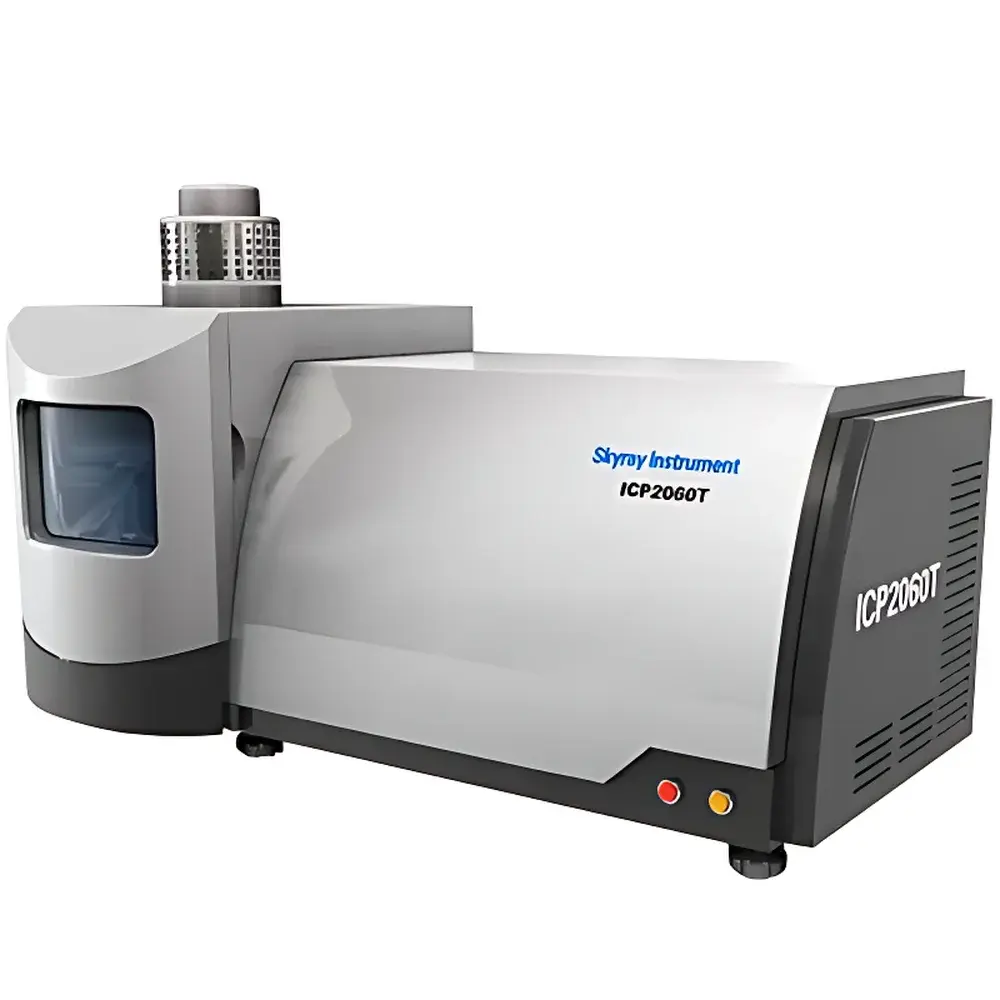
SkyRay ICP2060T Single-Channel Scanning Inductively Coupled Plasma Optical Emission Spectrometer
| Brand | SkyRay Instrument |
|---|---|
| Origin | Jiangsu, China |
| Manufacturer Type | Original Equipment Manufacturer (OEM) |
| Regional Classification | Domestic (China) |
| Model | ICP2060T |
| Price Range | USD 70,000 – 100,000 |
Overview
The SkyRay ICP2060T is a benchtop, vertically oriented single-channel scanning Inductively Coupled Plasma Optical Emission Spectrometer (ICP-OES) engineered for high-precision elemental analysis across environmental, geological, metallurgical, and regulatory testing laboratories. It employs robust plasma excitation—generated by a solid-state RF generator operating at 27.12 MHz—with optical detection based on a high-resolution Czerny-Turner monochromator and photomultiplier tube (PMT) detector architecture. The instrument supports both vertical and optional horizontal plasma viewing configurations, enabling flexibility in sensitivity versus matrix tolerance trade-offs. Its core measurement principle relies on the quantitative correlation between element-specific atomic emission intensities (at characteristic wavelengths in the 165–900 nm spectral range) and analyte concentration in liquid samples, following established calibration protocols compliant with ISO/IEC 17025, ASTM D1976, EPA Method 200.7, and GB/T 20002–2022 (Chinese national standard for ICP-OES performance verification).
Key Features
- Vertical plasma observation system with computer-controlled 2D torch positioning; real-time diagnostic feedback enables precise alignment optimization.
- Stable solid-state RF generator (800–1600 W, 2-W resolution), water-cooled and auto-tuned, featuring integrated over-temperature and over-load protection circuits.
- Optical platform mounted on a vibration-damped base with secondary isolation via adjustable leveling feet; thermal stability maintained within ±0.1 °C.
- High-sensitivity sample introduction: integrated quartz torch, imported high-efficiency nebulizer (HF-resistant and high-salt compatible options available), and dual-chamber spray chamber (with optional cyclonic configuration).
- Full software control of plasma gas flows (plasma, auxiliary, carrier), ignition/shutdown sequences, PMT high voltage, integration time, and wavelength scanning parameters.
- Sub-nanometer spectral resolution: ≤0.008 nm FWHM at Mn 257.610 nm (3600 grooves/mm grating); ≤0.015 nm (2400 grooves/mm grating).
- Quantitative performance: RSD < 1.5% (typical < 1.0%) for replicate measurements; 2-hour drift RSD < 2.0% (typical < 1.5%). Detection limits meet or exceed GB/T 20002 Class A requirements—including sub-ppt Ba detection.
Sample Compatibility & Compliance
The ICP2060T accommodates aqueous solutions, acid-digested environmental and biological matrices, and diluted metallurgical leachates. Its dual-chamber nebulization system minimizes polyatomic interferences and improves transport efficiency for low-volume or high-viscosity samples. Optional HF-resistant components support direct analysis of hydrofluoric acid digests. All operational parameters—including dwell time per wavelength, background correction zones, and dynamic range extension via automatic PMT attenuation—are configurable per analytical line. The system conforms to GLP data integrity requirements through audit-trail-enabled software (supporting user access control, electronic signatures, and change history logging). Full compliance with FDA 21 CFR Part 11 is achievable via validated software deployment and procedural documentation.
Software & Data Management
SkyRay’s proprietary ICP Analysis Suite runs natively on Windows 7/10 (32-/64-bit) and provides intuitive Chinese/English bilingual interface switching. It integrates full qualitative, semi-quantitative, and quantitative workflows—including spectral line tracing, multi-point calibration curve fitting (linear, quadratic, cubic), real-time wavelength recalibration, and peak-area/peak-height integration modes. Raw spectral data and processed results are stored in a structured database supporting backup, restore, and selective export to PDF, Excel (.xlsx), or plain-text formats. Reporting templates are customizable, including regulatory-compliant layouts for CNAS-accredited labs. The software includes native drivers for SkyRay AS100 autosamplers, enabling unattended batch analysis with automated rinse cycles, sample ID assignment, and QC flagging.
Applications
The ICP2060T delivers trace-to-major elemental quantification (e.g., Al, As, Cd, Cr, Cu, Fe, Pb, Zn, rare earths) in diverse sample types: municipal wastewater (EPA 200.7), soil extracts (ISO 11047), alloy homogeneity checks (ASTM E1479), pharmaceutical catalyst residues (ICH Q2(R2)), and food safety screening (GB 5009.268). Its flexible line selection capability—drawing from thousands of certified emission lines—allows interference-free analysis in complex matrices (e.g., Ca-rich waters, high-Na brines). Method development tools support custom spectral library creation and interference correction algorithms, facilitating rapid transition from research-grade assays to routine QC protocols.
FAQ
What plasma viewing orientation does the standard ICP2060T use?
The base configuration uses vertical plasma observation; horizontal viewing is available as a factory-upgrade option.
Is the instrument compatible with external autosamplers beyond SkyRay AS100?
Yes—the RS-232 and USB control interfaces support third-party autosamplers with TTL or ASCII command protocols, subject to driver validation.
Does the software support instrument qualification (IQ/OQ/PQ) documentation?
Yes; the software includes built-in performance verification modules aligned with ASTM D1976 and GB/T 20002, generating audit-ready reports for installation, operational, and performance qualification.
Can detection limits be verified independently per element and matrix?
Yes; method-specific detection limit calculations (based on 3σ of blank replicates) are automated during calibration and archived with each analytical run.
What maintenance intervals are recommended for the RF generator and optical components?
RF generator coolant replacement every 12 months; PMT gain calibration quarterly; grating and mirror inspection annually under GLP conditions.




