
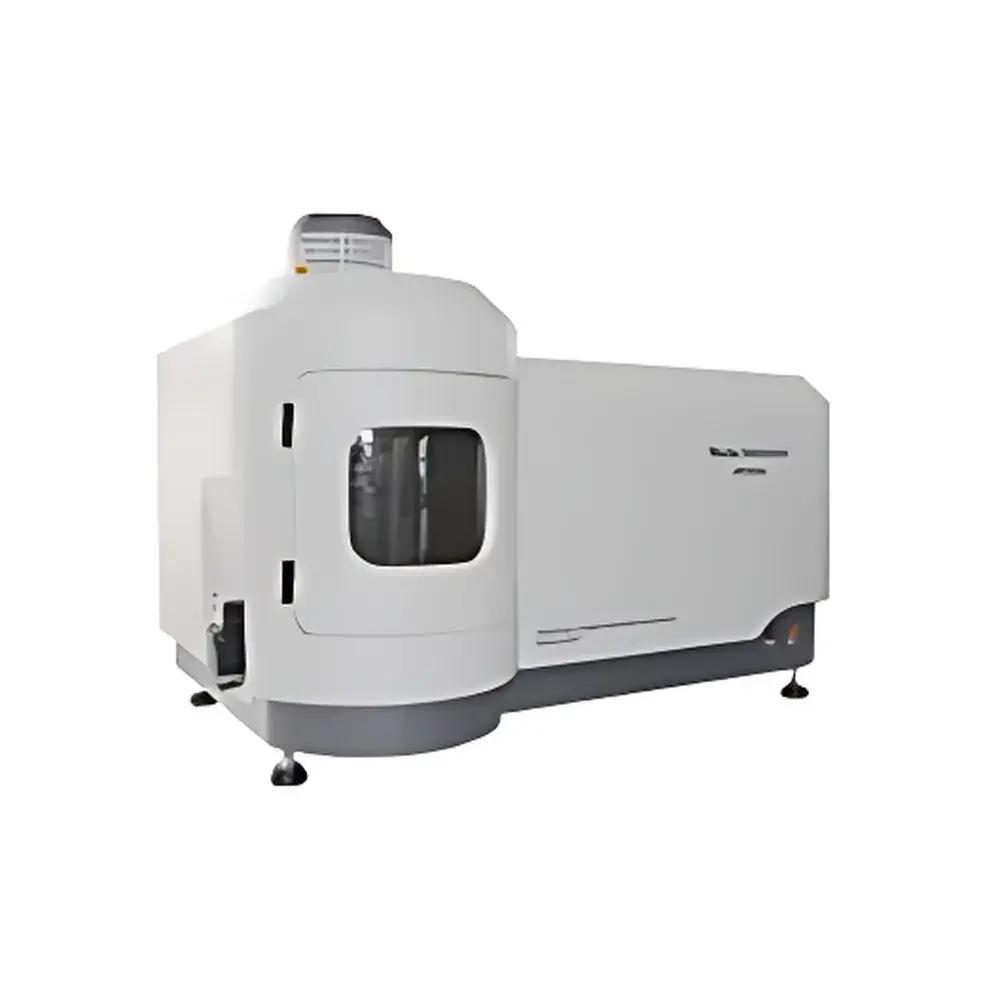
Skyray ICP3000 Inductively Coupled Plasma Optical Emission Spectrometer
| Brand | Skyray Instrument |
|---|---|
| Origin | Jiangsu, China |
| Manufacturer Type | OEM Manufacturer |
| Instrument Type | Full-Spectrum Simultaneous ICP-OES |
| Detection Limit | 1–10 µg/L (ppb) for most elements |
| Precision (Short-Term) | RSD < 0.5% |
| Stability (2-hr) | RSD < 1.0% |
| Wavelength Range | 165–900 nm |
| Optical Resolution | < 0.0068 nm @ 200 nm |
Overview
The Skyray ICP3000 is a high-performance, full-spectrum simultaneous inductively coupled plasma optical emission spectrometer (ICP-OES) engineered for trace and ultra-trace elemental analysis in liquid and dissolved solid matrices. It operates on the fundamental principle of atomic emission spectroscopy: analyte atoms and ions introduced into a high-temperature (~6,000–10,000 K) argon plasma are thermally excited and emit element-specific photons upon relaxation. These emissions are dispersed via a high-fidelity echelle grating–prism cross-dispersion optical system and captured by a large-format charge-injection device (CID) detector. The instrument’s vertical plasma observation configuration ensures optimal sensitivity for refractory and high-ionization-potential elements while minimizing matrix-induced interferences. Designed for compliance with ISO/IEC 17025 method validation requirements and compatible with GLP/GMP workflows, the ICP3000 delivers robust performance across regulated and research-intensive laboratories.
Key Features
- Full-spectrum simultaneous acquisition: 165–900 nm coverage in a single exposure, enabled by a 1024 × 1024 pixel CID detector with non-destructive readout (NDRO), enabling flexible line selection and interference correction without re-acquisition.
- Echelle optical architecture: Zerodur® substrate echelle grating (52.67 lp/mm, 64° blaze) paired with high-transmission UV-grade fused silica prisms; F/8 numerical aperture maximizes photon throughput while maintaining < 0.0068 nm resolution at 200 nm.
- Stabilized RF source: Self-developed solid-state 27.12 MHz generator (700–1600 W output, < 0.1% power stability, < 0.05% frequency drift) with automatic impedance matching (< 2 s convergence) and integrated E-field shielding (< 0.5 V/m at 30 cm).
- Intelligent gas control: Mass flow controllers (MFCs) for plasma (1.6–16 L/min), auxiliary (0.1–1 L/min), and nebulizer gases (0.1–1 L/min); pressure-regulated carrier gas delivery (0.2 MPa) ensures reproducible aerosol generation.
- Modular sample introduction: Four-channel peristaltic pump (12-roller, flow-adjustable), interchangeable quartz torches (20 mm OD, 25 mm ID coil), and support for high-salt, HF-resistant, and micro-flow nebulizers — including optional autosampler integration.
- Thermally stabilized optics: Sealed, nitrogen-purged spectrometer housing maintained at 35 ± 0.1 °C; distributed N₂ purge (2–4 L/min) suppresses ozone formation and ensures stable deep-UV response (e.g., P 178.222 nm, S 180.669 nm, As 189.042 nm).
Sample Compatibility & Compliance
The ICP3000 accepts aqueous samples digested in HCl, HNO₃, or HF-based media, as well as organic solvents (with oxygen ashing or micro-emulsion preparation). It supports direct analysis of diluted geological leachates, environmental waters, clinical biofluids, semiconductor process chemicals, and food extracts. The system meets ASTM D1976 (metals in water), ISO 11885 (wastewater), and USP / (elemental impurities in pharmaceuticals) measurement principles. Its hardware design facilitates 21 CFR Part 11-compliant software deployment, including electronic signatures, audit trails, and secure data archiving. All optical and RF subsystems comply with IEC 61000-6-3 (EMC) and IEC 61000-6-4 (emission) standards.
Software & Data Management
The proprietary Skyline™ analysis software provides intuitive workflow-driven operation: method setup, real-time spectral viewing, multi-element calibration (linear, quadratic, or weighted), interference correction (background subtraction, multivariate fitting), and QC monitoring (control charts, spike recovery, drift correction). Offline reprocessing allows retrospective background modeling and alternative line selection without re-running samples. Data export conforms to ASTM E1382-compliant .csv and .xlsx formats; raw spectral data (.dat) retains full 16-bit intensity arrays for third-party chemometric analysis. Audit trail logs capture all user actions, parameter changes, and calibration events with timestamps and operator IDs — essential for FDA inspection readiness.
Applications
- Environmental labs: Quantification of EPA-regulated metals (As, Cd, Cr, Pb, Hg, Ni, Se, V) in drinking water, wastewater, and soil extracts at sub-ppb levels.
- Geochemical exploration: Multi-element profiling (Ca, Mg, Fe, REEs, U, Th) in acid-digested rock powders and sediment cores using internal standardization (Y or Sc).
- Metallurgical QA/QC: Rapid screening of impurity elements (Bi, Sb, Sn, Te) in aluminum, copper, and rare-earth alloys affecting mechanical properties.
- Pharmaceutical manufacturing: Elemental impurity testing per ICH Q3D guidelines — particularly Co, Mo, Ni, V in catalyst residues and stainless-steel leachables.
- Food safety: Monitoring toxic elements (Pb, Cd, As) in infant formula, rice, and seafood; nutrient elements (Ca, Zn, Fe, Se) in fortified products.
- Semiconductor materials: Ultra-low-level contamination assessment (Na, K, Ca, Fe) in high-purity acids, photoresists, and CMP slurries.
FAQ
What sample preparation methods are recommended for solid matrices?
Acid digestion using closed-vessel microwave systems with HNO₃/HF/HCl mixtures is standard; fusion with lithium metaborate/tetraborate is advised for silicate-rich geological samples.
Does the instrument support hydride generation or cold vapor techniques?
No — the ICP3000 is optimized for conventional pneumatic nebulization; hydride-forming elements (As, Se, Sb) are measured directly via their UV emission lines with matrix-matched calibration.
Can the CID detector be calibrated for absolute intensity quantification?
Yes — spectral response is characterized using NIST-traceable holmium oxide and mercury-argon emission lamps; relative sensitivity factors (RSFs) are applied during quantitation.
Is remote diagnostics and firmware update supported?
Yes — the embedded Ethernet interface enables secure remote access via TLS-encrypted VNC for technical support and over-the-air firmware upgrades.
What maintenance intervals are recommended for routine operation?
Nebulizer cleaning every 8–10 h; torch inspection after 500 h; CID detector recalibration annually or after major optical realignment.




