
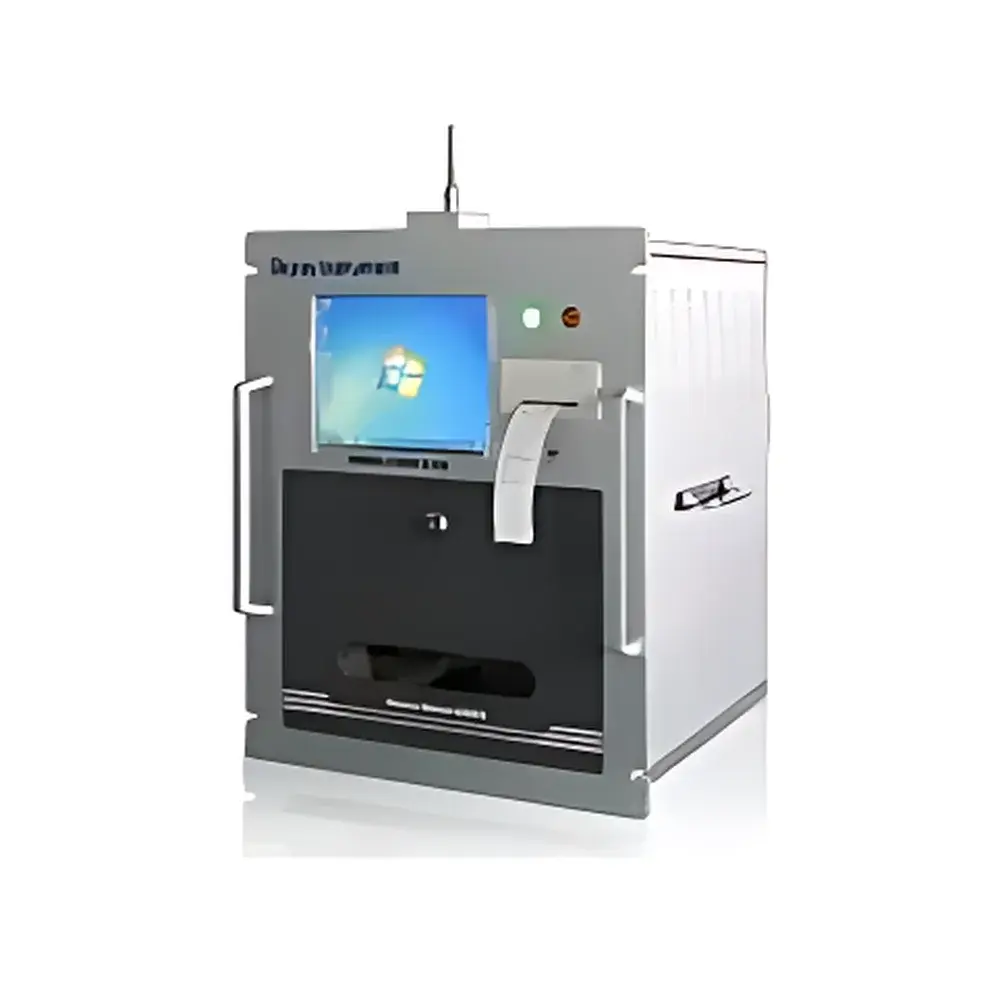
SkyRay Instrument CEMS-X100 Online Heavy Metal Monitoring System for Flue Gas
| Brand | SkyRay Instrument |
|---|---|
| Origin | Jiangsu, China |
| Manufacturer Type | Direct Manufacturer |
| Product Category | Domestic |
| Model | CEMS-X100 |
| Instrument Type | Continuous Emission Monitoring System (CEMS) |
| Measurement Accuracy | ±10% |
| Repeatability | ≤2% |
| Response Time | As low as 5 minutes (dependent on flue gas conditions) |
| Long-term Stability | ≤5% |
| Measurable Elements | Pb, Cu, Cd, Cr, Zn, Ni, and over 20 other heavy metals |
Overview
The SkyRay Instrument CEMS-X100 is a fully automated, in-situ continuous emission monitoring system engineered for real-time quantification of airborne heavy metal species in industrial flue gas streams. It employs energy-dispersive X-ray fluorescence (ED-XRF) spectroscopy coupled with isokinetic dilution sampling — a methodology compliant with ISO 14993, EN 14385, and US EPA Method IO-3.3 principles. The system extracts representative particulate matter from hot, humid, and corrosive flue gas via a heated, corrosion-resistant probe; cools and dilutes the sample to stabilize particle morphology; and deposits collected aerosols onto a continuously advancing, temperature-controlled membrane filter. A high-efficiency silicon drift detector (SDD) with patented digital pulse processing captures characteristic X-ray fluorescence emissions induced by a micro-focus X-ray source. Elemental concentrations are calculated using fundamental parameter (FP) algorithms calibrated against NIST-traceable reference standards, with automatic compensation for matrix effects, gas-phase interferences, and volumetric flow variations.
Key Features
- Multi-element capability: Simultaneous quantification of ≥22 regulated heavy metals including Pb, Cd, Cr(VI), As, Hg, Ni, Cu, Zn, Mn, Co, V, Sb, Tl, Be, Se, Mo, Ag, Sn, Ba, Sr, Bi, and Te — configurable per regulatory requirement (e.g., EU IED Annex VI, China GB 16297–1996, US EPA 40 CFR Part 63 Subpart EEEE).
- High temporal resolution: Configurable analysis cycle from 5 to 120 minutes; typical reporting interval is 15 minutes, enabling compliance with hourly average emission limit enforcement.
- Non-destructive measurement: Preserves filter tapes for archival storage and offline validation via ICP-MS or GF-AAS, supporting GLP-compliant data traceability.
- Automated quality assurance: Integrated internal standard (e.g., Sc or Y foil) enables real-time drift correction and long-term stability verification without manual intervention.
- Radiation safety certified: Fully shielded X-ray chamber meeting IEC 61000-6-4 and GBZ 126–2011 requirements; operational dose rate <0.5 µSv/h at 5 cm from housing surface.
- Minimal consumables: Only the roll-type membrane filter requires periodic replacement; no gases, reagents, or optical components subject to degradation under field conditions.
Sample Compatibility & Compliance
The CEMS-X100 accommodates flue gas matrices across diverse thermal and chemical environments: operating temperature range −20 °C to 600 °C, pressure range −20 to +50 kPa (gauge), and velocity up to 30 m/s. Its dual-stage heated sampling train — comprising an isokinetic primary probe, corrosion-resistant PTFE-lined tubing, and secondary heated dilution module — ensures representative particulate capture while suppressing condensation and volatilization artifacts. All hardware complies with CE marking (2014/30/EU EMC Directive, 2014/35/EU LVD), RoHS 2011/65/EU, and China’s CMA certification framework for environmental monitoring instruments. Data output conforms to HJ 75–2017 and HJ 76–2017 technical specifications for CEMS validation and QA/QC protocols.
Software & Data Management
The embedded CEMS-X100 software suite runs on a ruggedized industrial PC with Windows IoT Enterprise OS and supports full 21 CFR Part 11 compliance: electronic signatures, audit trails, role-based access control, and immutable raw-data logging. Real-time concentration values (µg/m³), mass loading (µg/filter), and cumulative emission totals (g/h, kg/day) are computed and stored locally with ≥12-month retention. Data export formats include CSV, XML (for integration with DCS/SCADA), and Modbus TCP/RTU. Remote diagnostics, firmware updates, and calibration history review are accessible via secure HTTPS web interface or optional GPRS/4G LTE telemetry.
Applications
This system is deployed in regulatory-compliant continuous monitoring applications across waste-to-energy incinerators (Municipal Solid Waste, Hazardous Waste), ferrous and non-ferrous metallurgical smelters (copper, zinc, lead refining), cement kilns with alternative fuels, coal-fired power plants equipped with ESPs or fabric filters, secondary battery recycling facilities, and sintering plants. It meets Tier 2 monitoring requirements under EU Industrial Emissions Directive (2010/75/EU) and serves as a reference method for stack testing where gravimetric PM10/PM2.5 data must be augmented with speciated toxic metal profiles.
FAQ
What regulatory standards does the CEMS-X100 meet for heavy metal monitoring?
It satisfies performance criteria outlined in HJ 76–2017 (China), EN 14385:2016 (EU), and aligns with methodological foundations of US EPA IO-3.3 and ISO 14993 for particulate-bound metal analysis.
Can the system detect mercury in its elemental or oxidized form?
The CEMS-X100 quantifies total particulate mercury (Hgp) adhered to filter media; speciation (Hg⁰ vs. Hg²⁺) requires complementary cold vapor atomic absorption (CVAA) or sorbent trap methods.
Is field calibration required during routine operation?
No routine field calibration is needed; system stability is verified daily using internal reference standards, with annual verification against NIST SRM 2783 (Air Particulate Matter) recommended.
How is filter tape integrity maintained under high-temperature flue gas?
The filtration module incorporates active heating (up to 120 °C) and tension control to prevent thermal deformation, hydrolysis, or mechanical slippage during continuous operation.
Does the system support integration with existing plant DCS or environmental data management platforms?
Yes — native Modbus TCP, OPC UA, and HTTP REST API interfaces enable seamless bidirectional communication with central control systems and third-party environmental information systems (EIS).







