
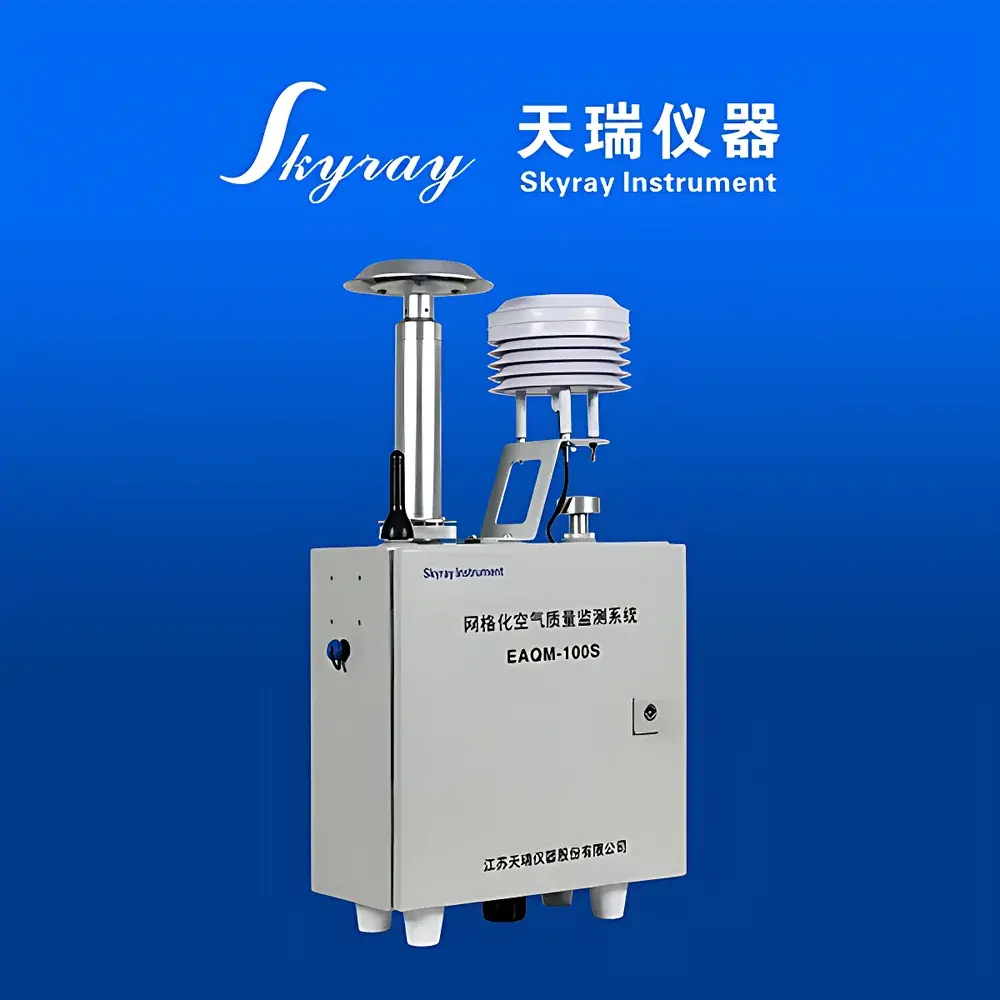
SkyRay Instrument EAQM-100S Grid-Based Ambient Air Quality Monitoring System
| Brand | SkyRay Instrument |
|---|---|
| Origin | Jiangsu, China |
| Manufacturer Type | Direct Manufacturer |
| Country of Origin | China |
| Model | EAQM-100S |
| Price Range | USD 7,000 – 14,000 (FOB) |
| Measured Parameters | SO₂, NO₂, CO, O₃, PM₂.₅, PM₁₀, Temperature, Relative Humidity, Wind Speed, Wind Direction, Atmospheric Pressure, TVOC |
| Measurement Principles | Optical Scattering (PM), Electrochemical Sensors (CO, NO₂, SO₂, O₃), Photoionization Detection (TVOC), Capacitive/Thermal Hygrometry & Thermistor-based Temperature Sensing, Ultrasonic Anemometry (Wind), Piezoresistive Barometry |
| Calibration | Dual-mode (Automated Zero/Span Drift Compensation + Manual Field Calibration via Remote Command) |
Overview
The SkyRay Instrument EAQM-100S Grid-Based Ambient Air Quality Monitoring System is an integrated, modular environmental sensing platform engineered for high-density spatial deployment in urban, industrial, and peri-urban environments. It operates on standardized physical and electrochemical measurement principles aligned with national ambient air quality standards (e.g., China’s HJ 653–2013, HJ 93–2013, HJ 654–2013) and internationally recognized methodologies—including optical scattering for particulate mass concentration (PM₂.₅ and PM₁₀), electrochemical detection for reactive gases (SO₂, NO₂, CO, O₃), photoionization for volatile organic compounds (TVOC), and precision micro-sensor arrays for meteorological parameters (temperature, relative humidity, atmospheric pressure, wind speed, and wind direction). Unlike centralized reference-grade stations, the EAQM-100S is designed for distributed grid monitoring—enabling sub-kilometer resolution mapping of pollution gradients, source attribution, and temporal trend analysis across heterogeneous landscapes such as traffic corridors, construction sites, industrial perimeters, and residential zones.
Key Features
- Modular sensor architecture supporting configurable gas channel selection: users may deploy 1–5 target gaseous pollutants (e.g., SO₂ + NO₂ + CO, or NO₂ + O₃ + TVOC + PM₂.₅ + Wind) without hardware modification.
- Embedded automatic calibration logic with zero/span drift compensation algorithms, supplemented by remote-triggered manual calibration sequences via secure TCP/IP or LTE-M command interface.
- Integrated 7-inch color TFT-LCD touchscreen with full Chinese GUI—designed for field technicians with minimal instrumentation training; supports multi-point capacitive touch, real-time parameter visualization, and local data logging (≥30 days at 1-min intervals).
- Ruggedized NEMA-4X-rated enclosure (IP65 ingress protection), operating temperature range: −20 °C to +50 °C, suitable for unattended outdoor deployment under varying climatic conditions.
- Low-power design with optional solar-battery hybrid power management (12 V DC input), enabling operation in off-grid locations with <3 W average system draw during continuous sampling.
- Onboard edge-processing capability for real-time data validation, outlier flagging (e.g., negative concentrations, sensor saturation), and protocol-compliant data packet generation (MQTT/HTTP(S) over IPv4/IPv6).
Sample Compatibility & Compliance
The EAQM-100S is validated for continuous ambient air sampling in non-explosive, non-corrosive atmospheres per IEC 61236-2:2018 (Environmental Monitoring Equipment — Part 2: Performance Requirements). Its electrochemical sensors meet ISO 12039:2000 (Stationary source emissions — Determination of carbon monoxide) and EN 50104:2013 (Electrochemical sensors for CO, NO₂, SO₂) specifications for linearity, cross-sensitivity, and response time (T₉₀ < 60 s for all regulated gases). PM measurements comply with ISO 25500:2021 (Air quality — Requirements for performance of instruments measuring PM₁₀ and PM₂.₅) and demonstrate repeatability ≤±5% CV across 30-day field trials. The system supports audit-ready data integrity features including tamper-evident timestamps, firmware-signed data payloads, and GLP-aligned metadata tagging (location, calibration history, maintenance logs).
Software & Data Management
The EAQM-100S integrates natively with SkyRay’s proprietary AQ-Cloud™ platform—a web-based, role-based SaaS environment compliant with ISO/IEC 27001:2022 information security requirements. Data ingestion supports dual-channel redundancy (primary cellular + secondary LoRaWAN fallback), TLS 1.3 encryption, and structured JSON/CSV export conforming to WMO GOS-12 and EU INSPIRE metadata schemas. The platform delivers automated Kriging interpolation maps, time-series anomaly detection (using seasonal-trend decomposition), and regulatory threshold alerting (e.g., WHO AQG 2021, EPA NAAQS, or local municipal limits). Mobile access is enabled via iOS/Android AQ-Link™ app featuring offline cache, GPS-tagged inspection reporting, and push-notified maintenance reminders. All user actions—including calibration events and configuration changes—are logged with immutable audit trails satisfying FDA 21 CFR Part 11 electronic record requirements.
Applications
- Urban air quality hotspot identification and dynamic emission inventory refinement.
- Real-time compliance monitoring at construction site boundaries per local dust control ordinances (e.g., GB 16297–1996).
- Industrial fence-line monitoring for fugitive VOC and criteria pollutant releases, supporting LDAR program integration.
- Micro-scale exposure assessment in school campuses, hospitals, and elderly care facilities.
- Validation and gap-filling for satellite-derived aerosol optical depth (AOD) products (e.g., Sentinel-5P TROPOMI).
- Supporting low-cost sensor network calibration through co-location with reference-grade monitors (e.g., FRM/FEM-certified analyzers).
FAQ
Does the EAQM-100S meet U.S. EPA or European Union regulatory equivalency requirements for ambient monitoring?
It is not certified as a Federal Reference Method (FRM) or Federal Equivalent Method (FEM) device under 40 CFR Part 53. However, its sensor-level performance aligns with EPA’s “Supplemental Monitoring” guidance (EPA-454/R-17-003) and EU’s Air Quality Directive (2008/50/EC) Annex III technical criteria for indicative measurement methods.
Can meteorological sensors be disabled if only gaseous/PM data are required?
Yes—each sensor module operates independently; firmware allows selective activation/deactivation of wind, temperature, humidity, or pressure channels without affecting core air pollutant measurement integrity.
What is the recommended calibration interval under continuous operation?
SkyRay recommends quarterly field calibration for gaseous sensors and semi-annual optical alignment verification for PM modules—though automated drift correction extends functional stability between interventions.
Is raw sensor output accessible for third-party algorithm development?
Yes—via RS-485 Modbus RTU or Ethernet TCP socket, the device exposes calibrated and uncalibrated analog/digital sensor outputs, ADC counts, and diagnostic registers for OEM integration or academic research use.
How is cybersecurity implemented for remote firmware updates and configuration changes?
All remote commands require mutual TLS authentication using X.509 certificates issued by SkyRay’s internal PKI; firmware updates are cryptographically signed with SHA-256 and verified prior to flash execution.







