
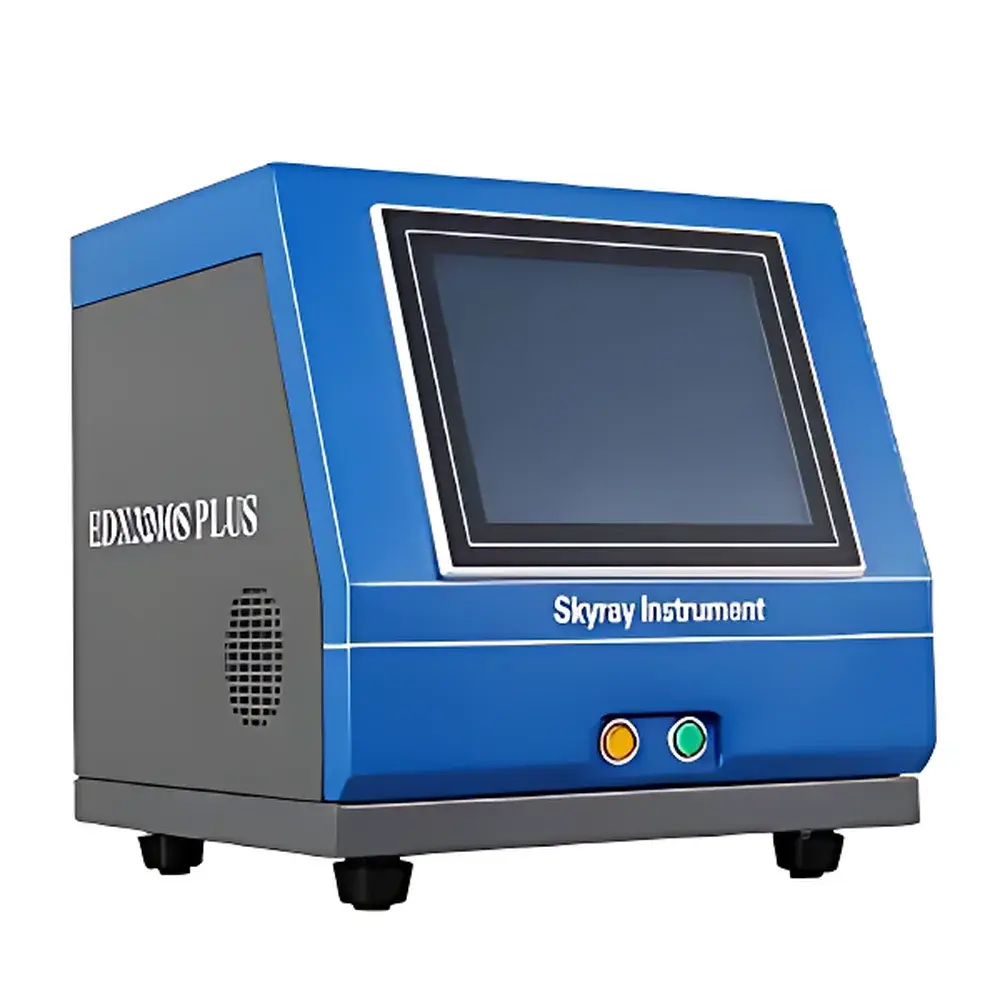
SkyRay Instrument EDX 3200S PLUS Energy Dispersive X-Ray Fluorescence Sulfur Analyzer
| Brand | SkyRay Instrument |
|---|---|
| Origin | Jiangsu, China |
| Manufacturer Type | Direct Manufacturer |
| Product Category | Domestic |
| Model | EDX 3200S PLUS |
| Configuration | Benchtop/Floor-standing |
| Industry Application | Energy & Petrochemicals |
| Energy Resolution | 125 eV |
| Detector | FAST-SDD |
Overview
The SkyRay Instrument EDX 3200S PLUS is a dedicated energy dispersive X-ray fluorescence (EDXRF) sulfur analyzer engineered for precise, non-destructive quantification of total sulfur in liquid hydrocarbon matrices—including gasoline, diesel, jet fuel, lubricating oils, and crude oil fractions. Operating on the fundamental principle of EDXRF, the instrument irradiates samples with primary X-rays from a side-window high-power X-ray tube, inducing characteristic sulfur Kα fluorescence (2.307 keV). The emitted photons are collected by a silicon drift detector (FAST-SDD) with 125 eV energy resolution at Mn Kα, enabling high spectral fidelity and low detection limits—typically sub-ppm for optimized light oil matrices under vacuum or inert atmosphere conditions. Designed to meet stringent regulatory requirements for fuel quality control, the EDX 3200S PLUS supports compliance-driven workflows across upstream, midstream, and downstream petrochemical operations.
Key Features
- Dedicated sulfur analysis architecture with optimized excitation geometry: side-window X-ray tube ensures high photon flux density and uniform sample irradiation
- FAST-SDD detector with Peltier cooling and real-time pulse processing, delivering stable count-rate performance and minimal peak broadening
- Downward-facing optical path design minimizes volatile loss during measurement and prevents contamination of the X-ray tube beryllium window and detector entrance window
- Integrated vacuum system eliminates the need for helium purging—reducing operational cost and eliminating gas supply dependencies
- Ultra-short sample-to-detector distance (< 5 mm) enhances solid angle efficiency and improves signal-to-noise ratio for trace sulfur detection
- Self-contained industrial computer with pre-installed firmware enables standalone operation—no external PC required for routine testing
- Automatic energy calibration upon power-up using internal reference sources, ensuring consistent spectral alignment across instrument lifetime
- Comprehensive X-ray shielding compliant with IEC 61000-6-4 (EMC) and IEC 62471 (photobiological safety), certified for unattended lab use
Sample Compatibility & Compliance
The EDX 3200S PLUS accommodates standard 10–40 mm diameter sample cups with polypropylene or Mylar film bottoms, supporting both neat liquid fuels and diluted refinery intermediates. It is validated for direct analysis of low-viscosity petroleum products without digestion or chemical pretreatment. Regulatory alignment includes full method equivalence to ASTM D7039 (Standard Test Method for Sulfur in Gasoline and Diesel Fuel by Wavelength Dispersive X-ray Fluorescence Spectrometry), GB/T 17040–2008 (Petroleum Products—Determination of Sulfur Content—Energy Dispersive X-ray Fluorescence Spectrometry), GB 252–2015 (Ordinary Diesel Fuel), and China’s CNCA-C11-01:2014 requirements for vehicle fuel sulfur content verification. The system architecture supports audit-ready data integrity per GLP and ISO/IEC 17025:2017 documentation standards, with optional 21 CFR Part 11-compliant software modules available for regulated environments.
Software & Data Management
The embedded analytical software features an intuitive GUI with role-based access control and automated workflow sequencing. Calibration models include factory-loaded multi-point sulfur standards (0.5–5000 ppm) traceable to NIST SRM 2722 and CRM 016-030. Intelligent algorithm modules automatically select optimal integration windows, background subtraction methods, and matrix correction factors based on sample type (e.g., gasoline vs. residual fuel oil), eliminating manual curve selection bias. All spectra, raw counts, and processed results are stored with time-stamped metadata, instrument parameters, and operator ID. Export formats include CSV, PDF reports, and XML-compatible structured data for LIMS integration. Audit trails record all user actions—including method edits, calibration updates, and result overrides—with immutable timestamps.
Applications
- Real-time sulfur monitoring in refinery blending units and pipeline custody transfer points
- Quality assurance testing of finished gasoline and ultra-low-sulfur diesel (ULSD) prior to distribution
- R&D support for catalyst development and desulfurization process optimization
- Regulatory compliance verification for national fuel specifications (e.g., China VI, Euro 6, EPA Tier 3)
- Crude assay screening for sour vs. sweet classification in upstream procurement
- Field-deployable analysis in mobile labs or offshore platforms via optional shock-mounted chassis and 110–240 V AC auto-ranging power supply
FAQ
Does the EDX 3200S PLUS require helium gas for operation?
No—the integrated vacuum system eliminates dependency on helium purge, reducing consumable costs and simplifying site deployment.
Can it measure sulfur in high-boiling-point fuels like bunker oil?
Yes, when used with appropriate sample cup geometry and optional temperature-controlled stage (−10 °C to +60 °C), though detection limits increase due to matrix absorption effects.
Is method validation documentation provided for regulatory submissions?
Yes—factory validation reports include precision (RSD 0.9995), limit of detection (LOD ≈ 0.8 ppm in gasoline), and inter-laboratory reproducibility data per ISO 5725.
How often does the instrument require recalibration?
Automatic daily energy calibration occurs at startup; quantitative calibration verification is recommended every 8 hours of continuous use or after environmental shifts exceeding ±5 °C.
What sample volume is required for reliable analysis?
Minimum fill volume is 2 mL for standard 32-mm cups; optimal performance achieved with 3–4 mL to ensure consistent meniscus height and beam penetration depth.





