
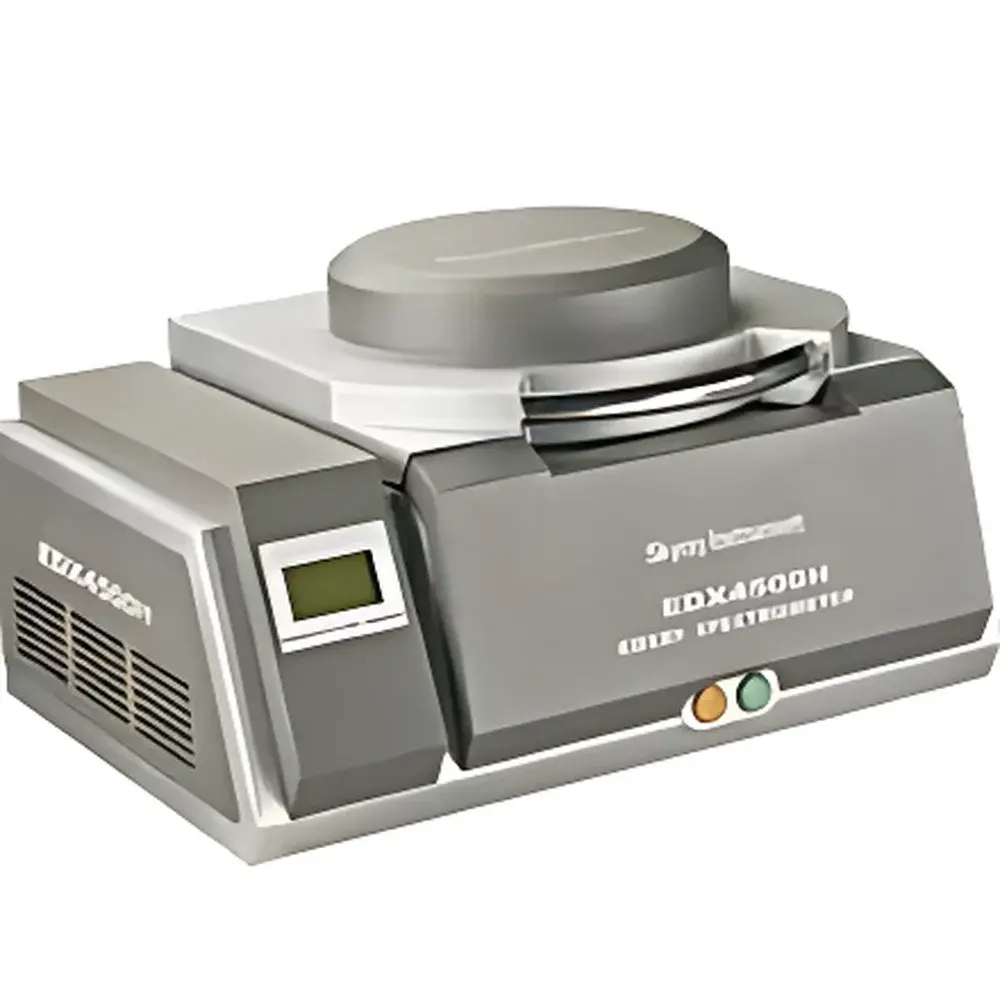
Skyray Instrument EDX 4500H Energy Dispersive X-Ray Fluorescence Spectrometer
| Brand | Skyray Instrument |
|---|---|
| Origin | Jiangsu, China |
| Manufacturer Type | OEM Manufacturer |
| Product Type | Benchtop/ Floor-Standing ED-XRF Spectrometer |
| Model | EDX 4500H |
| Element Range | Na–U |
| Concentration Range | 0.1 ppm – 99.99 wt% |
| Energy Resolution | 125 eV (Mn Kα) |
| Repeatability | RSD ≤ 0.05% for major elements (>96 wt%) |
| Detector | FAST-SDD (Silicon Drift Detector) |
| Tube Voltage | 5–50 kV |
| Tube Current | 50–1000 µA |
| Measurement Time | 30–200 s |
| Sample Chamber Dimensions | 320 × 100 mm |
| Instrument Dimensions | 660 × 510 × 350 mm |
| Weight | 65 kg |
| Operating Environment | 15–30 °C, 35–70% RH |
Overview
The Skyray Instrument EDX 4500H is a high-performance benchtop/floor-standing energy dispersive X-ray fluorescence (ED-XRF) spectrometer engineered for precise, non-destructive elemental analysis across solid, powder, and liquid samples. Based on fundamental XRF physics—where primary X-rays from a microfocus X-ray tube induce characteristic secondary (fluorescent) X-ray emission from sample atoms—the EDX 4500H quantifies elemental composition by measuring the energy and intensity of emitted photons using a high-resolution silicon drift detector (FAST-SDD). Its optimized optical path, ultra-thin beryllium window X-ray tube, and intelligent vacuum system collectively enhance sensitivity for light elements (Na, Mg, Al, Si, P, S), while maintaining robust quantification accuracy for mid- to high-Z elements including Cr, Ni, Mo, and heavy metals up to uranium. Designed for routine laboratory use in metallurgy, petrochemical QA/QC, RoHS compliance screening, and raw material certification, the instrument delivers trace-level detection (sub-ppm for many elements) with high spectral fidelity and long-term measurement stability.
Key Features
- FAST-SDD detector with 125 eV energy resolution (Mn Kα), delivering superior peak-to-background ratio, excellent linearity, and fast pulse processing for high-count-rate operation (up to 100,000 cps)
- Intelligent dual-mode vacuum system: automatically engages during light-element analysis (Na–S) to minimize atmospheric absorption of low-energy X-rays; operates in air mode for heavier elements to reduce cycle time
- Digital multi-channel analyzer (MCA) with real-time dead-time correction and adaptive pile-up rejection ensures accurate spectral deconvolution and quantitative integrity
- Auto-switching collimators and filter set—programmatically selected based on element group and matrix type—to optimize excitation efficiency and minimize spectral interferences
- Integrated high-resolution camera and motorized sample stage enable precise positioning and repeatable analysis of heterogeneous or irregular samples
- Automatic spectrum stabilization via built-in reference source and real-time gain/offset feedback loop maintains calibration consistency over extended operational periods
- Triple-layer safety architecture: hardware interlocks, software-enforced exposure limits, and chamber pressure monitoring comply with IEC 61010-1 and national radiation safety regulations
Sample Compatibility & Compliance
The EDX 4500H accommodates diverse physical forms—including pressed pellets, polished metal blocks, loose powders, thin films, and homogeneous liquids—within its 320 mm × 100 mm sample chamber. Its robust mechanical design (reinforced steel frame, vibration-damped base) ensures stable operation in industrial lab environments. The system supports method development and validation per ASTM E1621 (Standard Guide for XRF Analysis of Metals), ISO 21043 (XRF for geological materials), and IEC 62321-5 (RoHS screening of Cd, Pb, Hg, Cr(VI), Br). Data acquisition and reporting are structured to support GLP/GMP documentation requirements, with audit-trail-ready metadata logging (operator ID, date/time stamp, instrument parameters, calibration history).
Software & Data Management
Powered by Skyray’s proprietary QuantMaster™ analytical suite, the EDX 4500H provides intuitive workflow-driven operation—from automated setup and calibration to multi-layered quantification using fundamental parameter (FP) algorithms and empirical matrix-matched standards. The software implements multi-parameter linear regression to correct for inter-element absorption and enhancement effects, enabling accurate analysis across complex matrices (e.g., stainless steels, catalysts, polymer composites). All spectra and results are stored in vendor-neutral .csv and .edx formats. Optional 21 CFR Part 11-compliant module adds electronic signatures, role-based access control, and immutable audit logs for regulated environments.
Applications
- Metallurgical process control: rapid grade identification and alloy verification (e.g., 304 vs. 316 stainless, Ti-6Al-4V batch consistency)
- Routine quality assurance in petrochemical feedstock and catalyst analysis (S, V, Ni, Fe in crude oil fractions)
- Regulatory compliance testing: RoHS (Pb, Cd, Hg, Cr, Br), POPs (chlorinated flame retardants), and halogen-free certification per IEC 61249-2-21
- Geological and environmental screening: soil heavy metal profiling (As, Cd, Pb, Zn), mine tailings characterization
- Research applications: thin-film thickness and composition mapping, battery cathode material stoichiometry (Li, Co, Ni, Mn), and ceramic phase homogeneity assessment
FAQ
What is the minimum detection limit (MDL) for sulfur (S) in polymer matrices?
Typical MDL for S in PVC or ABS under vacuum conditions is ≤ 50 ppm (3σ, 100 s count time), dependent on sample homogeneity and surface flatness.
Does the instrument support quantitative analysis without certified reference materials (CRMs)?
Yes—fundamental parameter (FP) mode enables semi-quantitative screening and FP-based quantification; however, optimal accuracy for production QA requires at least one matrix-matched CRM for calibration validation.
Can the EDX 4500H analyze coated or layered samples?
It supports basic thin-film analysis (e.g., Zn on steel, Sn on Cu) using differential excitation modes and layer-fitting algorithms; full depth profiling requires complementary techniques such as TXRF or SEM-EDS.
Is remote diagnostics and software update capability available?
Yes—the system includes secure Ethernet connectivity and optional remote maintenance portal with encrypted session handshaking and version-controlled firmware deployment.
How often does the detector require recalibration?
Under normal operation, annual energy calibration verification is recommended; automatic daily stabilization minimizes drift between scheduled checks.



