
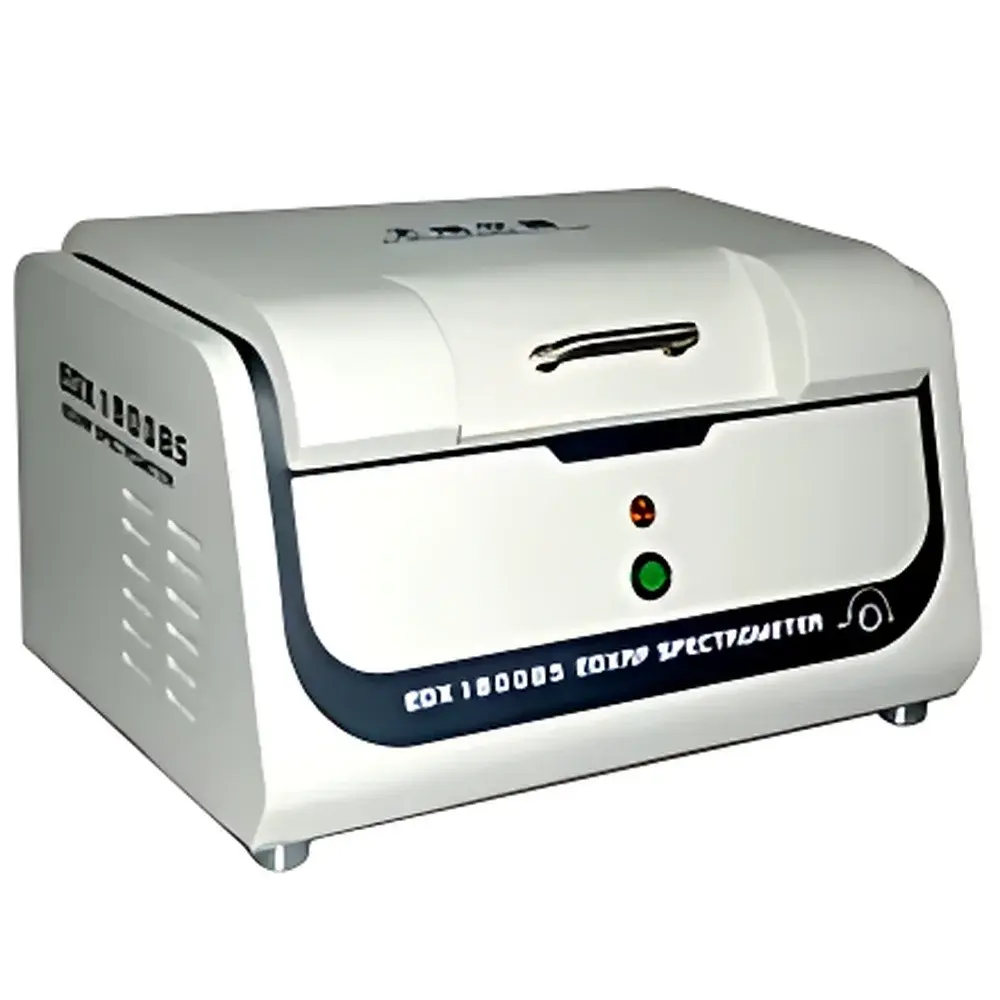
SkyRay Instrument EDX1800BS Energy Dispersive X-Ray Fluorescence Spectrometer
| Brand | SkyRay Instrument |
|---|---|
| Origin | Jiangsu, China |
| Manufacturer Type | Direct Manufacturer |
| Product Category | Domestic |
| Model | EDX1800BS |
| Form Factor | Benchtop |
| Application Scope | General-Purpose |
| Elemental Range | S (16) to U (92) |
| Quantification Range | 1 ppm – 99.99 wt% |
| Energy Resolution | 125 eV (Mn Kα) |
| Repeatability | ≤0.05% RSD (for major elements >96 wt%) |
| Detector | FAST-SDD (Silicon Drift Detector) |
| Power Supply | AC 220 V ±5 V |
| Operating Temperature | 15–30 °C |
| Dimensions (W×D×H) | 550 × 416 × 333 mm |
| Sample Chamber Size | 460 × 298 × 98 mm |
| Weight | 45 kg |
Overview
The SkyRay Instrument EDX1800BS is a benchtop energy dispersive X-ray fluorescence (EDXRF) spectrometer engineered for precise, non-destructive elemental analysis across industrial quality control, regulatory compliance, and materials research environments. Based on the fundamental principle of X-ray fluorescence—where primary X-rays excite inner-shell electrons in sample atoms, resulting in characteristic secondary (fluorescent) X-ray emission—the EDX1800BS delivers rapid qualitative and quantitative determination of elements from sulfur (Z = 16) to uranium (Z = 92). Its optimized optical path features a downward-irradiation geometry, enabling flexible analysis of irregularly shaped, flat, or vertically oriented samples without repositioning constraints. The system integrates a high-stability, 50 W microfocus X-ray tube with an advanced high-voltage power supply, ensuring consistent photon flux and long-term operational reliability. Coupled with a FAST-SDD detector offering 125 eV energy resolution at Mn Kα, the instrument achieves high peak-to-background ratios and low detection limits down to 1 ppm for many elements under standardized conditions.
Key Features
- Downward-beam optical configuration for universal sample accommodation—including bulk solids, coated substrates, powders, and small components
- Motorized filter and collimator turret supporting automated selection of excitation conditions for matrix-adapted analysis
- Precision manual XYZ sample stage with fine-adjustment capability for accurate positioning of measurement points
- FAST-SDD detector with Peltier cooling and digital pulse processing, delivering high count-rate capability and spectral fidelity
- Dual-stage signal processing architecture: low-noise preamplifier + high-speed multichannel analyzer with real-time dead-time correction
- Integrated hardware interlock system compliant with IEC 61010-1 safety standards, including beam shutter, door sensor, and X-ray emission indicator
Sample Compatibility & Compliance
The EDX1800BS supports solid, powdered, and liquid samples in standard holders or custom fixtures, with no requirement for vacuum or helium purge—enabling routine analysis of light elements (e.g., Mg, Al, Si, P, S) in air. It meets essential electromagnetic compatibility (EMC) and radiation safety requirements per GB/T 18268.1–2010 (equivalent to IEC 61326-1) and complies with national Class II radiation device registration protocols in China. While not certified to EU CE or US FDA 21 CFR Part 1020.40 out-of-the-box, its hardware architecture permits third-party verification for RoHS-compliant testing per EN 62321-5:2013 and IEC 62321-5:2013 methodologies. For regulated environments, optional audit-trail-enabled firmware upgrades support GLP/GMP-aligned data integrity practices.
Software & Data Management
The instrument operates via SkyRay’s proprietary SpectrumMaster™ software, built on a modular framework supporting multi-user permissions, method library management, and customizable reporting templates. Quantitative analysis employs fundamental parameter (FP) algorithms augmented by empirical calibration models and matrix-matched standards. The software includes independent matrix-effect correction routines for heterogeneous samples (e.g., plating layers on alloy substrates), multi-variable non-linear regression for complex inter-element interactions, and automatic spectral deconvolution using iterative least-squares fitting. All raw spectra, processed results, acquisition parameters, and user actions are timestamped and stored in a relational SQLite database; export options include CSV, PDF, and XML formats compatible with LIMS integration. Data backups and method transfers adhere to ISO/IEC 17025 documentation traceability requirements.
Applications
- Routine screening of electronic components, plastics, and packaging materials for restricted substances under RoHS, WEEE, and China RoHS directives
- Quantitative analysis of alloy composition in stainless steel, brass, aluminum, and copper-based materials for incoming inspection and scrap sorting
- Non-destructive thickness measurement and composition analysis of electroplated layers (e.g., Ni, Cr, Sn, Zn, Au) on PCBs and connectors
- Grade verification and purity assessment of precious metals—including gold, silver, platinum, and palladium—in jewelry manufacturing and assay laboratories
- Monitoring metal ion concentration in electroplating baths via filtered liquid cell analysis
- Geological survey support through rapid field-deployable elemental profiling of ores and mineral concentrates
FAQ
What is the minimum detectable limit for lead (Pb) in polymer matrices?
Typical Pb detection limits range from 2–5 ppm in homogeneous polymers under optimized measurement conditions (100 s live time, 40 kV/30 µA, Al filter), depending on sample homogeneity and background interference.
Can the EDX1800BS measure coating thickness on curved surfaces?
Yes—provided the curvature radius exceeds 10 mm and the measurement spot remains fully within the collimated beam footprint (available apertures: 1, 2, 4, 8 mm); results require empirical calibration against reference standards.
Is spectral data export compatible with third-party chemometric tools?
Yes—full-resolution .spc and ASCII-exported spectrum files retain channel-energy mapping and count data, supporting import into Unscrambler®, MATLAB®, or Python-based analysis pipelines.
Does the system support automated batch analysis for production line QA?
Batch mode is supported via scriptable method execution and pass/fail threshold logic; integration with PLC or MES systems requires optional RS-232/Modbus TCP interface module.
How often does the detector require recalibration?
Energy calibration is stable for ≥6 months under constant temperature conditions; annual verification with certified multi-element check sources (e.g., NIST SRM 2136) is recommended for accredited labs.






