
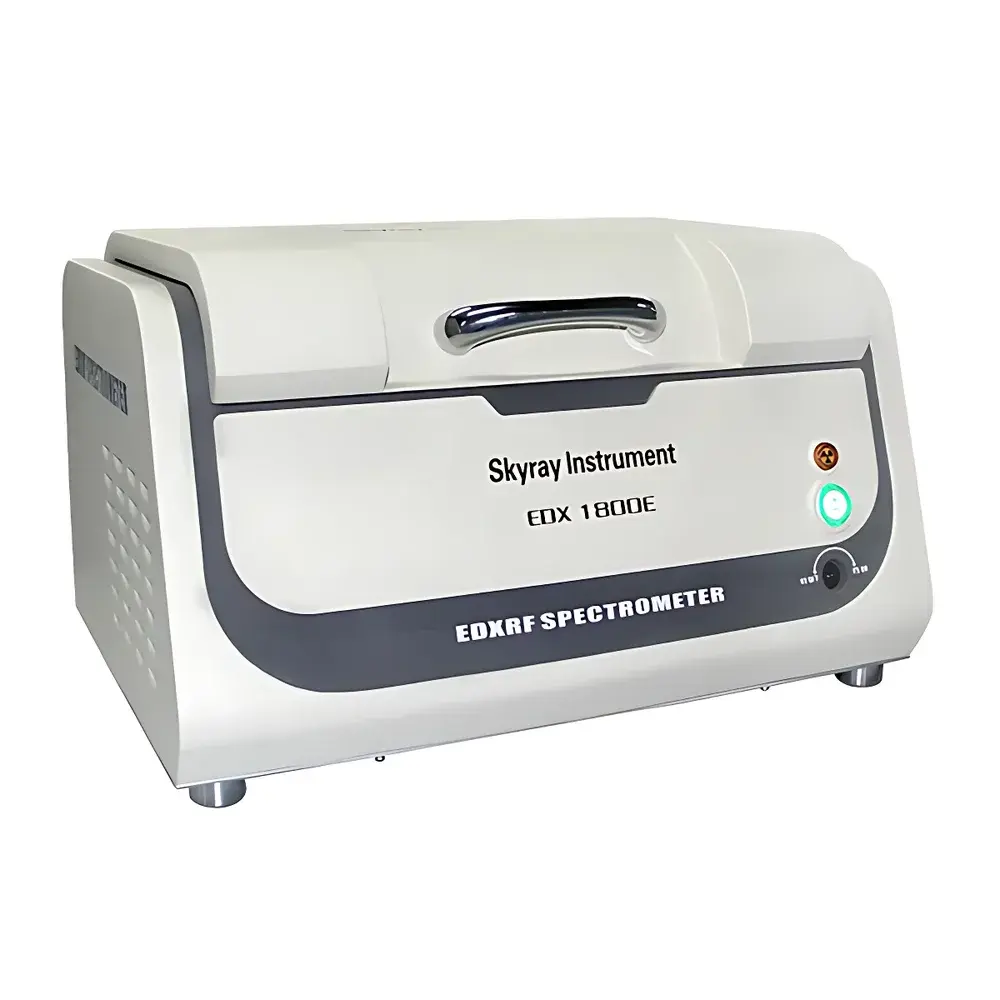
SkyRay Instrument EDX1800E Energy Dispersive X-Ray Fluorescence Spectrometer for Hazardous Element Screening
| Brand | SkyRay Instrument |
|---|---|
| Origin | Jiangsu, China |
| Manufacturer Type | Direct Manufacturer |
| Product Category | Domestic |
| Model | EDX1800E |
| Form Factor | Benchtop |
| Application Scope | General-Purpose |
| Elemental Range | S (16) to U (92) |
| Quantification Range | 1 ppm to 99.99 wt% |
| Energy Resolution | 125 eV (at Mn Kα) |
| Repeatability | 0.05% RSD |
| Detector | FAST-SDD (Silicon Drift Detector) |
Overview
The SkyRay Instrument EDX1800E is a benchtop energy dispersive X-ray fluorescence (EDXRF) spectrometer engineered for precise, non-destructive elemental analysis across regulatory, industrial, and quality control laboratories. Operating on the fundamental principle of X-ray fluorescence—where primary X-rays excite inner-shell electrons in sample atoms, resulting in characteristic secondary X-ray emission—the EDX1800E delivers rapid qualitative and quantitative determination of elements from sulfur (Z = 16) to uranium (Z = 92). Designed as an evolution of the EDX1800B platform, it integrates a high-stability 50 W microfocus X-ray tube with an advanced high-voltage power supply, enabling improved photon flux and enhanced signal-to-noise ratio without compromising radiation safety. The instrument complies with IEC 61000-4 electromagnetic compatibility standards and meets Class I radiation safety requirements per GBZ 18871-2002 (China’s Basic Standards for Radiation Protection), with measured ambient dose equivalent rates ≤0.25 µSv/h at 5 cm from any surface—comparable to natural background levels.
Key Features
- Downward-Beam Geometry: Enables flexible analysis of irregularly shaped, large, or thick samples—including bulk metals, coated substrates, and heterogeneous solids—without requiring vacuum or helium purge.
- Motorized Collimator & Filter System: Eight-position automatic filter wheel and interchangeable collimators (Φ0.5 mm to Φ4.0 mm) support tailored excitation conditions for matrix-matched calibration and inter-element interference minimization.
- High-Performance FAST-SDD Detector: Silicon drift detector with Peltier cooling achieves 125 eV energy resolution at Mn Kα (5.89 keV), ensuring reliable peak separation for adjacent elements (e.g., Cr/Mn/Fe, As/Se, Pb/Bi).
- Manual Precision Stage: Three-axis micrometer-driven sample platform (X/Y ±25 mm, Z ±15 mm) facilitates accurate positioning under real-time optical viewing and laser crosshair targeting.
- Integrated Safety Architecture: Dual interlock system includes mechanical lid lock during X-ray operation and hardware-triggered high-voltage cutoff, fully compliant with EN 62471 and IEC 61010-1 safety directives.
- Robust Power Management: Regulated 50 W X-ray source coupled with low-noise pulse processing electronics ensures long-term intensity stability (<0.05% RSD over 8 h) and reproducible quantification.
Sample Compatibility & Compliance
The EDX1800E accommodates solid, powder, and thin-film samples up to 439 mm × 300 mm × 50 mm in the standard chamber. It supports direct analysis of RoHS-restricted substances (Pb, Cd, Hg, Cr⁶⁺, Br), precious metal alloys (Au, Ag, Pt group), electroplated layers (Ni, Cu, Zn, Sn), and geological matrices (ore concentrates, slag, soils). Method validation aligns with ASTM E1621–22 (Standard Guide for XRF Analysis of Metals), ISO 21043–1:2022 (EDXRF for Coating Thickness), and IEC 62321–5:2013 (RoHS screening). For regulated environments, optional audit-trail-enabled software supports 21 CFR Part 11-compliant user authentication, electronic signatures, and immutable data archiving—meeting GLP/GMP documentation requirements in QC labs.
Software & Data Management
The proprietary SkyRay EDX Analysis Suite v4.2 provides full spectral acquisition, peak deconvolution (using iterative least-squares fitting), matrix correction (fundamental parameters + empirical coefficient models), and multi-layer thickness calculation. Up to 10 independent calibration models can be stored per application—each with customizable background subtraction, inter-element correction coefficients, and detection limit reporting. Data export supports CSV, TXT, and XML formats; spectral files retain raw counts, live time, dead time, and acquisition parameters. Local database integration enables batch report generation with LIMS-compatible metadata tagging (sample ID, operator, timestamp, instrument ID).
Applications
- Routine screening of electronic components, PCBs, and plastic housings for EU RoHS and China RoHS compliance.
- Quantitative analysis of alloy composition in stainless steel, brass, aluminum, and titanium grades per ASTM E1086 and ISO 11573.
- Non-destructive measurement of plating thickness (e.g., Au/Ni/Cu on PCB pads) and bath concentration monitoring in electroplating lines.
- Assay verification of jewelry and bullion—certifying fineness of gold (375–999.9), silver (800–999), and platinum-group metals.
- Geochemical exploration support via rapid field-deployable screening of soil, sediment, and rock core samples.
FAQ
What regulatory standards does the EDX1800E meet for hazardous substance screening?
It conforms to IEC 62321–5 for RoHS screening, ASTM F2617 for coating thickness, and ISO 21043–1 for EDXRF performance validation.
Is vacuum or helium purging required for light element analysis?
No—its optimized beam path and SDD sensitivity enable reliable detection of sulfur (S) and chlorine (Cl) in air, though helium flush is available as an optional upgrade for sub-ppm phosphorus or silicon quantification.
Can the instrument perform layered structure analysis?
Yes—using fundamental parameter algorithms and reference-free modeling, it calculates individual layer thicknesses and compositions for up to three-layer systems (e.g., Sn/Cu/PCB substrate).
What maintenance is required for long-term operational stability?
Annual recalibration of detector energy scale and X-ray tube output is recommended; no consumables are required beyond periodic cleaning of the beryllium window and sample chamber.
Is remote diagnostics supported?
Yes—via secure TLS-encrypted VNC connection, authorized service engineers can perform firmware updates, spectral diagnostics, and parameter optimization without onsite visits.




