
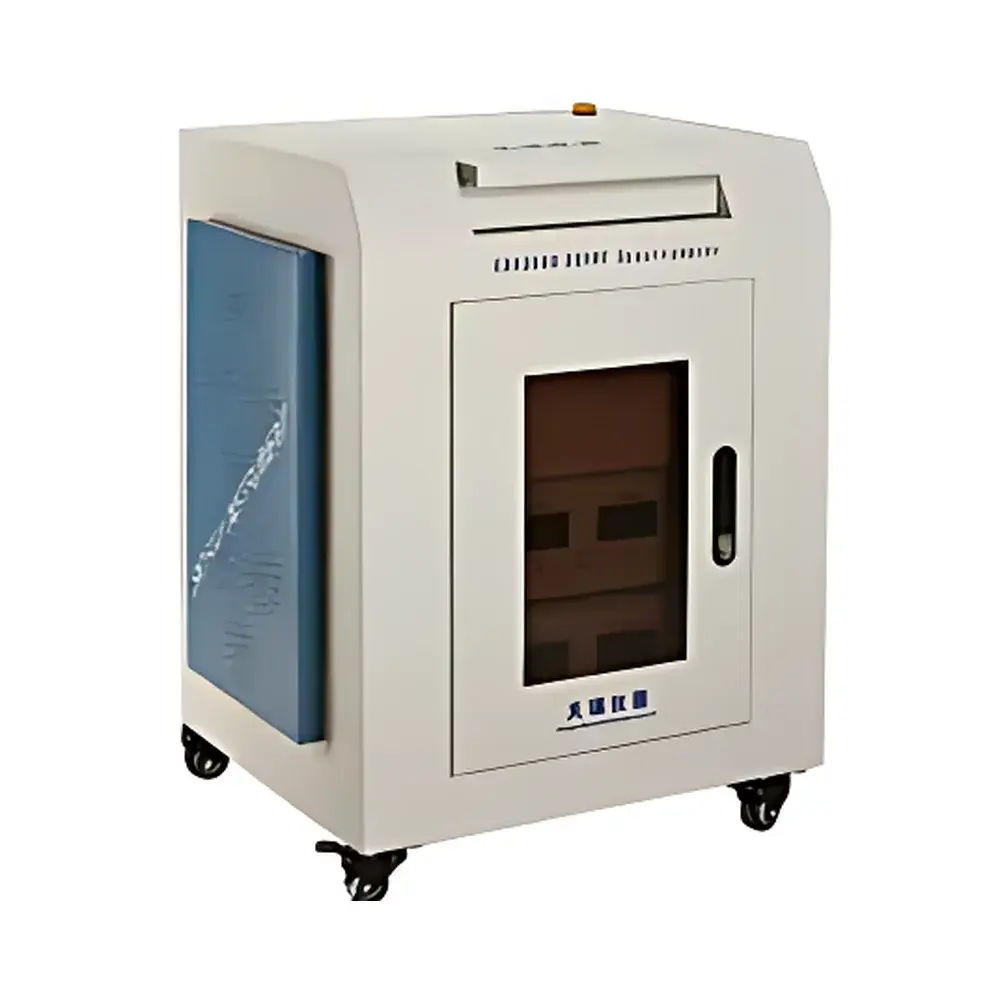
SkyRay Instrument EDX3600 Energy Dispersive X-Ray Fluorescence Spectrometer
| Brand | SkyRay Instrument |
|---|---|
| Origin | Jiangsu, China |
| Manufacturer Type | Direct Manufacturer |
| Regional Classification | Domestic (China) |
| Model | EDX3600 |
| Form Factor | Benchtop/Floor-standing |
| Application Scope | General-purpose |
| Elemental Range | Na–U |
| Quantification Range | 1 ppm – 99.99 wt% |
| Energy Resolution | 125 eV |
| Repeatability | 0.05% RSD (for major elements >96 wt%) |
| Detector | FAST-SDD |
Overview
The SkyRay Instrument EDX3600 Energy Dispersive X-Ray Fluorescence (ED-XRF) Spectrometer is an engineered benchtop/floor-standing analytical platform designed for non-destructive, multi-element quantitative and qualitative analysis of solid, powder, and liquid samples. Based on the fundamental principle of X-ray fluorescence—where primary X-rays excite inner-shell electrons in sample atoms, resulting in characteristic secondary (fluorescent) X-ray emission—the EDX3600 delivers high-fidelity elemental composition data across the full range from sodium (Na, Z=11) to uranium (U, Z=92). Its core architecture integrates a high-stability microfocus X-ray tube (5–50 kV, 50 µA–1000 µA), a cryogen-free FAST-SDD (Silicon Drift Detector) with 125 eV energy resolution at Mn Kα, and a digitally optimized pulse processing chain ensuring high signal-to-noise ratio and low spectral background. The system supports both air and vacuum measurement environments; optional vacuum pumping (6×10⁻² Pa base pressure) enables reliable detection and quantification of light elements (e.g., Na, Mg, Al, Si, P, S) that would otherwise be attenuated by atmospheric absorption.
Key Features
- FAST-SDD detector with 125 eV energy resolution at Mn Kα—enabling clear separation of adjacent peaks such as Pt L-lines and Ir L-lines, critical for high-accuracy precious metal assay.
- Dual-mode operation: air mode for rapid screening of mid-to-heavy elements; vacuum mode (with optional pump) for enhanced sensitivity to elements below calcium (Z<20).
- Configurable collimation: Interchangeable apertures down to 0.2 mm diameter, facilitating micro-area analysis of jewelry solder joints, plating layers, or inclusion-rich zones.
- Triple-layer safety architecture: Hardware interlock, software-controlled beam shutter, and real-time chamber pressure monitoring ensure compliance with IEC 61010-1 and national radiation safety regulations.
- Multi-matrix correction framework: Independent empirical and fundamental parameter (FP)-based calibration models, coupled with non-linear multivariate regression algorithms, minimize matrix effects across heterogeneous sample types (e.g., Au–Ag–Cu alloys, Pt–Ir–Rh ternaries).
- Cryogen-free thermoelectric cooling: Eliminates liquid nitrogen dependency and associated operational downtime—ideal for continuous QC lab environments.
Sample Compatibility & Compliance
The EDX3600 accommodates diverse physical forms—including irregular solids (e.g., rings, coins, catalytic converters), pressed pellets, fused beads, and homogenized liquids—within its 334 × 500 × 80 mm sample chamber. Its analytical performance meets key regulatory benchmarks: results are traceable to certified reference materials (CRMs) and fully compliant with GB/T 18043–2013 (Non-destructive Testing of Precious Metal Content by XRF) and GB 11887–2012 (Marking and Purity Standards for Jewelry). For regulated industries, the instrument supports audit-ready data handling: all measurements include timestamped metadata, user ID logging, and raw spectrum archiving—facilitating GLP/GMP alignment and readiness for FDA 21 CFR Part 11-compliant electronic record implementation when paired with validated LIMS integration.
Software & Data Management
The EDX3600 ships with SkyRay’s proprietary EDX Analysis Suite—a modular, Windows-based application supporting three core workflows: Precious Metals Analysis (standard), Coating Thickness & Composition (optional), and Hazardous Substance Screening (RoHS/ELV/WEEE, optional). Each module includes pre-loaded calibrations for common alloy systems (e.g., Au–Ag–Cu, Pt–Ni, Ag–Cu–Zn), customizable reporting templates (PDF/CSV/XLSX), and statistical process control (SPC) tools. All spectra are stored in vendor-neutral .spc format; raw counts, peak deconvolution parameters, and matrix correction coefficients are fully exportable for third-party validation. Software updates follow ISO/IEC 17025-aligned change control procedures, with version history and release notes maintained in the embedded help system.
Applications
The EDX3600 serves as a primary tool in quality assurance laboratories across multiple sectors: jewelry manufacturers rely on it for incoming material verification and hallmark compliance; recycling facilities use it for rapid sorting of scrap precious metals; electronics suppliers apply it to screen printed circuit board finishes (e.g., Ni/Au, Sn/Pb) and detect restricted substances; and geological labs deploy it for bulk rock and ore screening where light-element quantification (e.g., Mg, Al, Si) is required under vacuum. Its ability to quantify Ir in Pt–Ir alloys (<0.1 wt% LOD) and resolve overlapping Au M-lines and Pb L-lines makes it particularly suited for forensic-grade precious metal authentication and failure analysis of high-value components.
FAQ
What is the minimum detectable limit (MDL) for sodium (Na) under vacuum conditions?
Under optimal vacuum (<6×10⁻² Pa) and 200 s counting time, the typical MDL for Na is ≤50 ppm in homogeneous matrix-matched standards.
Does the system support ASTM E1621 or ISO 21043 methodologies?
Yes—the instrument’s FP engine and CRM-based calibration protocols are compatible with ASTM E1621 (Standard Guide for XRF Analysis of Metals) and ISO 21043 (XRF for Precious Metals), subject to laboratory-specific validation per ISO/IEC 17025.
Is remote diagnostics or firmware update capability available?
Firmware updates are performed via secure USB media; remote desktop-assisted troubleshooting is supported under signed service agreements, with all communications encrypted per TLS 1.2+.
Can the EDX3600 be integrated into an automated production line?
Yes—RS-232, Ethernet (TCP/IP), and Modbus TCP interfaces enable OEM-level integration with PLCs and MES platforms for pass/fail decision logic and real-time SPC dashboarding.
What maintenance is required for the X-ray tube and detector?
The microfocus X-ray tube has a rated lifetime of ≥15,000 hours; the FAST-SDD requires no consumables and maintains stable resolution over >5 years with routine thermal cycling verification every 6 months.





