
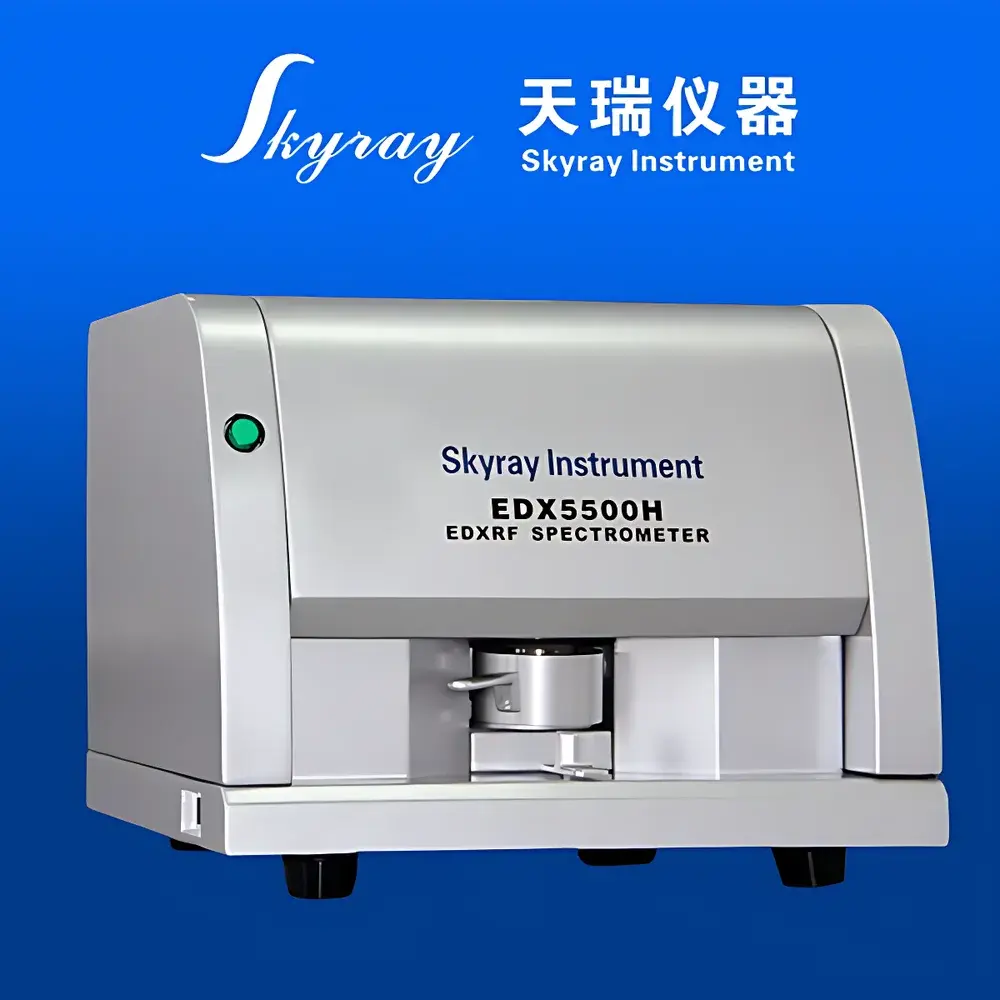
SkyRay Instrument EDX5500H Benchtop Energy Dispersive X-Ray Fluorescence (ED-XRF) Elemental Logging Analyzer
| Brand | SkyRay Instrument |
|---|---|
| Origin | Jiangsu, China |
| Manufacturer Type | Original Equipment Manufacturer (OEM) |
| Country of Origin | China |
| Model | EDX5500H |
| Configuration | Benchtop / Floor-Standing |
| Industry-Specific Application | Oil & Gas Exploration & Petrochemicals |
| Energy Resolution | ≤125 eV at Mn Kα |
| Detector | FAST-SDD (Silicon Drift Detector) |
| Excitation Source | Rhodium (Rh) Target X-ray Tube with Ultra-Thin Beryllium Window |
| Digital Pulse Processing | 4096-Channel Multichannel Analyzer (MCA) |
| Sample Chamber | Vacuum-Compatible Sealed Cavity |
| Optical Geometry | Top-View Direct-Beam Configuration |
| Beam Spot Size | Up to 150 mm² (via Optimized Collimation) |
| Typical Analysis Time | 60–240 s per sample |
| Simultaneous Element Detection | Up to 40 elements (Na–U) |
Overview
The SkyRay Instrument EDX5500H is a purpose-engineered benchtop energy dispersive X-ray fluorescence (ED-XRF) analyzer optimized for elemental logging in oilfield geoscience applications. It applies fundamental XRF physics—where primary X-rays from a Rh-target tube excite characteristic secondary (fluorescent) X-rays from sample atoms—to quantitatively determine elemental composition in drill cuttings, core chips, and sidewall samples without destructive digestion. Unlike conventional lab-based XRF systems, the EDX5500H integrates vacuum-compatible sample chamber design, FAST-SDD detection, and real-time digital pulse processing to achieve sub-125 eV energy resolution—enabling reliable differentiation of adjacent emission lines (e.g., S Kα/Kβ, Ca Kα/Kβ, Fe L-lines) critical for lithological discrimination. Its top-illumination optical path minimizes airborne particulate interference in field environments, while the sealed vacuum cavity ensures optimal low-Z element sensitivity (down to Na), essential for carbonate, shale, and clay mineral fingerprinting.
Key Features
- FAST-SDD detector with high count-rate capability (>100,000 cps) and superior peak-to-background ratio for enhanced signal fidelity in heterogeneous geological matrices.
- Rh anode X-ray tube with ultra-thin Be window (≤8 µm) and optimized kV/mA control, delivering high photon flux across the 1–20 keV range for efficient excitation of light to heavy elements.
- 4096-channel digital multichannel analyzer enabling precise spectral deconvolution and real-time dead-time correction—critical for accurate quantification under variable count rates encountered in cuttings analysis.
- Vacuum-sealed, compact sample chamber (≤1.5 L volume) with rapid pump-down (<60 s), enabling consistent measurement conditions without external vacuum infrastructure.
- Top-view direct-beam geometry with large-area collimation (up to 150 mm²) ensuring representative sampling of coarse, irregular rock fragments and minimizing grain-size bias.
- Passive vibration mitigation system: high-damping adjustable feet + rigid vacuum chamber mounting + static sample holder—validated per IEC 60068-2-6 (vibration) and IEC 60068-2-14 (thermal shock).
- Integrated CCD camera (1080p) with coaxial illumination for precise sample positioning and documentation—supporting GLP-compliant audit trails.
Sample Compatibility & Compliance
The EDX5500H accommodates unprepared or minimally processed geological samples—including dry cuttings, split core halves, pressed pellets (via optional hydraulic press), and powdered standards. No acid digestion or fusion is required, preserving sample integrity and enabling same-shift decision-making during drilling operations. The system complies with international radiation safety standards (IEC 61010-1, GBZ 126–2011) via double-shielded X-ray housing, interlocked vacuum door, and real-time dose monitoring. Software supports ASTM D7359 (standard test method for elemental analysis of petroleum products by ED-XRF), ISO 20884 (petroleum products—determination of vanadium and nickel), and USP (elemental impurities in pharmaceuticals) protocols through customizable calibration libraries and uncertainty propagation modules. All firmware and software updates maintain traceability per FDA 21 CFR Part 11 requirements for electronic records and signatures.
Software & Data Management
SkyRay’s GeoLogIQ™ analytical suite provides full workflow automation—from spectral acquisition and matrix correction (Fundamental Parameters + Empirical Calibration modes) to lithology classification and stratigraphic correlation. The software includes embedded QA/QC tools: daily drift correction using internal reference standards, automatic peak identification (NIST SRM library), and statistical outlier detection. Raw spectra and processed results are stored in vendor-neutral .cdf (Common Data Format) files compatible with Petrel, Techlog, and third-party reservoir modeling platforms. Audit logs record user actions, instrument parameters, calibration history, and environmental metadata (temperature, pressure, vacuum level)—fully compliant with GLP/GMP data integrity expectations. Remote diagnostics and over-the-air firmware updates are supported via encrypted TLS 1.2 communication.
Applications
- Lithological identification: Discrimination of sandstone, limestone, dolomite, shale, and volcaniclastic units based on elemental ratios (e.g., Si/Al, Ca/Mg, Fe/Ti, Th/U).
- Stratigraphic correlation: Matching cuttings profiles across wells using trace element “fingerprints” (e.g., rare earth element patterns, Zr/Nb, Y/Ni).
- Hydrocarbon prospectivity assessment: Rapid screening for organic richness indicators (e.g., V/Ni, Mo/U, S content) and redox-sensitive elements (U, V, Mo) in source rocks.
- Drilling fluid contamination monitoring: Quantifying barite (BaSO₄), hematite (Fe₂O₃), or bentonite (Al₂Si₂O₅(OH)₄) carryover into cuttings via Ba, Fe, Al signals.
- Core-to-cuttings reconciliation: Cross-validating core XRF data with cuttings datasets to refine depth-of-sample assignment and improve log quality.
FAQ
What sample preparation is required for cuttings analysis?
Minimal preparation is needed: cuttings are air-dried, homogenized, and loaded directly into the sample cup. Optional pelletization (using cellulose binder) improves reproducibility for fine-grained shales.
Can the EDX5500H operate in a mobile logging unit or rig floor environment?
Yes—the instrument is certified for operation across –10°C to +50°C ambient temperature, 20–95% RH (non-condensing), and withstands mechanical vibration up to 5 g RMS (5–500 Hz), meeting API RP 54 requirements for offshore equipment.
How does the system ensure long-term calibration stability?
It employs internal reference standards (Cr–Fe–Cu–Zn alloy) monitored before each batch; automated recalibration triggers if drift exceeds ±2% intensity deviation over 24 h.
Is spectral data exportable for third-party geochemical modeling?
Yes—full-resolution spectra (.cdf), quantified elemental concentrations (.csv/.xlsx), and metadata are exportable without proprietary lock-in; no dongle or subscription required for data access.
Does the analyzer support regulatory reporting for HSE compliance?
Yes—preconfigured templates align with IOGP Report 503 (wellsite geochemical data standards) and include built-in uncertainty budgets per ISO/IEC 17025 Annex A.2.
Related Products






