
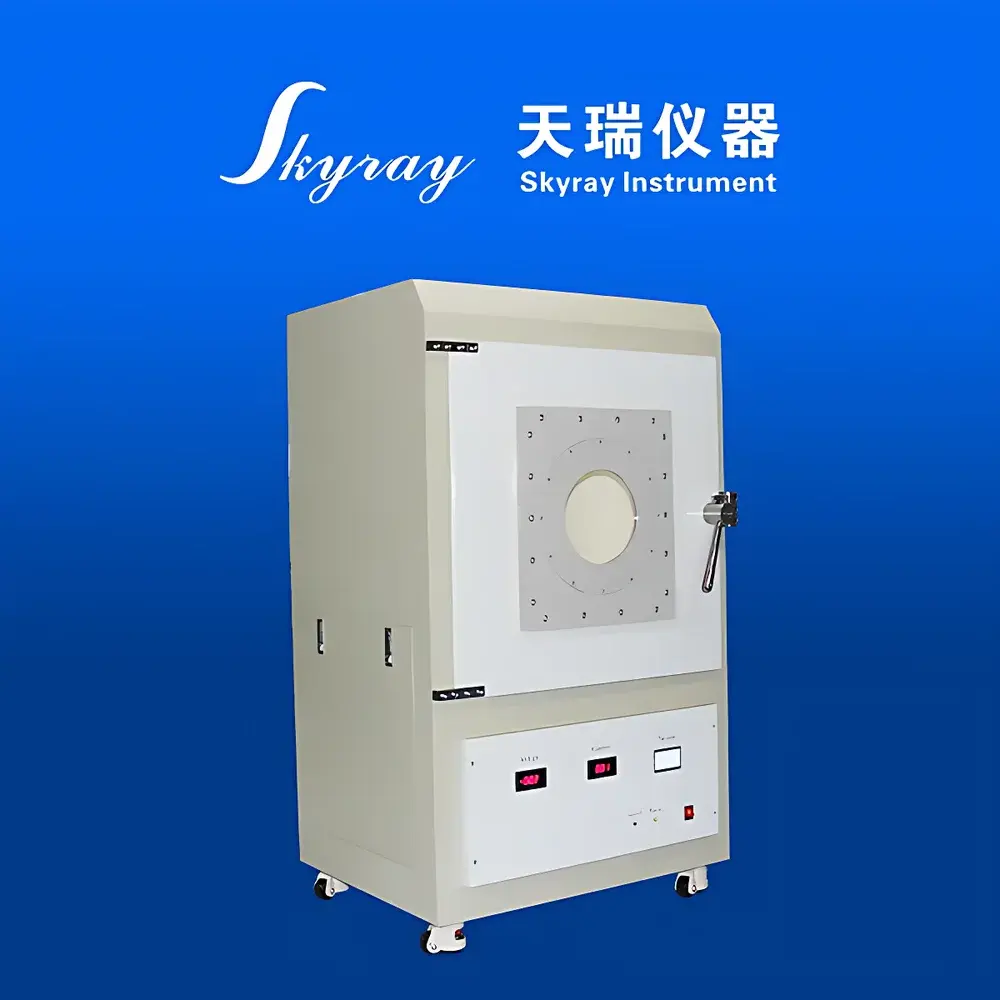
SkyRay Instrument EDX8000L Benchtop Energy Dispersive X-Ray Fluorescence Spectrometer
| Brand | SkyRay Instrument |
|---|---|
| Origin | Jiangsu, China |
| Manufacturer Type | Direct Manufacturer |
| Country of Origin | China |
| Model | EDX 8000L |
| Configuration | Floor-standing benchtop |
| Application Scope | General-purpose |
| Elemental Range | Na (11) to U (92) |
| Quantification Range | 1 ppm – 99.99% |
| Energy Resolution | 125 eV (at Mn Kα) |
| Detector | FAST-SDD (Silicon Drift Detector) |
Overview
The SkyRay Instrument EDX8000L is a high-performance, floor-standing energy dispersive X-ray fluorescence (EDXRF) spectrometer engineered specifically for non-destructive elemental analysis of cultural heritage artifacts. Operating on the fundamental principle of X-ray fluorescence—where primary X-rays excite inner-shell electrons in sample atoms, resulting in characteristic secondary (fluorescent) X-ray emission—the EDX8000L delivers precise, reproducible quantification across the full elemental range from sodium (Na, Z=11) to uranium (U, Z=92). Its design prioritizes analytical fidelity for archaeometric applications: calibrated using certified reference materials jointly developed with the National Museum of China and the Shanghai Institute of Ceramics, Chinese Academy of Sciences, the instrument enables simultaneous quantification of major, minor, and trace elements—including Na₂O, MgO, Al₂O₃, SiO₂, CaO, TiO₂, Fe₂O₃, K₂O, MnO, As, Cr, Cu, Co, Ni, Pb, Zn, Zr, Ba, V, and more—in both ceramic bodies and glazes. This capability directly supports provenance attribution and chronological classification when cross-referenced against regionally validated archaeological databases.
Key Features
- FAST-SDD detector with 125 eV energy resolution at Mn Kα, optimized for high-count-rate, low-noise detection of trace elements down to 1 ppm
- Large-volume vacuum sample chamber (590 × 550 × 600 mm), accommodating irregularly shaped or oversized artifacts—including intact vessels, bronze statuettes, and metalwork—without fragmentation or surface contact
- Programmable X-ray tube (5–50 kV, 50–1000 µA) with automatic collimator and filter selection, enabling tailored excitation for light-element enhancement (e.g., Na, Mg, Al) or heavy-metal suppression
- Dual-mode analysis: quantitative bulk composition (powder, solid, liquid) and non-destructive coating thickness measurement (down to 0.01 µm for single- and multi-layer metallic films)
- Integrated high-resolution optical camera with live imaging and spatial mapping functionality for precise targeting of heterogeneous surfaces
- Triple safety interlock system compliant with IEC 61010-1:2010, including hardware-based beam shutter, door sensor, and real-time radiation monitoring
Sample Compatibility & Compliance
The EDX8000L accepts heterogeneous, non-conductive, and fragile specimens without requiring conductive coating or destructive preparation—critical for irreplaceable museum objects. It supports analysis of ceramics, bronzes (Cu–Sn–Pb–Zn systems), precious metals (Au, Ag, Pt, Rh), and layered alloys. Method validation follows internationally recognized protocols: calibration traceability aligns with ISO/IEC 17025 requirements for testing laboratories; quantification algorithms incorporate matrix-matched standards and multivariate non-linear regression models to correct for absorption and enhancement effects. The instrument meets GLP documentation standards for audit-ready reporting and supports 21 CFR Part 11-compliant electronic signatures when paired with optional secure software modules.
Software & Data Management
The proprietary SkyRay SmartEDX software provides intuitive workflow control, real-time spectral visualization, and automated peak deconvolution using a library of over 300 reference spectra. It features independent, element-specific matrix correction models—each trained on >500 archaeological reference samples—and supports batch processing of multi-location scans (e.g., glaze vs. body, corrosion layer vs. substrate). Data export formats include ASTM E1301-compliant .csv, .xlsx, and .spc; spectral archives are stored with full metadata (operator ID, date/time, vacuum status, tube parameters, detector temperature). Audit trails record all user actions, parameter changes, and calibration events—essential for regulatory review and inter-laboratory comparison.
Applications
- Archaeometric Ceramics Analysis: Discrimination of kiln sites via geochemical fingerprinting (e.g., Al/Si, Fe/Ti, rare earth element ratios) and temporal grouping based on flux evolution (K₂O/Na₂O trends)
- Ancient Metalwork Characterization: Alloy composition profiling of bronze ritual vessels (Sn/Cu/Pb ratios), gilded bronze corrosion stratigraphy, and mercury-gilding layer thickness verification
- Provenance & Authentication: Statistical clustering (PCA, LDA) of EDXRF data against curated reference collections (e.g., Jingdezhen porcelain database, Sanxingdui bronze corpus)
- Conservation Science: In situ assessment of corrosion products (e.g., basic copper carbonates vs. chlorides), pigment identification (As-containing emerald green, Pb–Cr yellows), and post-excavation treatment monitoring
- Museum Collection Surveying: High-throughput screening of large inventories for material homogeneity, outlier detection, and acquisition due diligence
FAQ
Does the EDX8000L require sample digestion or coating prior to analysis?
No. It performs fully non-destructive, direct solid analysis under vacuum or helium flush—preserving artifact integrity and eliminating preparation-induced bias.
Can it distinguish between surface contamination and bulk composition?
Yes. By combining variable tube voltage control, multi-angle irradiation, and depth-profiling algorithms, it differentiates superficial deposits (e.g., soil residues, handling salts) from intrinsic material chemistry.
Is spectral data compatible with third-party chemometric platforms like Unscrambler or MATLAB?
Yes. Raw spectrum files (.spc) and processed concentration tables (.csv) are natively exportable for external multivariate analysis, PCA modeling, or machine learning training.
What maintenance intervals are recommended for long-term operational stability?
Detector vacuum integrity and X-ray tube output are monitored continuously; annual calibration verification using NIST-traceable standards and biannual SDD performance validation are advised per ISO 14833-2 guidelines.
How does the instrument handle overlapping peaks (e.g., Pb Mα and S Kα)?
Its digital multi-channel analyzer employs iterative least-squares fitting with physical peak shape models and interference correction libraries—validated against certified glass and alloy reference materials.




