
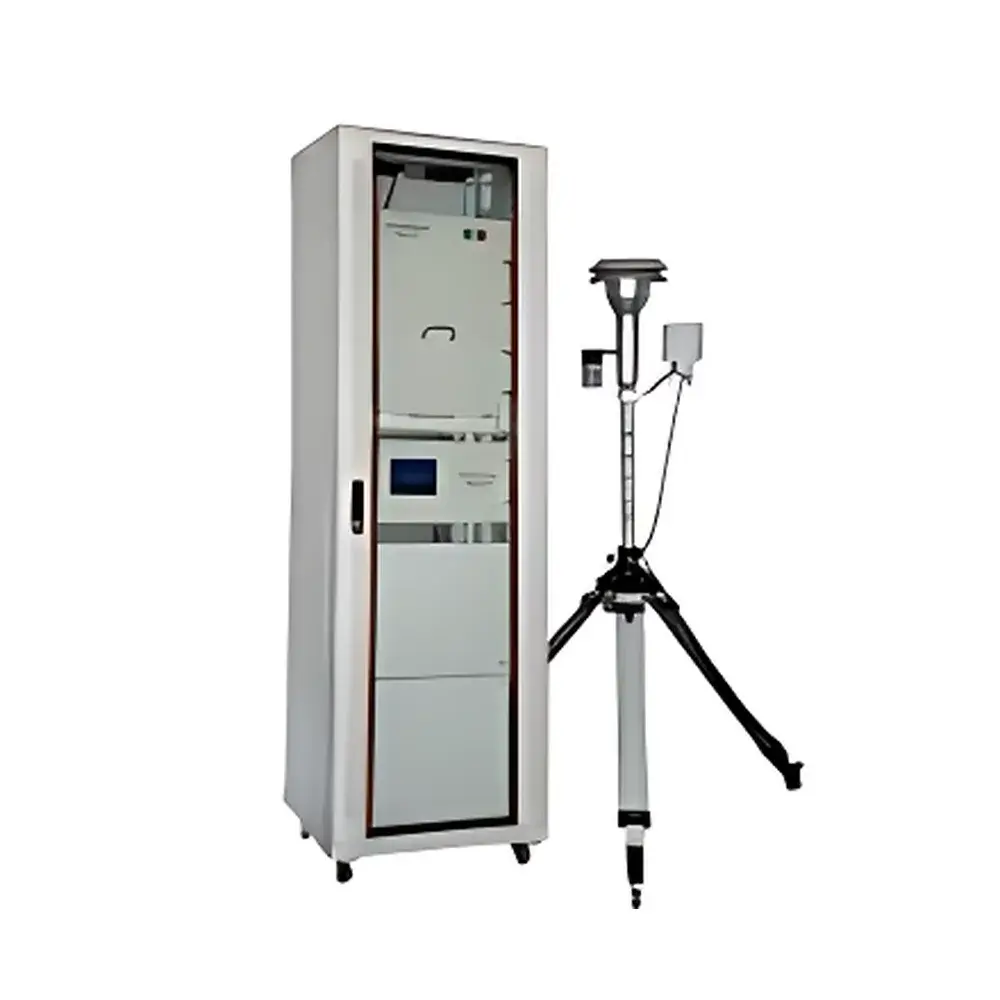
SkyRay Instrument EHM-X100 Atmospheric Heavy Metal Online Analyzer
| Brand | SkyRay Instrument |
|---|---|
| Origin | Jiangsu, China |
| Manufacturer Type | Original Equipment Manufacturer (OEM) |
| Country of Origin | China |
| Model | EHM-X100 |
| Pricing | Upon Request |
Overview
The SkyRay Instrument EHM-X100 Atmospheric Heavy Metal Online Analyzer is a fully automated, real-time monitoring system engineered for continuous, unattended measurement of trace heavy metals in ambient airborne particulate matter (PM). It integrates proprietary X-ray fluorescence (XRF) spectroscopy with integrated atmospheric particle enrichment—combining high-efficiency sampling, precision membrane-based collection, and laboratory-grade elemental quantification in a single 19-inch rack-mountable platform. The instrument operates in full compliance with U.S. EPA Method IO-3.3, “X-Ray Fluorescence Spectrometry for Metals in Ambient Particulate Matter,” and delivers quantitative analysis for up to 28 elements—including Pb, Hg, Cd, As, Cr, Cu, Zn, Ni, Fe, Ag, Se, Sb, Mn, V, and others—at detection limits in the ng/m³ range (based on 2-hour sampling at 16.7 L/min). Designed for year-round deployment in regulatory air quality networks, background stations, industrial fence-line monitoring, and mobile surveillance platforms, the EHM-X100 supports uninterrupted operation for up to 3 months without manual intervention.
Key Features
- Simultaneous multi-element quantification of up to 28 heavy metals—including regulated priority pollutants (Pb, Hg, Cd, As, Cr)—with expandable elemental library via software update;
- Integrated PM size-selective inlet compatibility: supports TSP, PM10, and PM2.5 cyclone or impactor-based cut points per ISO 25242 and EN 12341;
- Automated filter tape advancement system with programmable sampling duration (10–1440 min) and analysis time (1–60 min), enabling flexible duty-cycle optimization;
- Ruggedized industrial architecture: IP54-rated enclosure, lightning-protected signal interfaces, radiation-shielded XRF chamber (meets IEC 61000-4-5 and GBZ 188-2014 occupational exposure limits), and fail-safe thermal management;
- High-reliability hardware design validated for ≥8,760 hours/year (24/7) continuous operation, featuring self-diagnostic routines, automatic fault recovery, and redundant sensor validation;
- Modular data acquisition stack supporting RS232/485, USB 2.0, Ethernet (10/100BASE-T), GPRS, and ADSL connectivity—with native support for HJ/T 212-2005 data transmission protocol for Chinese environmental monitoring networks.
Sample Compatibility & Compliance
The EHM-X100 collects airborne particulates onto low-background polyvinyl chloride (PVC) or quartz fiber filter tapes, compatible with gravimetric and leaching-based reference methods. Sample loading follows standardized flow control (0–20 L/min adjustable) and temperature/humidity compensation (−40 °C to +50 °C; 0–90% RH non-condensing). All analytical outputs meet traceability requirements under ISO/IEC 17025:2017 for testing laboratories and align with QA/QC protocols referenced in EPA IO-3.3. System calibration is traceable to NIST SRM 2783 (Air Particulate on Filter Media) and certified reference materials from BAM (Germany) and IRMM (Belgium). Radiation safety certification complies with national Class II X-ray device regulations (CNCA-C11-01:2020) and includes interlocked shutter mechanisms and dose-rate monitoring.
Software & Data Management
The embedded GeniScan™ v3.2 control and analysis suite features a layered, modular architecture compliant with GLP data integrity principles. It provides full audit trail logging (user actions, calibration events, system errors), electronic signatures, and configurable data retention (≥10 years locally stored on industrial SSD). Data export formats include CSV, XML, and NetCDF; integration with SCADA systems and cloud-based environmental dashboards (e.g., SkyRay Cloud EMS) is supported via OPC UA and RESTful API. Software modules include dynamic spectral deconvolution (using fundamental parameter and empirical calibration models), matrix-effect correction for varying aerosol composition, and automated drift compensation using internal reference standards. All firmware and application updates are digitally signed and version-controlled.
Applications
- Ambient air quality monitoring networks (national, regional, urban);
- Source apportionment and receptor modeling studies requiring speciated heavy metal time-series;
- Industrial emissions compliance verification near smelters, coal-fired power plants, waste incinerators, and battery recycling facilities;
- Background and remote site characterization (e.g., alpine, marine, polar environments);
- Emergency response and fugitive emission tracking during accidental releases;
- Long-term trend analysis aligned with WHO Air Quality Guidelines and EU Directive 2004/107/EC on heavy metals in ambient air.
FAQ
What regulatory standards does the EHM-X100 comply with?
The analyzer conforms to U.S. EPA Method IO-3.3, Chinese standard HJ/T 212-2005, and technical specifications outlined in GB 3095-2012 (Ambient Air Quality Standards). Calibration traceability follows ISO/IEC 17025 requirements.
Can the system operate autonomously for extended periods?
Yes—it supports unattended operation for up to 90 days using standard filter tape rolls, with remote diagnostics, automated recalibration checks, and alarm-triggered notifications via SMS or email.
Is the instrument suitable for mobile deployment?
Absolutely—the 19-inch 14U chassis (482 × 420 × 600 mm) is vibration-damped and shock-rated for vehicle mounting; optional roof-mounted PM inlets and vehicle-integrated power conditioning are available.
How is data security and integrity ensured?
All measurement records include timestamped metadata, digital signatures, immutable audit logs, and optional 21 CFR Part 11-compliant user access controls when deployed in regulated environments.
What maintenance intervals are recommended?
Preventive maintenance is scheduled annually; consumables (filter tape, X-ray tube, pump diaphragms) have documented service lifetimes exceeding 12 months under typical operating conditions.
Related Products







