
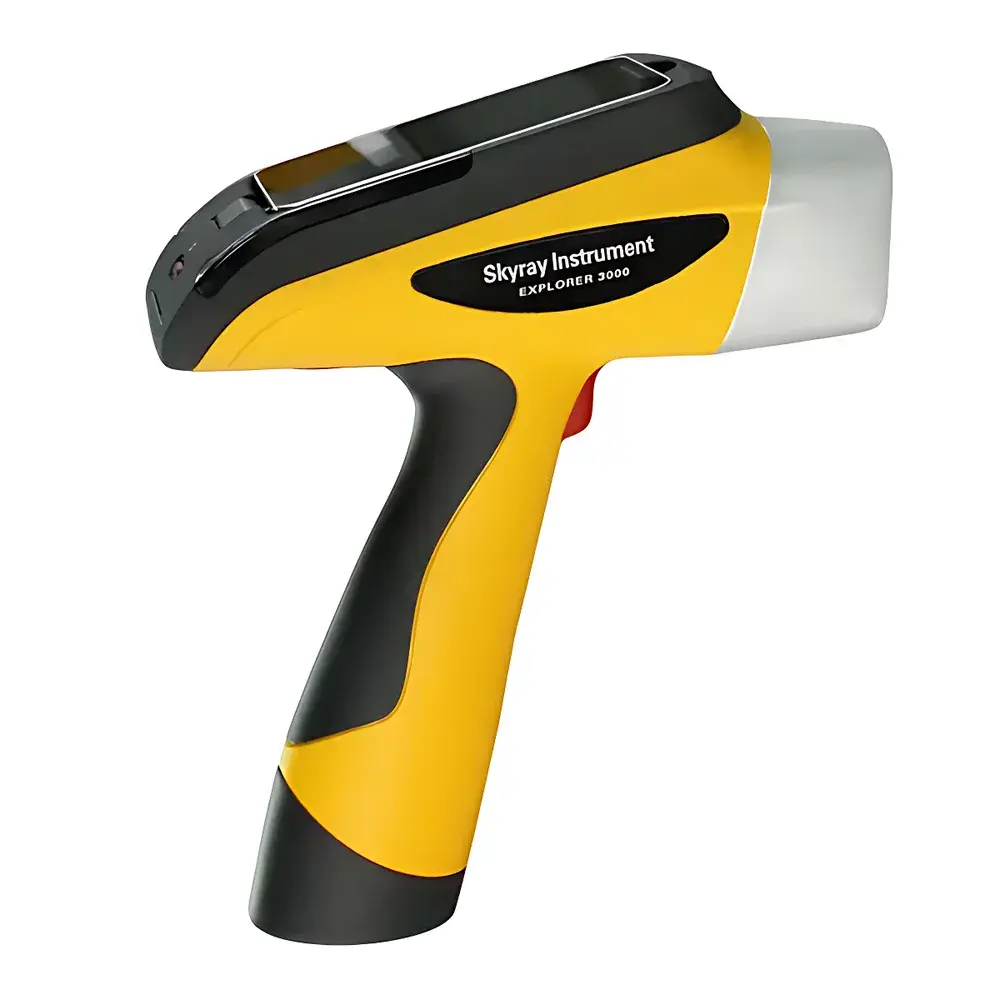
Skyray Instrument Explorer 5000 Portable Energy Dispersive X-Ray Fluorescence (ED-XRF) Spectrometer for Alloy Analysis
| Brand | Skyray Instrument |
|---|---|
| Origin | Jiangsu, China |
| Manufacturer Type | OEM Manufacturer |
| Country of Origin | China |
| Model | Explorer 5000 |
| Application | Handheld / Portable |
| Industry-Specific Use | Non-Ferrous & Specialty Alloys |
| Detector | Silicon Drift Detector (SDD) |
| Excitation Source | Micro-focus X-ray Tube |
| Elemental Range | Mg (12) to U (92) |
| Light Element Capability | Down to Magnesium (Mg) without He purge |
| Display | 5-inch HD LCD, 270° rotation, multi-touch |
| Battery | 27,000 mAh Li-ion, up to 72 h continuous operation |
| Safety | Triple-interlocked radiation safety system with auto-shutoff, shielded test chamber, and real-time LED status indicator |
| Compliance | Meets IEC 62495, GB/Z 20001.3–2018, and supports GLP/GMP audit trails via optional software module |
Overview
The Skyray Instrument Explorer 5000 is a handheld energy dispersive X-ray fluorescence (ED-XRF) spectrometer engineered for rapid, non-destructive elemental analysis and alloy grade identification in field and industrial environments. Based on the fundamental principle of X-ray fluorescence—where primary X-rays excite atoms in a sample, causing emission of secondary characteristic X-rays—the Explorer 5000 quantifies elemental composition by measuring energy spectra using a high-resolution silicon drift detector (SDD). Its optimized optical path design enables detection of light elements down to magnesium (Mg, Z=12) without helium purging or vacuum requirements, significantly expanding applicability beyond conventional portable XRF systems. Designed for metrological robustness in demanding conditions, the instrument delivers laboratory-grade precision in a ruggedized, ergonomic form factor weighing under 1.7 kg. It serves as a field-deployable analytical tool for material verification, process control, scrap sorting, and regulatory compliance across metallurgical, manufacturing, and recycling sectors.
Key Features
- High-performance SDD detector with <145 eV Mn Kα resolution at 100,000 cps, enabling precise peak deconvolution for overlapping transitions (e.g., Cr/V, Ni/Co, Pb/As)
- Micro-focus X-ray tube with selectable kV/mA settings (up to 50 kV / 200 µA), optimized for both heavy and light element excitation
- 12-position programmable collimator and filter wheel for adaptive excitation geometry and spectral background suppression
- 5-inch rotatable HD touchscreen with glove-compatible multi-touch interface and ambient-light adaptive brightness
- IP54-rated sealed enclosure with reinforced impact-resistant housing, certified for operation in temperatures from –10 °C to 50 °C and relative humidity up to 90% non-condensing
- Triple-layer radiation safety architecture: hardware interlock, proximity-sensing trigger, and mechanical shutter—fully compliant with IEC 62495 Class II requirements
- Onboard 8-megapixel coaxial camera with real-time ROI preview and automatic focus-assisted positioning
- Dual-mode software interface: intuitive “User Mode” for one-button grade ID and configurable “Expert Mode” supporting custom calibrations, curve optimization, and matrix correction algorithms
Sample Compatibility & Compliance
The Explorer 5000 analyzes solid metallic samples—including castings, forgings, welds, sheets, rods, and fasteners—without surface preparation. Its fixed geometry and intensity-based normalization algorithms accommodate irregular shapes, curved surfaces, and varying surface finishes. The instrument supports ASTM E2857–22 (Standard Guide for Validation of Portable XRF Analyzers), ISO 21043–1:2021 (XRF — Part 1: General principles), and aligns with USP / elemental impurity screening workflows when configured with appropriate calibration standards. For PMI (Positive Material Identification), it references over 500 alloy grade specifications—including ASTM, ASME, EN, JIS, GB, and UNS designations—with embedded logical branching for hierarchical grade matching (e.g., distinguishing 304L from 304H based on C/Ni/Cr/Mo ratios). All measurement data includes timestamp, GPS coordinates (optional), operator ID, and instrument serial number—enabling traceability per FDA 21 CFR Part 11 and ISO/IEC 17025 documentation requirements.
Software & Data Management
The proprietary SkyAnalysis™ v4.2 software provides full spectral acquisition, qualitative/quantitative analysis, and report generation directly on-device or via desktop synchronization. Raw spectra are stored in standardized .spc format compliant with ASTM E1341 and IUPAC spectral exchange protocols. The system supports audit trail logging with immutable timestamps, user authentication (PIN or biometric), and role-based access control. Data export options include CSV, PDF, XML, and direct integration with LIMS via secure HTTPS API. Optional cloud-based fleet management allows remote firmware updates, calibration validation tracking, and centralized spectral library deployment across multi-site operations. All calibration models undergo periodic stability verification using CRMs (Certified Reference Materials) traceable to NIST SRMs.
Applications
- Scrap metal sorting: Real-time differentiation of stainless steels (300/400 series), nickel alloys (Inconel 625 vs. Hastelloy C-276), titanium grades (Ti-6Al-4V vs. CP-Ti), and copper-base alloys (brass, bronze, cupronickel)
- PMI in critical infrastructure: Verification of piping, valves, and pressure vessel components in power generation, petrochemical, and pharmaceutical facilities
- Manufacturing QA/QC: In-line validation of raw material receipt, heat treatment verification, and post-weld composition checks
- Cultural heritage and archaeometry: Non-invasive characterization of historical artifacts, coins, and decorative metals without sampling
- Recycling facility throughput optimization: High-speed classification of shredded automotive scrap, electronic waste (e-waste), and mixed alloy streams
- Field-based coating thickness analysis: Quantitative determination of Zn, Sn, Ni, and Cr electroplating layers on steel substrates using fundamental parameter (FP) modeling
FAQ
Does the Explorer 5000 require external gas purging or vacuum for light element analysis?
No. Its ultra-short excitation path and high-efficiency SDD enable reliable Mg–P detection in air mode without He flushing or vacuum pumping.
Can the instrument be calibrated for customer-specific alloys not included in the default library?
Yes. Using certified reference materials and the Expert Mode calibration wizard, users can build and validate custom grade models with full uncertainty estimation.
Is spectral data export compatible with third-party chemometric software?
Yes. Raw spectra (.spc) and processed results (.csv) are fully interoperable with Unscrambler®, MATLAB®, and Python-based libraries (e.g., scikit-learn, PyMca).
What is the typical counting statistics performance at 1-second acquisition?
At 1 s dwell time, the system achieves >50,000 net counts for Fe Kα in low-alloy steel, supporting ±0.03 wt% repeatability (1σ) for major constituents under field conditions.
How is measurement reproducibility maintained across changing environmental conditions?
The instrument employs internal temperature-stabilized detector electronics, real-time tube output monitoring, and automatic dead-time correction—ensuring consistent spectral fidelity across ambient fluctuations.






