
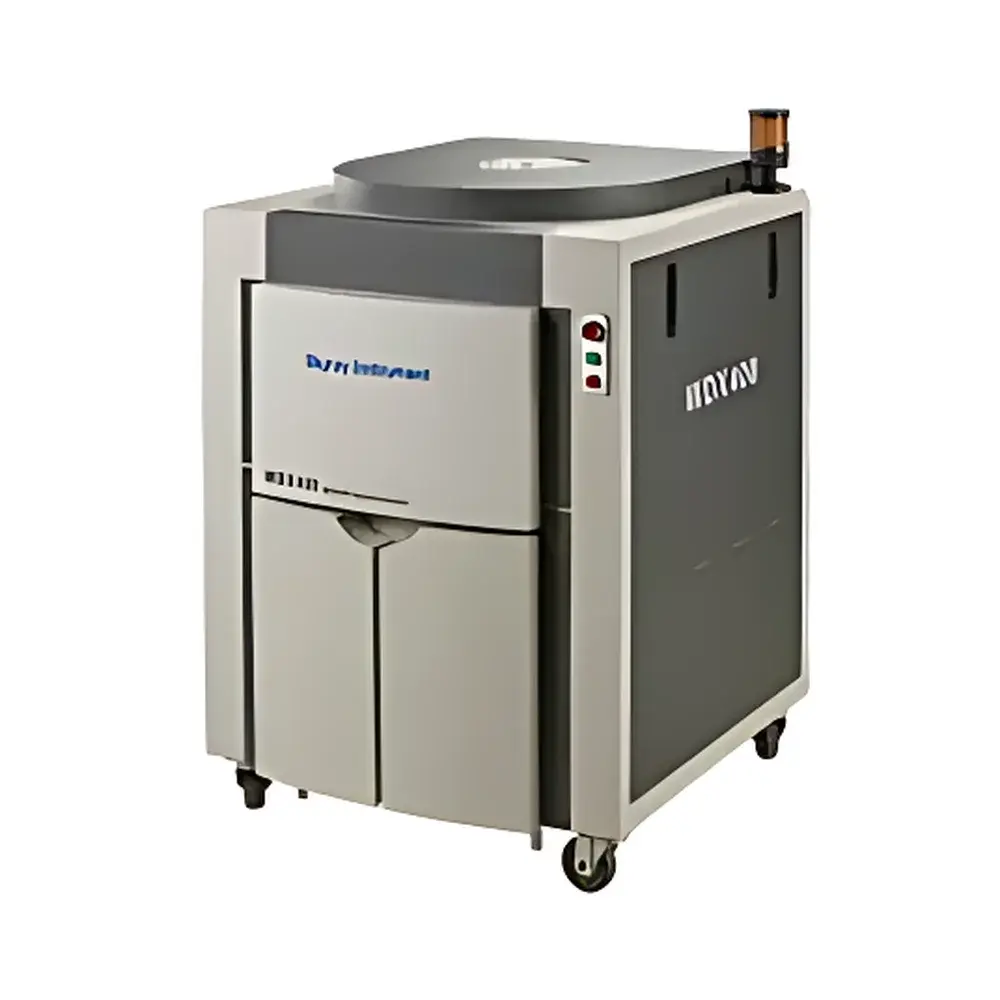
Skyray Instrument WDX400 Wavelength Dispersive X-Ray Fluorescence Spectrometer
| Brand | Skyray Instrument |
|---|---|
| Origin | Jiangsu, China |
| Manufacturer Type | OEM Manufacturer |
| Origin Category | Domestic (China) |
| Model | WDX400 |
| Pricing | Upon Request |
Overview
The Skyray Instrument WDX400 is a fixed-channel wavelength dispersive X-ray fluorescence (WDXRF) spectrometer engineered for high-precision, multi-element quantitative analysis in industrial quality control and routine laboratory environments. Unlike sequential scanning systems, the WDX400 employs ten parallel optical channels—each equipped with a dedicated analyzing crystal, collimator, and detector—enabling simultaneous detection of up to ten elements within a single measurement cycle. Its core measurement principle relies on Bragg diffraction of characteristic X-rays emitted from a sample under primary X-ray excitation; spectral separation is achieved via crystal lattice spacing (d-spacing), allowing resolution of closely spaced emission lines (e.g., Si Kα at 1.839 Å and P Kα at 1.844 Å). Designed for robustness and long-term stability, the system integrates a 400 W Rh-target end-window X-ray tube (Pd optional), a dual-mode detector array (flow-proportional + sealed proportional), and real-time digital multichannel analyzers (MCA) for pulse-height discrimination. The instrument operates under high vacuum (<5 Pa) in the measurement chamber and supports helium purging for light-element analysis (Na–F) and volatile or liquid samples.
Key Features
- Simultaneous 10-element analysis using fixed, pre-aligned spectrometric channels—eliminates mechanical goniometer wear and ensures long-term angular reproducibility.
- High-stability 400 W X-ray source with ±0.05% 12-hour voltage/current drift, enabling reliable calibration transfer across shifts and production batches.
- Dual detector configuration: flow-proportional detectors for low-Z elements (Na–Ca) and sealed proportional detectors for mid-to-high Z elements (Ti–U), optimized for count-rate linearity and energy resolution.
- Digital MCA architecture with 1024-channel pulse-height analysis per channel—supports real-time peak deconvolution, background subtraction, and dead-time correction.
- Modular vacuum system with independent pump station design—facilitates rapid maintenance without compromising main chamber integrity or requiring full system shutdown.
- Helium flush option enables quantitative analysis of liquids, oils, polymers, and hygroscopic solids—extending applicability beyond conventional fused beads and pressed pellets.
- Thermostatically controlled恒温 chamber (±0.1 °C)—minimizes thermal drift of crystal lattice parameters and detector gain, critical for sub-0.05% RSD precision over 24-hour operation.
Sample Compatibility & Compliance
The WDX400 accommodates diverse solid and semi-solid formats including pressed powder pellets (with binder), glass fusion beads (Li₂B₄O₇/LiBO₂), polished metal alloys, and ceramic tiles. With helium atmosphere, it supports direct analysis of lubricating oils, catalyst slurries, and geological brines. All hardware and firmware comply with IEC 61000-6-3 (EMC) and IEC 61010-1 (safety). Data acquisition and reporting support audit-trail functionality aligned with GLP and ISO/IEC 17025 requirements. While not FDA 21 CFR Part 11–certified out-of-the-box, the software architecture permits integration with validated LIMS platforms supporting electronic signatures and change-controlled workflows.
Software & Data Management
The proprietary analytical software provides full spectrum visualization, matrix correction (Lachance–Traill, Lucas–Tooth), and empirical calibration management. It includes built-in uncertainty propagation tools per ISO 11097 and supports export of raw spectra (ASCII), quantified results (CSV/Excel), and QC charts (X-bar/R, CUSUM). All measurement parameters—including HV settings, dwell times, vacuum status, and detector gas pressure—are logged with timestamps and user IDs. Data files are stored in a structured directory hierarchy with SHA-256 checksum verification to ensure integrity during archival or regulatory submission.
Applications
The WDX400 is widely deployed in cement manufacturing (CaO, SiO₂, Al₂O₃, Fe₂O₃, SO₃ control), ferrous and non-ferrous metallurgy (grade verification of stainless steels, aluminum alloys, copper concentrates), mining and geochemical exploration (multi-element ore assays), petroleum refining (S, Cl, Ni, V in fuels and catalysts), and building materials certification (heavy metal screening in ceramics and glass). Its speed (≤5 min/sample including vacuum cycling) and repeatability (σn−1 ≤ 0.05% for major oxides) make it suitable for incoming raw material inspection, process stream monitoring, and final product release testing under ISO 9001 and ASTM E1361 protocols.
FAQ
Can the WDX400 analyze sodium (Na) and fluorine (F) reliably?
Yes—when operated under helium purge mode, the instrument achieves sufficient transmission for Kα lines of Na (1.04 Å) and F (1.47 Å), with detection limits typically <100 ppm in fused glass discs.
Is the X-ray tube replaceable in the field?
Yes—the Varian 400 W end-window tube is designed for tool-free replacement; alignment is maintained via precision-machined kinematic mounts and verified using built-in reference channels.
Does the system support ASTM C114 or ISO 29581-1 cement analysis protocols?
Yes—pre-configured method templates for cement clinker and hydrated cement are included, with certified reference material (CRM) libraries traceable to NIST and BAM standards.
What vacuum level is required for optimal light-element performance?
Measurement chamber vacuum must be sustained below 5 Pa; the independent pump station achieves this in <90 seconds post-load, with continuous pressure monitoring and automatic re-pump triggers.
How is long-term calibration stability ensured?
Through daily automated intensity checks using internal radioactive sources (⁵⁵Fe, ¹⁰⁹Cd), combined with quarterly drift correction using CRMs and temperature-compensated crystal lattice modeling.
Related Products




