
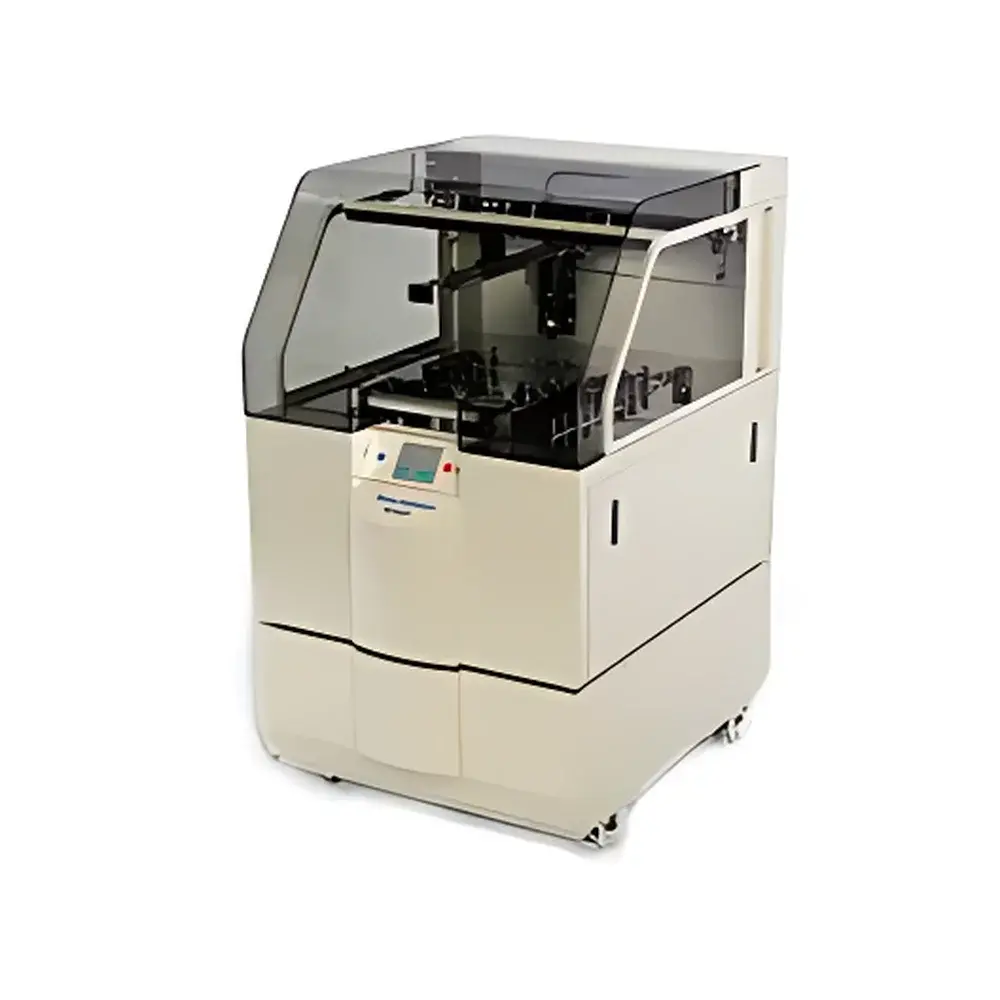
Skyray Instrument WDX4000 Sequential Wavelength Dispersive X-Ray Fluorescence Spectrometer
| Brand | Skyray Instrument |
|---|---|
| Origin | Jiangsu, China |
| Manufacturer Type | Original Equipment Manufacturer (OEM) |
| Product Category | Domestic |
| Model | WDX4000 |
| Price Range | USD 210,000 – 280,000 |
| Instrument Type | Sequential Scanning |
| X-ray Tube Power | 4 kW |
| Elemental Coverage | Standard: C–U (Z = 6–92) |
| Enhanced | Be–U (Z = 4–92) |
Overview
The Skyray Instrument WDX4000 is a high-performance sequential wavelength dispersive X-ray fluorescence (WDXRF) spectrometer engineered for precision elemental analysis across solid matrices in industrial QA/QC and research laboratories. Based on Bragg’s law (nλ = 2d sinθ), the instrument disperses characteristic X-rays using analyzing crystals and measures intensities at precisely defined diffraction angles (θ/2θ), enabling quantitative determination of elemental composition with high spectral resolution and minimal peak overlap. Developed under China’s National Major Scientific Instrument Development Program (Grant No. 2011YQ170065), the WDX4000 complies with JJG 810–1993 — the national metrological verification regulation for WDXRF spectrometers — and supports trace-to-major element quantification from beryllium (Be, Z=4) to uranium (U, Z=92). Its robust mechanical architecture, thermally stabilized optical path, and modular crystal/detector configuration make it suitable for routine operation in geology, cement manufacturing, metallurgy, environmental monitoring, and raw material certification.
Key Features
- Innovative θ/2θ goniometer with patented steel-belt drive mechanism: eliminates backlash and mechanical hysteresis, ensuring angular positioning repeatability of ±0.0002° and absolute accuracy of ±0.0006°
- Dual-axis independent motion control via permanent-magnet AC servo motors and high-resolution circular optical encoders (12-bit interpolation)
- Digital multichannel analyzer (MCA): 12-bit ADC with 80 MS/s sampling rate and 4096-channel histogramming; FPGA-based digital signal processing enables real-time pulse pile-up rejection and noise discrimination
- High-power X-ray source: 4 kW generator with programmable HV supply (20–60 kV / 10–140 mA standard; up to 75 kV / 160 mA optional); Rh anode target standard, with Cu, Mo, W, Cr, or Pt alternatives available
- Optimized light-element detection: 50 µm or 75 µm Be window; 0.3 µm polymer window for flow-proportional counter; up to 10 crystal positions supporting LiF(420), LiF(220), Ge(111), PET, InSb, TAP, and custom synthetic multilayer crystals
- Thermally regulated spectrometer chamber: temperature stability ≤ ±0.05 °C; dual-loop deionized water cooling system maintaining conductivity < 1 µS/cm to extend X-ray tube lifetime
- Automated sample handling: dual-load vacuum chamber with dust filtration and pre-evacuation capability; optional robotic autosampler (168-position capacity); motorized sample spinner with three selectable rotation speeds
Sample Compatibility & Compliance
The WDX4000 accepts flat, polished solid samples up to 51.5 mm × 40 mm and 500 g mass. Sample introduction is compatible with fused bead, pressed pellet, and bulk metal formats. The system meets core requirements for ISO 2936:2021 (XRF — General requirements for calibration and validation), ASTM E1621 (Standard Guide for XRF Elemental Analysis), and supports audit-ready workflows aligned with GLP and GMP principles. While not inherently 21 CFR Part 11 compliant out-of-the-box, its SQLite-based data storage architecture, full audit trail logging (user actions, parameter changes, calibration events), and password-protected method editing enable straightforward validation for regulated environments upon site-specific qualification.
Software & Data Management
The WDX4000 operates on a native 32-bit Windows-compatible software platform featuring intuitive graphical workflow navigation, real-time spectrum visualization, and context-sensitive help. Quantitative analysis is supported via both empirical calibration (standard-based fundamental parameters with matrix correction) and theoretical fundamental parameter (FP) methods — enabling rigorous semi-quantitative screening without certified standards. All measurement parameters (voltage, current, counting time, crystal/detector selection, collimator/filter combinations) are stored as reusable methods. Raw spectra, processed results, and metadata are archived in an embedded SQLite database, facilitating SQL-based querying, batch report generation (PDF/CSV/XLSX), and LIMS integration via ODBC drivers. Software updates and method libraries are distributed through secure vendor portals with version-controlled release notes.
Applications
- Geological exploration and ore grade assessment: rapid quantification of major oxides (SiO₂, Al₂O₃, Fe₂O₃, CaO, MgO) and trace metals (Ni, Co, V, Cr, REEs) in rocks, soils, and drill cores
- Cement and clinker quality control: precise determination of LOI, SO₃, alkalis (Na₂O, K₂O), and minor constituents affecting burnability and strength development
- Metallurgical process monitoring: alloy verification (stainless steels, Al/Mg/Ti alloys), inclusion analysis, and coating thickness evaluation via FP modeling
- Environmental compliance testing: screening of hazardous elements (Pb, Cd, Hg, Cr⁶⁺, Br) in electronic waste (RoHS), soils (EPA Method 6200), and fly ash
- Raw material certification in ceramics, glass, and refractories: compositional verification against supplier specifications and industry benchmarks (e.g., ASTM C25, C114)
FAQ
What is the minimum detectable limit (MDL) for light elements such as sodium or fluorine?
MDLs are matrix- and condition-dependent; typical values range from 10–50 ppm for Na in silicate glasses and 5–20 ppm for F in CaF₂-rich standards, achieved using optimized multilayer crystals, low-background vacuum operation, and extended counting times.
Can the WDX4000 perform thin-film or coating analysis?
Yes — by combining fundamental parameter modeling with variable incidence angle measurements and appropriate standards, the system supports non-destructive thickness and composition analysis of single- and multi-layer coatings down to ~10 nm resolution.
Is remote diagnostics or service support available?
Skyray provides secure remote access capabilities for firmware updates, parameter diagnostics, and collaborative troubleshooting via encrypted TLS sessions, subject to customer network policy approval.
How is long-term intensity drift compensated during extended runs?
The system implements automatic pulse height stabilization and real-time gain adjustment using internal reference sources; additionally, scheduled drift correction routines monitor primary beam intensity via scintillation counter feedback every 2 hours.
Are certified reference materials (CRMs) required for calibration?
For highest accuracy, matrix-matched CRMs are recommended; however, the FP engine allows initial screening and semi-quantitative reporting without standards — ideal for unknown sample triage or rapid pass/fail decisions.






