
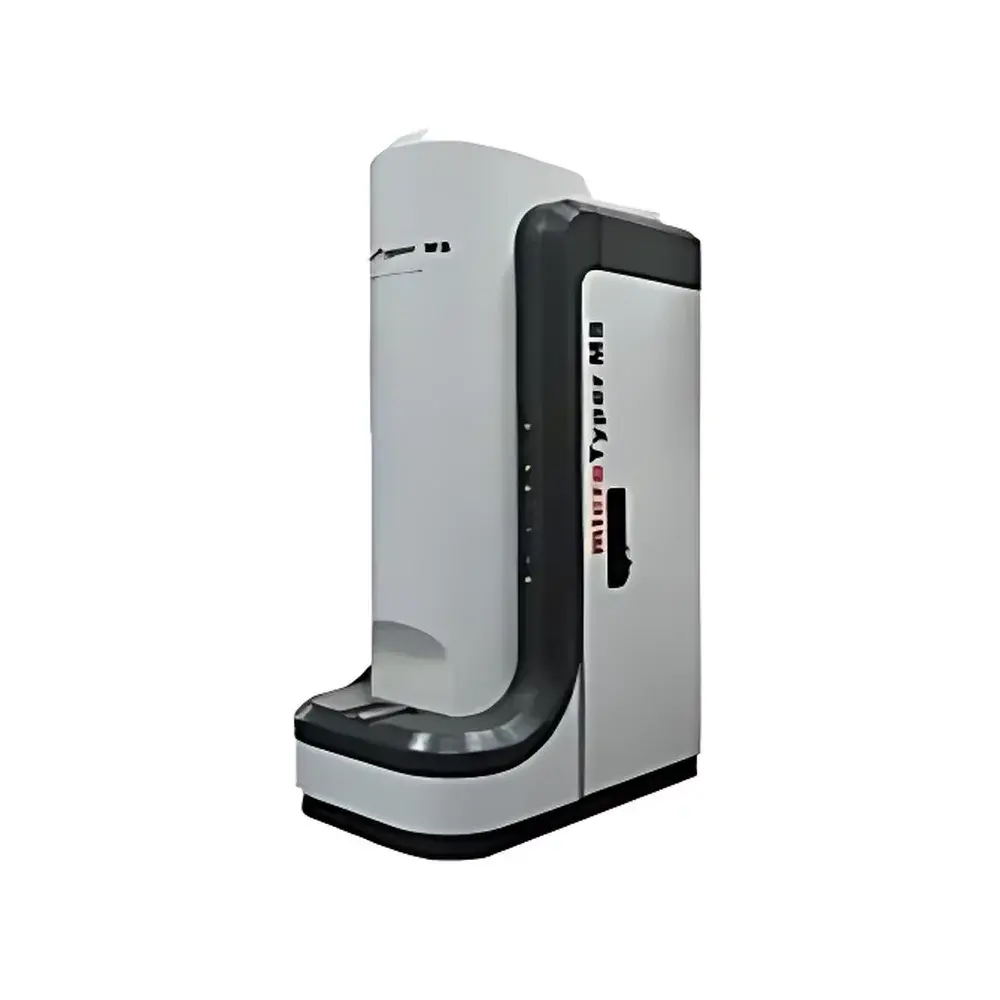
SkyRay microTyper MS MALDI-TOF Mass Spectrometer
| Brand | SkyRay Instrument |
|---|---|
| Origin | Fujian, China |
| Manufacturer Type | Original Equipment Manufacturer (OEM) |
| Product Category | Domestic |
| Model | microTyper MS |
| Instrument Type | Time-of-Flight (TOF) Mass Spectrometer |
| Mass Resolution | R ≥ 500 |
| Sensitivity | Signal-to-Noise Ratio ≥ 100 |
| Mass Stability | ≤ 800 ppm |
| Mass Accuracy | ≤ 500 ppm |
| Mass Range | > 16,000 u |
| Repeatability | ≤ 0.06% |
| Ion Source | Matrix-Assisted Laser Desorption/Ionization (MALDI) |
| Detector | Large-Area Microchannel Plate (MCP) |
| Laser | Long-Life Nitrogen UV Laser (1–60 Hz Tunable) |
| Acquisition Rate | Up to 3 GHz sampling rate |
| Vacuum System | 320 L/s Turbo Molecular Pump |
| Sample Target | 96-well Reusable Stainless Steel Plate with 6 QC Spots |
| Exhaust Treatment | Triple-Stage Sterilization Unit |
Overview
The SkyRay microTyper MS is a fully domestically developed, commercially deployed matrix-assisted laser desorption/ionization time-of-flight mass spectrometer (MALDI-TOF MS) engineered for high-throughput microbial identification in clinical, public health, food safety, and industrial microbiology laboratories. It operates on the fundamental principle of MALDI ionization followed by orthogonal acceleration and linear time-of-flight separation, enabling rapid generation of peptide mass fingerprint (PMF) profiles from intact microorganisms. These profiles are matched against a curated, expandable reference spectral database to deliver species- or genus-level identification within minutes—bypassing lengthy culture-based biochemical assays. As China’s first MALDI-TOF MS system with complete independent intellectual property rights, the microTyper MS was awarded the BCEIA Gold Prize in 2015 by the China Association for Instrumental Analysis, signifying its technical maturity and regulatory readiness for routine use under GLP-compliant workflows.
Key Features
- Linear TOF geometry with gridless flight tube design minimizes ion scattering and improves transmission efficiency for enhanced signal intensity.
- Large-area microchannel plate (MCP) detector ensures high sensitivity across the full mass range (>16,000 u), supporting robust detection of ribosomal proteins critical for microbial taxonomy.
- 3 GHz ultra-high-speed analog-to-digital converter (ADC) enables precise time-stamping of ion arrival events, contributing to reproducible mass calibration and low mass drift.
- Nitrogen UV laser (337 nm) with adjustable repetition rate (1–60 Hz) delivers stable pulse energy over extended operational lifetimes, reducing maintenance intervals and downtime.
- Integrated 96-well stainless steel target plate includes six dedicated quality control (QC) spots for real-time instrument performance verification prior to each batch run.
- 320 L/s turbo molecular pumping system achieves base vacuum <5×10⁻⁷ mbar in under 90 seconds, significantly shortening sample loading turnaround time.
- Triple-stage exhaust sterilization unit—comprising HEPA filtration, UV irradiation, and catalytic oxidation—ensures safe handling of bioaerosols and compliance with biosafety level 2 (BSL-2) laboratory requirements.
Sample Compatibility & Compliance
The microTyper MS accepts standard microbial isolates grown on routine media (e.g., blood agar, chocolate agar, Mueller-Hinton agar) following established CLSI M58 and ISO 13406 protocols. Direct colony transfer via steel loop or automated pin tooling is supported. The system complies with key international standards for analytical instrumentation, including ISO/IEC 17025:2017 (general requirements for competence of testing and calibration laboratories), and supports audit-ready documentation for FDA 21 CFR Part 11–aligned environments through electronic signatures, audit trails, and user access controls embedded in firmware. All spectral acquisition, processing, and reporting functions adhere to GLP principles, facilitating integration into regulated diagnostic and QC workflows.
Software & Data Management
microTyper MS Control Software provides a unified interface for instrument operation, real-time spectral acquisition, automated peak detection, and database-driven identification. Key capabilities include:
- AI-powered fuzzy logic algorithm for autonomous spectral acquisition—evaluating signal quality metrics (S/N, peak width, baseline flatness) before accepting spectra for analysis.
- Self-calibrating mass axis using internal calibrants; recalibration triggered automatically after every 10 samples or upon user-defined thresholds.
- Batch processing engine supporting parallel identification of up to 96 samples with customizable reporting templates (PDF, CSV, LIMS-exportable XML).
- Open database architecture enabling users to curate private spectral libraries—including strain-specific variants—with version-controlled metadata and traceable provenance.
- Remote operation via integrated industrial-grade touchscreen tablet running APS (Automated Processing System), supporting unattended overnight runs with email/SMS alerts upon completion or error conditions.
Applications
The microTyper MS serves as a primary identification platform across multiple regulated domains:
- Clinical microbiology laboratories performing rapid identification of bacterial and fungal isolates from blood cultures, urine, sputum, and wound swabs.
- National and provincial CDCs conducting surveillance of emerging pathogens, antimicrobial resistance markers, and outbreak-associated strains.
- Food and beverage manufacturers implementing environmental monitoring programs per ISO 22000 and HACCP frameworks.
- Port health authorities executing border inspection protocols for imported agricultural commodities and live animals.
- Biotechnology and fermentation facilities performing strain authentication, purity verification, and bioprocess consistency monitoring.
- Academic and government research institutes developing novel microbial diagnostics, synthetic biology chassis validation, and metataxonomic reference databases.
FAQ
What types of microorganisms can be identified using the microTyper MS?
The system reliably identifies Gram-positive and Gram-negative bacteria, yeasts, and filamentous fungi commonly isolated in clinical and industrial settings—covering >95% of routinely encountered species per current database versions.
Is database expansion supported?
Yes. Users may import proprietary spectra, assign taxonomic labels, and perform hierarchical clustering to build institution-specific libraries compatible with all downstream search and reporting modules.
How does the system ensure long-term mass accuracy?
Through hardware-level thermal stabilization of the flight tube, real-time laser energy monitoring, and software-driven iterative recalibration using dual-point internal standards embedded in each target spot.
Can the microTyper MS integrate with existing LIMS?
It supports ASTM E1384-compliant data export formats (including HL7 and ASTM E2554) and offers optional API-based middleware for bidirectional communication with major LIMS platforms.
What maintenance is required for routine operation?
Scheduled maintenance includes quarterly MCP gain optimization, annual laser energy calibration, and semi-annual vacuum system integrity checks—all documented in the onboard service log with automated reminders.





