
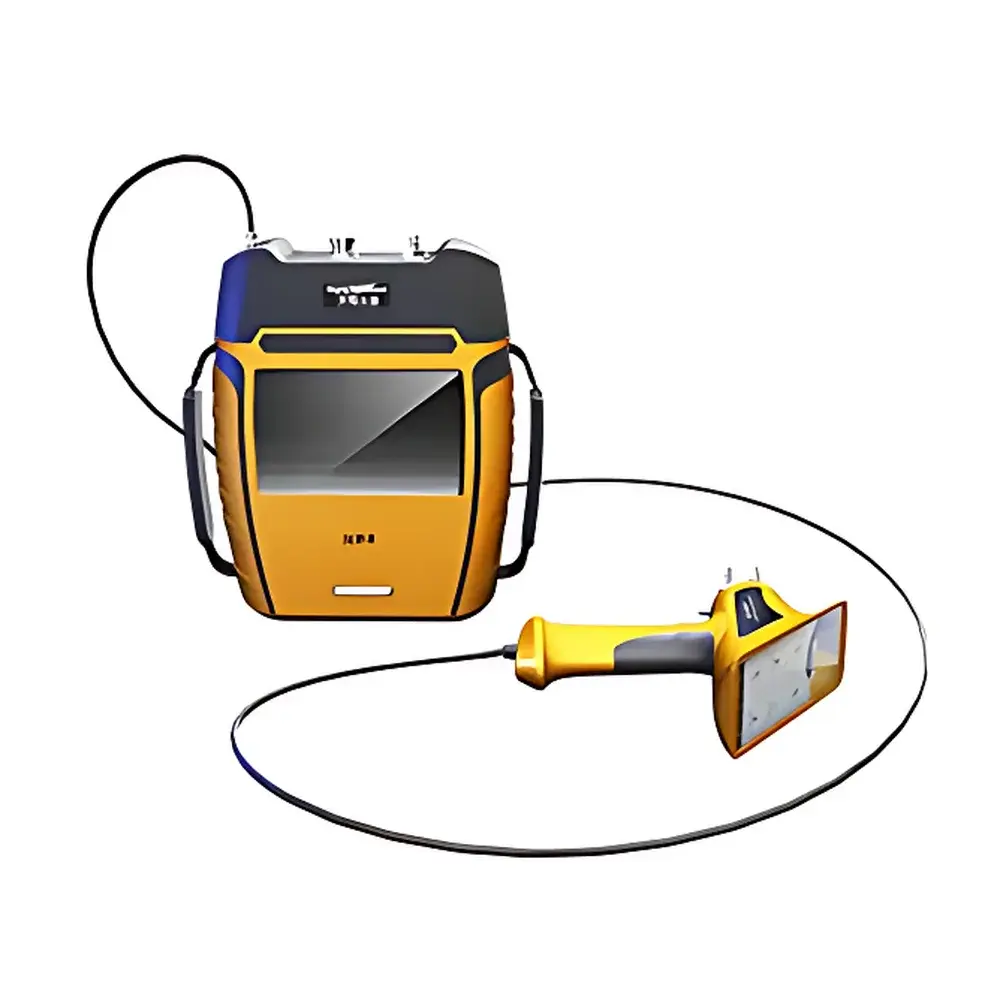
SkyRay VOC-5000 Portable Total Hydrocarbon Analyzer with Dual FID/PID Detection
| Brand | SkyRay Instrument |
|---|---|
| Origin | Jiangsu, China |
| Manufacturer Type | Original Equipment Manufacturer (OEM) |
| Instrument Category | Domestic |
| Model | VOC-5000 |
| Detection Principle | Flame Ionization Detection (FID) & Photoionization Detection (PID) |
| Instrument Type | Portable |
| Typical Configuration | Total Volatile Organic Compounds (TVOC) Analyzer |
| Detection Range (FID) | 0–50,000 ppm |
| Detection Range (PID) | 0–4,000 ppm |
| Resolution | 0.1 ppm (PID), 0.1 ppm (FID) |
| Accuracy | ±5% of reading or ±3 ppm (whichever is greater) |
| Detection Limit (FID) | 0.5 ppm |
| Detection Limit (PID) | 0.1 ppm |
| T90 Response Time (FID) | ≤3.5 s |
| T90 Response Time (PID) | <3 s |
| Zero Recovery Time (FID) | ≤4 s to 10% of baseline |
| H₂ Cylinder Capacity | 100 mL at 20 MPa |
| H₂ Runtime | >12 h per full charge |
| Battery Life | 10 h (typical operation) |
| Ignition System | Dual spark igniters |
| Displayed Parameters | Flame temperature, battery level, pump power, H₂ pressure |
| CPU | Octa-core ARM Cortex-A53 (64-bit, 2.3 GHz) |
| Memory | 64 GB ROM + 4 GB RAM, expandable via 128 GB microSD |
| OS | Android 9.0 |
| Connectivity | USB Type-C, Wi-Fi 802.11 a/b/g/n, Bluetooth 4.0 |
Overview
The SkyRay VOC-5000 Portable Total Hydrocarbon Analyzer is an engineered field-deployable instrument designed for quantitative measurement of total hydrocarbons and volatile organic compounds (VOCs) in ambient air, industrial workspaces, and fugitive emission sources. It integrates two complementary detection technologies—Flame Ionization Detection (FID) and Photoionization Detection (PID)—to deliver broad-spectrum sensitivity across aliphatic, aromatic, and chlorinated hydrocarbons, as well as select inorganic species (e.g., ammonia, hydrogen sulfide) detectable by PID. The FID module operates on the principle of hydrocarbon combustion in a hydrogen–air flame, generating ions proportional to carbon mass flow; it offers exceptional linearity, low drift, and immunity to humidity interference. The PID module employs a 10.6 eV UV lamp to ionize molecules with ionization potentials below this energy threshold, enabling real-time detection of low-concentration VOCs without chemical consumption. This dual-detector architecture ensures compliance with regulatory requirements for LDAR (Leak Detection and Repair), stack screening, soil gas surveys, and emergency response scenarios where compound-agnostic quantification is critical.
Key Features
- Dual-sensor architecture: Simultaneous, independent FID and PID measurement channels with auto-switching display and data logging
- High-speed response: T90 ≤ 3.5 s (FID) and <3 s (PID), enabling rapid survey of large facility perimeters and valve networks
- Robust field operation: Integrated 100 mL high-pressure (20 MPa) hydrogen cylinder with >12-hour runtime; dual spark ignition system ensures reliable flame re-ignition under variable ambient conditions
- Industrial-grade computing platform: Octa-core 64-bit ARM processor running Android 9.0 OS, supporting multi-tasking, offline data capture, and embedded diagnostics
- Comprehensive onboard instrumentation: Real-time display of flame temperature, H₂ pressure, pump duty cycle, battery status, and sensor health metrics
- Expandable storage: 64 GB internal flash memory plus support for 128 GB microSD cards—optimized for long-duration LDAR campaigns with geotagged photo documentation
- Regulatory-ready connectivity: USB Type-C for firmware updates and bulk data export; Wi-Fi 802.11 a/b/g/n and Bluetooth 4.0 for secure synchronization with enterprise cloud platforms
Sample Compatibility & Compliance
The VOC-5000 is validated for direct sampling of ambient air, headspace vapors, and diluted exhaust streams without pre-concentration or catalytic conversion. Its FID channel responds linearly to all organic compounds containing C–H bonds—including methane, ethane, benzene, toluene, xylene, styrene, and chlorinated solvents—while the PID channel extends detection to lower-ionization-potential species such as formaldehyde, acetaldehyde, and methyl ethyl ketone. The instrument meets performance criteria specified in key Chinese environmental standards: GB 20950–2020 (Storage Terminal Emissions), GB 20951–2020 (Petroleum Transport Emissions), GB 20952–2020 (Gasoline Station Emissions), HJ 733–2014 (Fugitive Emission Monitoring Methodology), and GB 37822–2019 (Unorganized VOC Emission Control). Though not certified to ISO 16000 or ASTM D6196, its detection limits, accuracy, and repeatability align with internationally accepted field screening benchmarks for Tier 1 LDAR implementation under EPA OOOOa and EU IED Annex VI frameworks.
Software & Data Management
The VOC-5000 runs a purpose-built Android application that supports full lifecycle management of LDAR programs. Core modules include instrument control (flame ignition, zero/span calibration, alarm threshold configuration), field task execution (photo-captured leak tagging with GPS metadata, repair status tracking), and hierarchical reporting (enterprise-level dashboards accessible by provincial, municipal, park, or site administrators). All measurement records are time-stamped, location-tagged, and cryptographically signed to satisfy audit trail requirements under GLP-aligned workflows. Data exports comply with CSV and PDF formats compatible with third-party LIMS and environmental compliance platforms. Optional cloud service enables encrypted over-the-air synchronization between field devices and central servers—supporting role-based access control, versioned firmware deployment, and remote diagnostic telemetry. Audit logs retain full history of calibration events, user logins, and configuration changes, meeting traceability expectations under internal quality systems and external regulatory review.
Applications
- LDAR program execution across petrochemical, refinery, and chemical manufacturing facilities per national and corporate VOC management protocols
- Soil vapor intrusion assessment during brownfield redevelopment and landfill monitoring
- Workplace exposure evaluation in pharmaceutical cleanrooms, coating operations, and resin synthesis units
- Rapid-response identification of uncontrolled emissions during process upsets or equipment failure events
- Performance verification of VOC abatement systems—including activated carbon beds, thermal oxidizers, and biofilters—via inlet/outlet concentration profiling
- Source apportionment studies using spatial mapping of concentration gradients around storage tanks, loading arms, and wastewater treatment units
- Fugitive emission quantification from open-top tanks, seals, flanges, and pump packing in oil terminals and distribution depots
FAQ
What is the difference between FID and PID detection in the VOC-5000?
FID provides universal, carbon-mass-proportional response to virtually all hydrocarbons with high dynamic range (0–50,000 ppm) and minimal matrix interference. PID delivers selective, low-level detection (down to 0.1 ppm) for VOCs with ionization potentials ≤10.6 eV, including many oxygenates and sulfur compounds not fully responsive to FID.
Does the instrument require external hydrogen supply?
No—the VOC-5000 integrates a self-contained 100 mL, 20 MPa hydrogen cylinder; no external gas lines or compressors are needed for field operation.
Can the device be used for methane-only measurements?
Yes—FID responds robustly to methane, though users should note that background methane in ambient air may affect low-level TVOC readings unless compensated via zero-air purging or differential measurement protocols.
Is the Android OS customizable for enterprise deployment?
The OS is locked to prevent unauthorized app installation; however, MDM (Mobile Device Management) policies can be enforced via standard Android Enterprise APIs to restrict settings, enforce encryption, and manage certificate provisioning.
How is calibration traceability maintained?
The instrument supports two-point calibration (zero and span) using NIST-traceable certified gas standards; all calibration events—including gas lot numbers, concentrations, and operator IDs—are stored in immutable audit logs with SHA-256 hash integrity verification.
Related Products







