
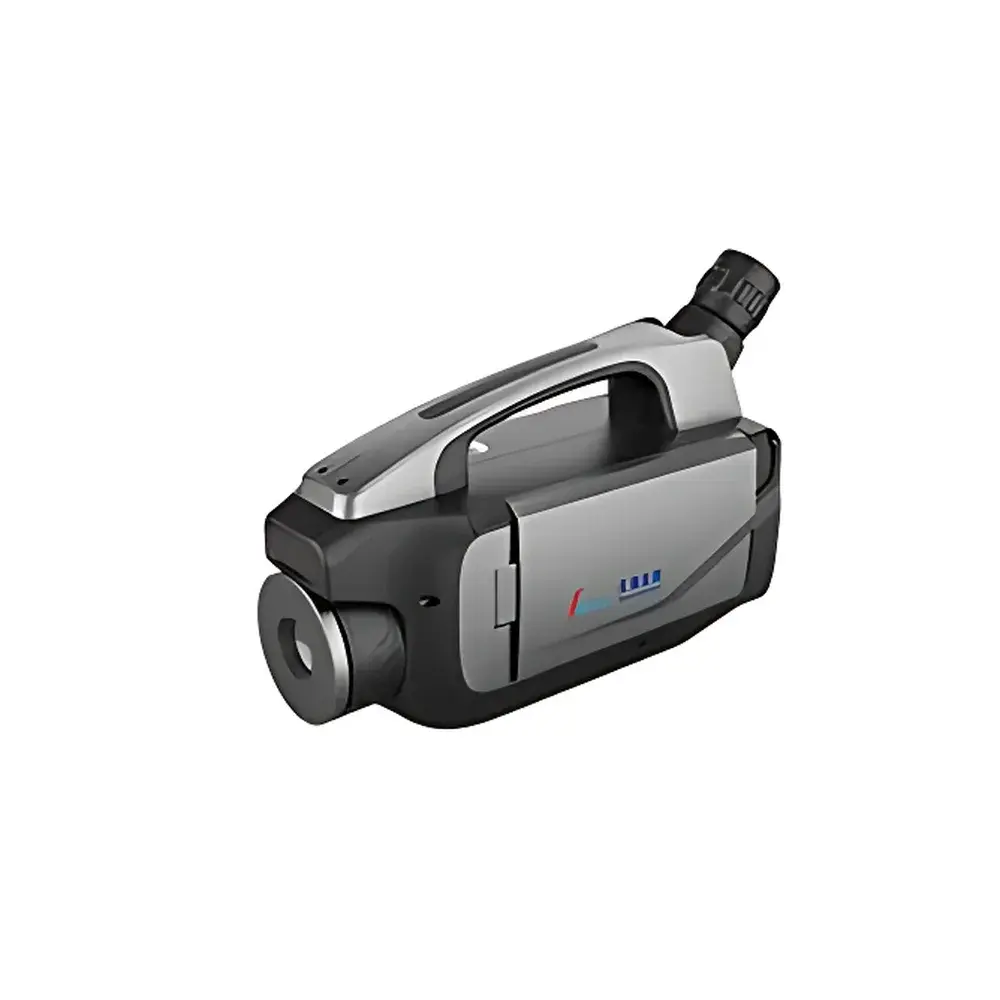
SkyRay VOC-9000 Portable VOC Leak Detection Infrared Imaging Camera
| Brand | SkyRay Instrument |
|---|---|
| Origin | Jiangsu, China |
| Manufacturer Type | OEM Manufacturer |
| Country of Origin | China |
| Model | VOC-9000 |
| Instrument Type | Portable |
| Detection Principle | Infrared Absorption Imaging (Mid-Wave IR, 3.2–3.5 µm spectral band optimized for hydrocarbon VOCs) |
| Target Analytes | Volatile Organic Compounds (VOCs), including but not limited to methane, propane, butane, benzene, toluene, xylene, and C2–C4 aliphatic/aromatic hydrocarbons |
| Detection Range | Quantitative leak rate from 0.001 mL/s to >100 mL/s (per ISO 21876:2022 Annex B reference methodology) |
| Thermal Sensitivity (NETD) | ≤0.01 °C @ 30 °C |
| Spatial Resolution | ≤1.3 mrad (with 24° lens) |
| Minimum Detectable Leak Rate | ≤0.001 mL/s (as verified per HJ 733–2014 protocol using calibrated methane/propylene challenge gas) |
| Response Time | <4 s (T90, per IEC 60079-29-1) |
| Operating Temperature Range | –20 °C to +50 °C |
| Enclosure Rating | IP54 |
| Explosion Protection | Ex ic nC op is IIC T4 Gb / Ex ic nC op is IIIC T130°C Db (IEC 60079-0, -11, -15, -31) |
| Weight | 2.5 kg (including battery and standard lens) |
| Data Storage | Internal SD card (up to 512 GB, FAT32 formatted), supporting synchronized thermal + visible image pairs and time-stamped video (.mp4, H.264) |
| Software Compatibility | SkyRay LDAR Pro v3.2 (Windows 10/11), supports ASTM D7039–23 compliant reporting, US EPA OOOOa audit-ready export, and GLP-compliant metadata logging (operator ID, GPS coordinates, timestamp, ambient conditions) |
Overview
The SkyRay VOC-9000 is a purpose-built portable infrared imaging camera engineered for optical gas imaging (OGI) of volatile organic compounds in industrial and environmental compliance applications. It operates on the principle of passive mid-wave infrared (MWIR) absorption spectroscopy—specifically tuned to the 3.2–3.5 µm spectral region where key hydrocarbon VOCs exhibit strong fundamental vibrational absorption bands. Unlike point-sensor detectors or flame ionization-based systems, the VOC-9000 enables non-contact, real-time visualization of gas plumes across distances up to 20 meters, transforming qualitative leak screening into spatially resolved, operator-guided quantification. Its core architecture integrates a cooled Type-II Strained Layer Superlattice (T2SL) focal plane array with high quantum efficiency in the MWIR band, delivering thermal sensitivity better than 0.01 °C (NETD) at ambient temperatures—critical for resolving low-contrast, low-mass-flow VOC emissions against complex thermal backgrounds. Designed explicitly for regulatory LDAR (Leak Detection and Repair) programs, the VOC-9000 meets the technical performance requirements defined in HJ 733–2014, GB 20950–2020, GB 20951–2020, and GB 20952–2020, and is validated for use in EPA Method 21–aligned surveys under 40 CFR Part 60 and Part 63.
Key Features
- Cooled Type-II SLS detector with spectral response optimized for hydrocarbon VOC absorption (3.2–3.5 µm), enabling high-contrast plume visualization under variable lighting and thermal conditions
- Dual-mode operation: simultaneous VOC gas imaging and calibrated infrared thermometry (±2 °C accuracy, 0.1 °C resolution) for correlated thermal anomaly assessment
- Verified minimum detectable leak rate of ≤0.001 mL/s for propane and methane, traceable to NIST-traceable calibration sources per HJ 733–2014 Section 5.2
- Integrated visible-light camera with automatic co-registration and pixel-level fusion for precise geolocation and report annotation
- Ruggedized handheld form factor (2.5 kg total mass), ergonomic grip, and hot-swappable lithium-ion battery supporting ≥3.5 hours continuous operation
- Intrinsically safe design certified to Ex ic nC op is IIC T4 Gb and IIIC T130°C Db per IEC 60079 series—approved for Zone 1/21 hazardous locations in petrochemical, refining, and storage facilities
- On-device data management: JPEG+thermal radiometric files and H.264 MP4 video stored directly to removable SD card with embedded EXIF metadata (GPS, UTC timestamp, operator ID, instrument serial)
Sample Compatibility & Compliance
The VOC-9000 is validated for detection of saturated and unsaturated aliphatic and aromatic VOCs commonly encountered in petroleum handling, chemical manufacturing, and solvent use—including but not limited to methane, ethane, propane, butane, isobutane, pentane, hexane, benzene, toluene, ethylbenzene, xylenes (BTEX), and methyl tert-butyl ether (MTBE). It does not detect non-hydrocarbon gases (e.g., CO, NOx, SO2) or highly polar VOCs lacking strong MWIR absorption (e.g., methanol, acetone). Regulatory alignment includes full compatibility with China’s national LDAR frameworks (HJ 733–2014, GB 20950/51/52–2020), as well as international best practices referenced in ISO 21876:2022 (leak detection using OGI) and ASTM D7039–23 (standard guide for optical gas imaging surveys). All firmware and software modules comply with data integrity requirements for regulated environments, including audit trail generation and electronic signature support per FDA 21 CFR Part 11 (when used with SkyRay LDAR Pro v3.2 in validated configuration).
Software & Data Management
SkyRay LDAR Pro v3.2 is the dedicated desktop application for post-processing, reporting, and fleet management. It imports radiometric .seq files and synchronizes them with GPS-tagged field annotations, ambient temperature/humidity logs, and wind speed inputs. The software implements automated plume quantification algorithms based on the “controlled release” method described in HJ 733–2014 Annex A and EPA OOOOa Appendix A. Reports are exportable in PDF and Excel formats compliant with provincial ecological environment bureaus’ submission templates. All data operations maintain full ALCOA+ principles: attributable, legible, contemporaneous, original, accurate, complete, consistent, enduring, and available. Audit trails record every user action—including file modification, threshold adjustment, and report finalization—with immutable timestamps and operator credentials.
Applications
- LDAR program execution across refineries, chemical plants, and bulk terminals—supporting quarterly monitoring cycles per GB 20950–2020 and EPA Subpart VV
- Emergency response for uncontrolled VOC releases during transportation incidents, tank overfills, or valve failures
- Regulatory enforcement inspections by provincial MEE offices, verifying compliance with fugitive emission limits
- Ongoing verification of vapor recovery system integrity at gasoline dispensing facilities and floating roof tanks
- Pre-commissioning and turnaround leak screening in upstream oil & gas infrastructure, including compressor stations and pipeline metering skids
FAQ
Does the VOC-9000 require gas-specific calibration for each compound?
No. It relies on broadband MWIR absorption common to most C–H bond-containing VOCs; no field recalibration is needed between compounds. Calibration is performed annually at SkyRay’s ISO/IEC 17025-accredited service center using certified reference gases.
Can it be used indoors or in low-light conditions?
Yes. As a passive imaging system, it requires no external illumination and performs equivalently in daylight, dusk, or enclosed spaces—provided ambient temperature gradients allow plume contrast development.
Is GPS geotagging mandatory for regulatory reporting?
Per HJ 733–2014 Section 6.3.2 and provincial implementation guidelines, GPS coordinates are required for all identified leaks in formal LDAR reports; the VOC-9000 embeds this data automatically in every image/video file.
What maintenance is required between inspections?
Routine lens cleaning with nitrogen-purged air and lint-free wipes is recommended. Annual detector calibration, dewar vacuum verification, and explosion-proof housing integrity checks are required for continued compliance with Ex certification.
Does it meet EPA OOOOa Method 21 alternative compliance criteria?
Yes. When operated per manufacturer instructions and documented using LDAR Pro v3.2, the VOC-9000 satisfies the “optical gas imaging” pathway defined in 40 CFR §60.5397a and §63.1001(b)(2) for detecting leaks ≥0.001 mL/s.







