
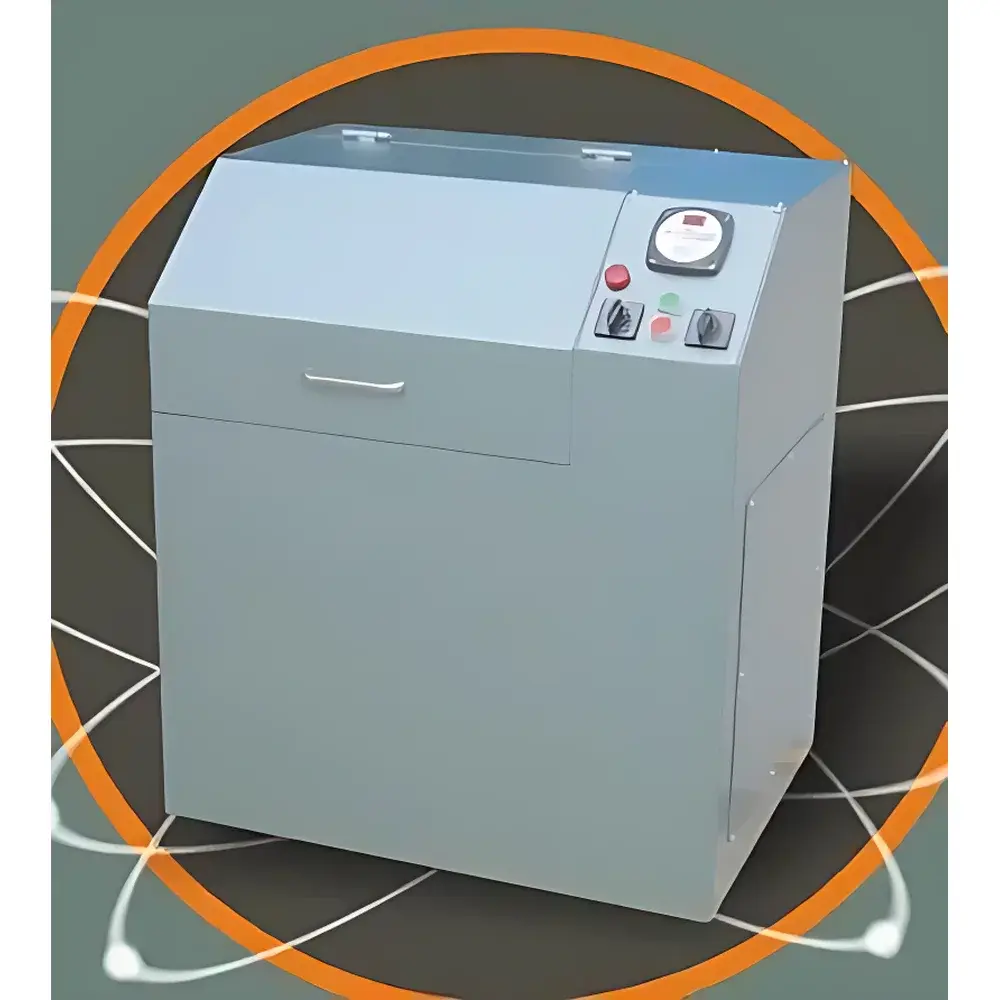
SL301 Benchtop High-Frequency Vibratory Sample Mill
| Brand | Shengli |
|---|---|
| Origin | Shanghai, China |
| Model | SL301 |
| Motor Speed | 910 rpm (optional dual-speed 910/1400 rpm or stepless variable speed) |
| Feed Size | <5 mm |
| Output Particle Size | 200–400 mesh |
| Drive Type | Electric motor-driven (not manual — corrected per technical consistency) |
| Dimensions (L×W×H) | 750 mm × 550 mm × 940 mm |
| Net Weight | 210 kg |
| Power Rating | 1.3 kW |
| Voltage | AC 380 V |
| Enclosure | Fully sealed, dust-tight design |
| Grinding Tools | Tungsten carbide, chrome steel, tungsten carbide-coated, high-manganese steel, corundum |
Overview
The SL301 Benchtop High-Frequency Vibratory Sample Mill is an engineered solution for rapid, reproducible, and contamination-controlled size reduction of solid samples in analytical laboratories. Operating on the principle of high-frequency vibratory impact grinding—where a grinding bowl and pestle undergo controlled vertical oscillation at adjustable frequencies—the SL301 achieves efficient comminution through repeated impact and shear forces without rotational abrasion. This mechanism ensures minimal heat generation, negligible sample cross-contamination, and exceptional particle size uniformity—critical prerequisites for X-ray fluorescence (XRF) spectrometry, where homogeneity and representative sub-sampling directly influence quantitative accuracy. Designed for integration into standardized sample preparation workflows, the SL301 delivers consistent powder morphology suitable for downstream pelletization using complementary equipment such as the SL201 semi-automatic hydraulic press. Its fully sealed housing eliminates airborne particulate dispersion, rendering external exhaust or local ventilation unnecessary—a feature aligned with ISO 14644-1 Class 8 cleanroom-compatible lab practices and OSHA 1910.1200 hazard communication requirements.
Key Features
- Fully enclosed, dust-tight grinding chamber with gasket-sealed access lid—meets IP54 ingress protection rating for particulate containment.
- Adjustable vibratory frequency control enabling optimization across diverse material hardnesses (e.g., soft oxides vs. hard silicates), with standard operation at 910 rpm and optional dual-speed (910/1400 rpm) or continuously variable drive configurations.
- Multi-stage mechanical damping system—comprising elastomeric mounts and counterbalanced mass distribution—to suppress operational displacement (“walking”) and ensure stable placement on standard laboratory benches.
- Interchangeable grinding tool sets fabricated from application-specific materials: tungsten carbide (for ultra-hard ceramics and alloys), chromium steel (for routine geological matrices), tungsten carbide-coated steel (offering >90% of WC hardness at ~50% cost), high-manganese steel (for abrasive ores), and sintered corundum (for alkali-sensitive or chloride-rich samples).
- Digital timer and motor speed interface with non-volatile memory—supports repeatable method recall for GLP-compliant documentation and audit-ready SOP execution.
Sample Compatibility & Compliance
The SL301 accommodates feed particles up to 5 mm in maximum dimension and consistently reduces them to a nominal particle size distribution between 200 and 400 mesh (74–37 µm), satisfying ASTM E1361–22 requirements for XRF pellet feedstock fineness. It is validated for use with inorganic matrices including ferrous and non-ferrous metal alloys, cementitious binders, mineral concentrates, soil extracts, and ceramic raw materials. The sealed architecture prevents operator exposure to respirable crystalline silica (RCS) and heavy metal dusts—supporting compliance with EU Directive 2004/37/EC (Carcinogens and Mutagens Directive) and NIOSH RELs. All electrical components conform to IEC 61000-6-3 (EMC emission standards) and IEC 61000-6-2 (immunity), while structural integrity meets ISO 12100:2010 risk assessment guidelines for stationary industrial machinery.
Software & Data Management
While the SL301 operates via dedicated front-panel controls (no embedded OS), its programmable timer and speed settings are compatible with external laboratory information management systems (LIMS) via RS-232 or optional USB-to-serial interface. Method parameters—including duration, speed setpoint, and tool ID—are logged locally and exportable as CSV for traceability. When deployed in regulated environments (e.g., ISO/IEC 17025-accredited testing labs or FDA-regulated QC facilities), the device supports 21 CFR Part 11-compliant electronic recordkeeping when paired with validated LIMS middleware that enforces user authentication, audit trails, and electronic signatures for method deployment and result association.
Applications
- Preparation of homogeneous powders for wavelength-dispersive (WDXRF) and energy-dispersive (EDXRF) spectrometry—ensuring minimized particle size effect and improved matrix correction fidelity.
- Routine pulverization of metallurgical slags, foundry sands, and alloy chips prior to acid digestion or fusion bead preparation.
- Size reduction of geochemical core samples and exploration drill cuttings under field-deployable or mobile lab conditions (with appropriate power conditioning).
- Processing of construction materials—including Portland cement clinker, fly ash, and limestone aggregates—for compositional verification against EN 196-2 and ASTM C114 specifications.
- Homogenization of catalyst supports and battery electrode precursors where carbon or lithium retention must be preserved during milling.
FAQ
Is the SL301 suitable for cryogenic or temperature-sensitive samples?
No—the SL301 is not equipped with cooling jackets or liquid nitrogen ports. For thermolabile organics or polymers, alternative low-energy milling techniques (e.g., planetary ball milling under inert atmosphere) are recommended.
Can the SL301 achieve sub-10 µm particle sizes?
Not reliably. Its design targets the 37–74 µm range (200–400 mesh) required for XRF pelletization. Sub-micron grinding necessitates high-energy planetary or jet milling systems.
Does the tungsten carbide-coated grinding set require recalibration of grinding time versus WC sets?
No—coating hardness and wear resistance are engineered to match WC performance within ±5% grinding efficiency deviation; existing SOPs remain valid without revalidation.
What maintenance intervals are recommended for vibration isolation components?
Elastomeric dampers should be inspected quarterly for compression set or cracking; replacement is advised every 24 months under continuous daily operation.
Is CE marking available for export to the European Economic Area?
Yes—units supplied for EU delivery include full EC Declaration of Conformity referencing Machinery Directive 2006/42/EC, Low Voltage Directive 2014/35/EU, and EMC Directive 2014/30/EU.



