
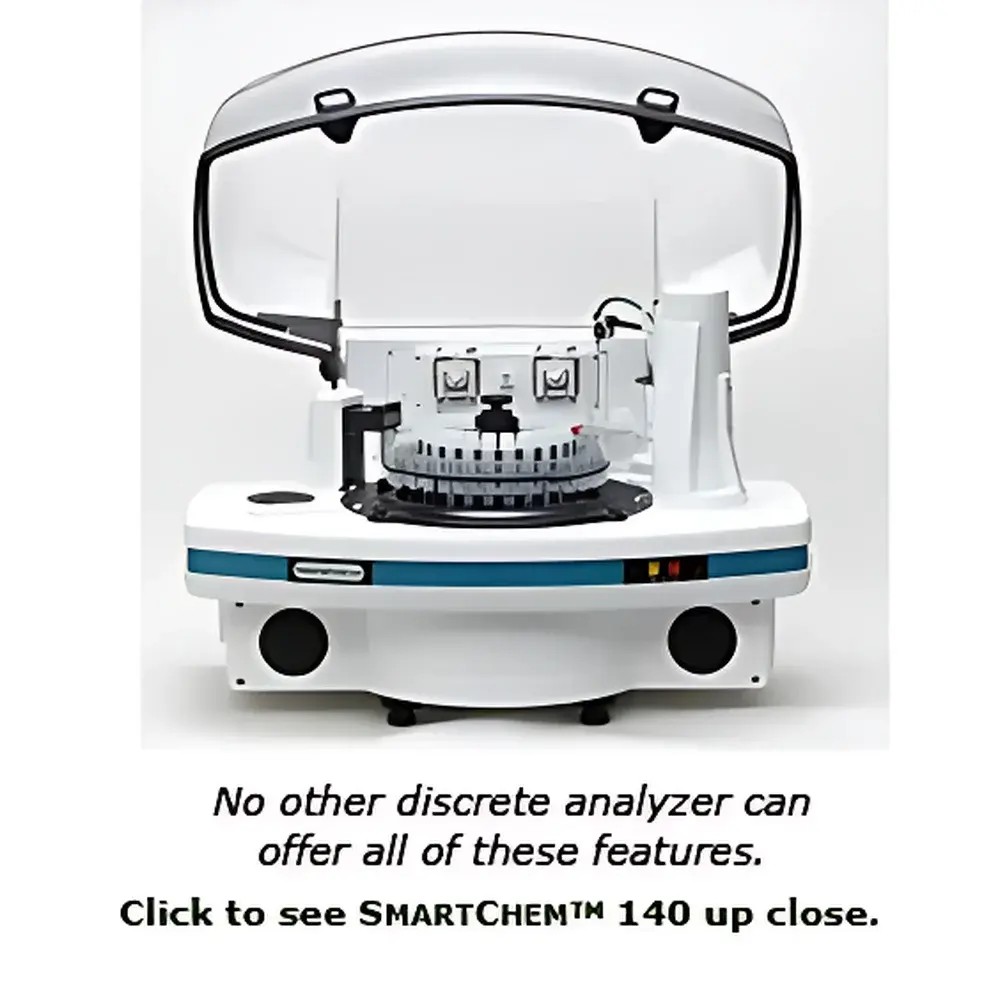
Smartchem 140 Automated Discrete Analyzer
| Origin | France |
|---|---|
| Manufacturer Type | Authorized Distributor |
| Origin Category | Imported |
| Model | SMARTCHEM 140 |
| Pricing | Available Upon Request |
Overview
The Smartchem 140 is a second-generation automated discrete analyzer engineered for high-precision, high-throughput wet-chemistry analysis in regulated and research laboratory environments. Unlike continuous-flow or segmented-flow systems, the Smartchem 140 employs true discrete analysis methodology: each sample and reagent combination reacts in an individual optical-grade cuvette, with absorbance measured directly in situ using a dual-beam photometer. This eliminates flow-cell carryover, minimizes cross-contamination risk, and ensures analytical integrity across heterogeneous sample matrices—including turbid, particulate-laden, or highly colored environmental, agricultural, food & beverage, and industrial samples. The system complies with foundational principles of ASTM D5179 (water quality), ISO 15586 (nutrient analysis), and EPA-approved methods referenced in the instrument’s validated application library—enabling traceable, auditable results suitable for regulatory reporting under GLP and GMP frameworks.
Key Features
- Direct-in-Cuvette Photometry: Absorbance is measured within the reaction cuvette without transfer to a flow cell—eliminating delay, dispersion, and dilution artifacts inherent in flow-based systems.
- Intelligent Cuvette Quality Assurance (CQA): Each of the 120 optical-grade cuvettes undergoes pre-use optical transmittance verification to ensure consistent pathlength and baseline integrity.
- Adaptive Blank Management: User-selectable blanking—pre-, mid-, or post-reaction—performed without interrupting batch processing or altering method sequencing.
- Smart Wash Protocol: Integrated needle-wash station activates automatically after every aspiration step, utilizing programmable rinse cycles with air-dry validation to prevent carryover between samples and reagents.
- Full Automation Suite: Includes on-board standard preparation, dynamic range extension via automatic serial dilution (up to 1:100), low-volume alerts for both samples and reagents, and auto-mode scheduling for unattended overnight operation.
- Thermostatically Controlled Reaction Environment: Precise temperature regulation (30–45 °C) maintained across all reaction zones to ensure kinetic consistency and method reproducibility per ISO 8655-7 and USP <1058> guidelines.
Sample Compatibility & Compliance
The Smartchem 140 supports diverse liquid-phase matrices including wastewater, soil extracts, plant digests, feed homogenates, wine musts, and tobacco leachates. Its open-method architecture accommodates any colorimetric or enzymatic assay requiring up to 9 wavelength-specific detection points (420, 480, 510, 520, 550, 570, 630, 660, and 880 nm), enabling implementation of over 50 EPA, APHA, SM, and ISO reference methods—including but not limited to EPA 310.2 (acidity), EPA 350.1 (ammonia), EPA 410.4 (COD), EPA 365.2 (total phosphorus), and ISO 11908 (nitrate/nitrite). All operational logs, calibration records, and audit trails are timestamped and exportable in CSV or PDF format, supporting compliance with FDA 21 CFR Part 11 requirements when paired with validated LIMS integration.
Software & Data Management
Controlled via ChemSoft v5.x software, the Smartchem 140 provides role-based user access, method versioning, electronic signature support, and full audit trail logging—including parameter changes, reagent lot tracking, and instrument error events. Data output conforms to ASTM E1384 and ISO/IEC 17025 metadata standards, with native export compatibility for LabWare LIMS, Thermo Fisher SampleManager, and Waters Empower platforms. Raw absorbance values (0.0005–3.500 AUFS), calculated concentrations, QC flagging (e.g., drift, saturation, outlier rejection), and calibration curve statistics are stored with SHA-256 hash integrity verification.
Applications
- Environmental monitoring: Nitrate, nitrite, phosphate, sulfate, cyanide, fluoride, and heavy metals (Cr, Fe, Mn) in surface water, groundwater, and effluent.
- Agricultural testing: Total Kjeldahl nitrogen (TKN), total Kjeldahl phosphorus (TKP), calcium, magnesium, and boron in fertilizers and soil extracts.
- Food & beverage QA/QC: Phenol index in wine, silicate in soft drinks, chloride in dairy products, and COD in brewery wastewater.
- Tobacco & feed analysis: Alkalinity, ammonia, and nicotine-related nitrogen species in leaf extracts and animal feed formulations.
FAQ
What distinguishes discrete analysis from flow injection or segmented flow techniques?
Discrete analysis isolates each reaction in a dedicated cuvette, eliminating inter-sample dispersion and tubing memory effects—critical for complex, variable-matrix samples.
Does the Smartchem 140 support method validation per ISO/IEC 17025?
Yes—its traceable calibration routines, CQA-driven cuvette verification, and full electronic audit trail meet core technical requirements for accredited testing laboratories.
Can the system handle viscous or suspended samples?
It accepts samples up to 100 cP viscosity and tolerates particulates <50 µm when filtered inline; optional ultrasonic probe integration is available for homogenization pre-aspiration.
Is remote monitoring and diagnostics supported?
ChemSoft includes secure HTTPS-based remote access with real-time status dashboards, predictive maintenance alerts, and firmware update capability via encrypted channel.
What is the minimum sample volume required per test?
As low as 20 µL for high-sensitivity assays; typical protocols use 100–300 µL, with auto-dilution compensating for volume constraints.







