
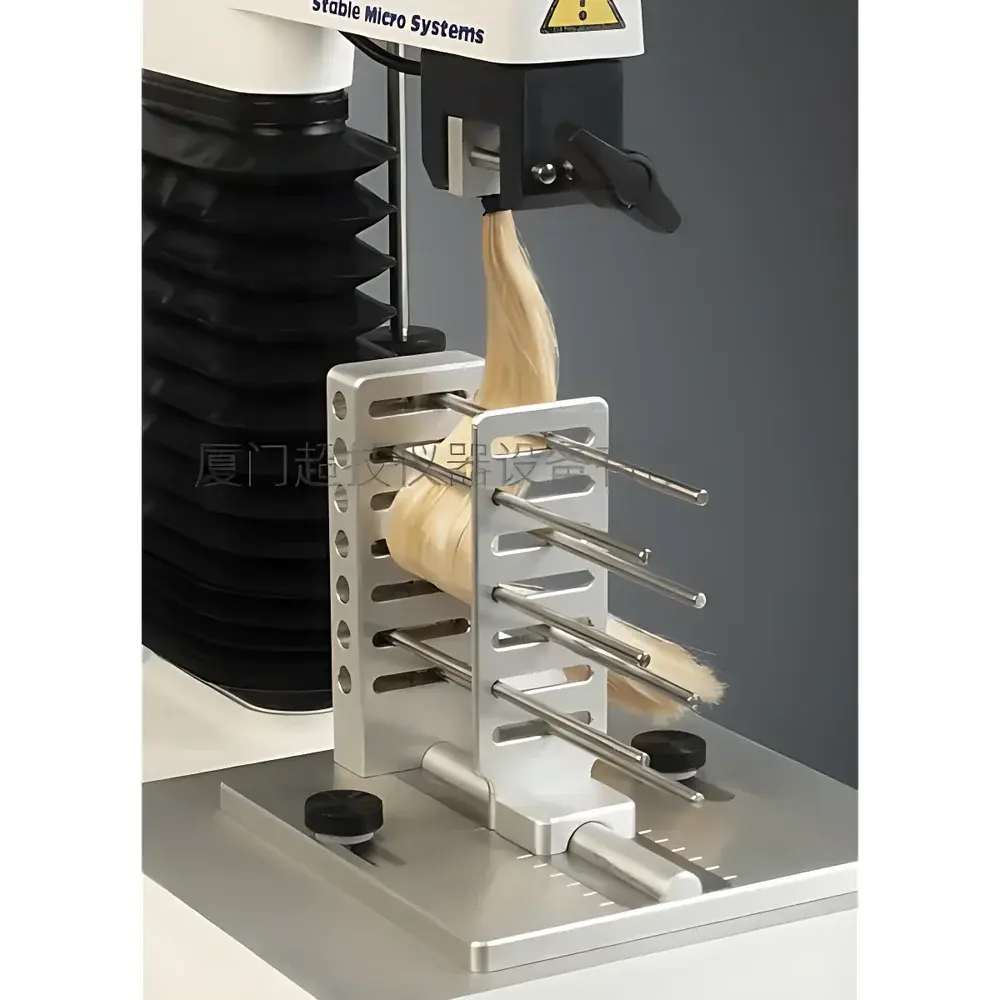
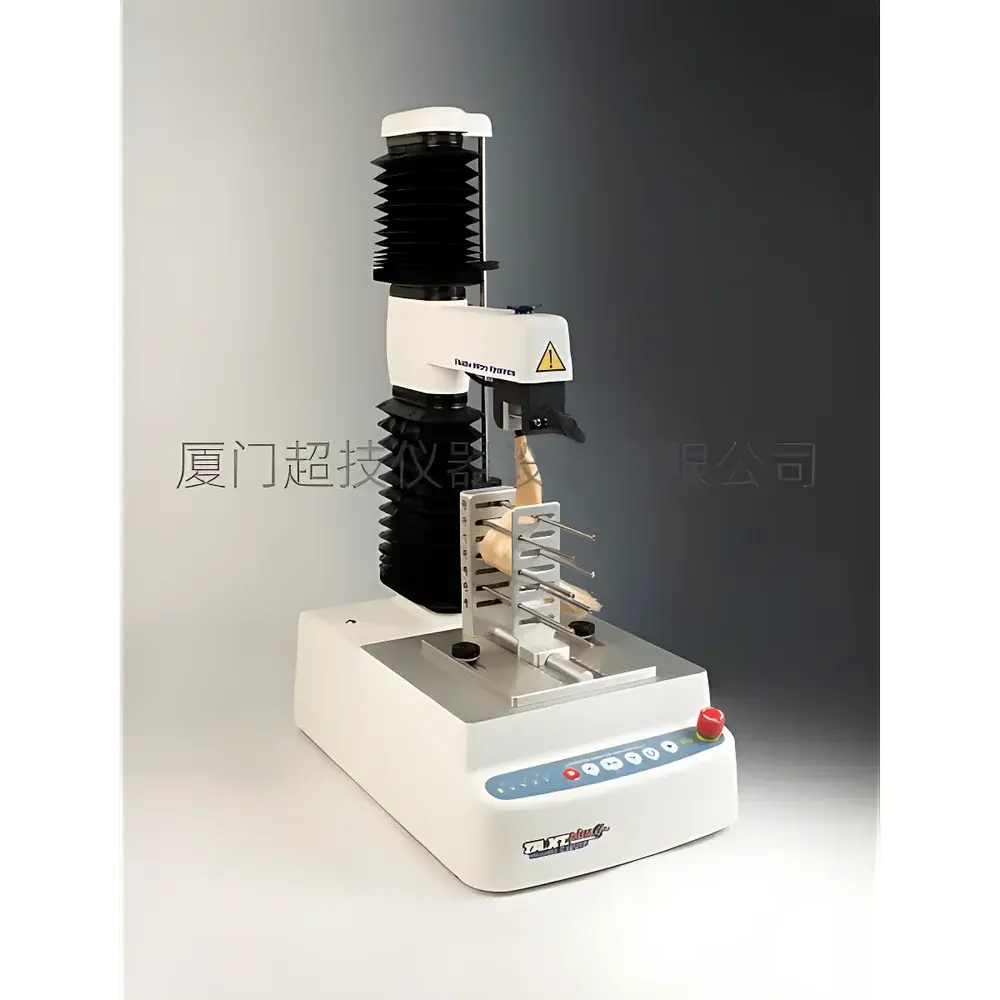
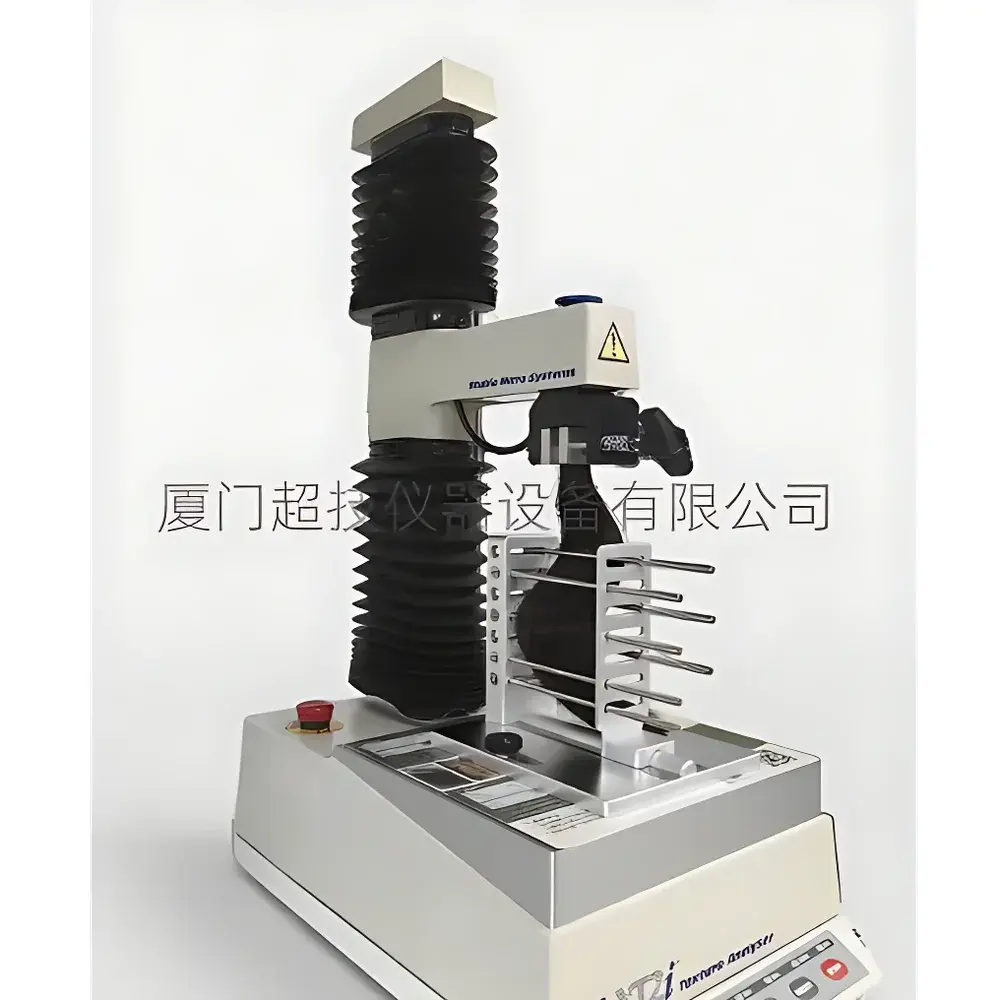
SMS TA.XTplus Hair Smoothness Tester (A/HSR)
| Brand | SMS |
|---|---|
| Origin | United Kingdom |
| Manufacturer Type | Authorized Distributor |
| Origin Category | Imported Instrument |
| Model | A/HSR Hair Smoothness Tester |
| Price | Upon Request |
| Movement Speed Range | 0.01–40 mm/s |
| Force Calibration | Software-automated with traceable external weights |
| Test Distance Range | 0.001–370 mm |
| Measurable Parameters | Force, Time, Distance, Stress, Strain, Temperature, Relative Humidity |
| Test Modes | Standard Compression/Tension, SIN Variable-Speed Testing, Relaxation, Creep, Rheological Profiling, Powder Flow, Adhesion, Tensile Strength |
| Force Capacity Options | ±0.5 kg, ±5 kg, ±30 kg, ±50 kg |
| Probe Library | >400 application-specific probes |
| Software Interface | English & Chinese |
| PC Connectivity | RS232 or USB |
| Operating Temperature | 0–40 °C |
| Dimensions (H×W×D) | 650 × 280 × 540 mm |
| Weight | 14.9 kg |
| Power Supply | 220 V, 50 Hz |
Overview
The SMS TA.XTplus Hair Smoothness Tester (A/HSR) is a purpose-engineered physical property testing system designed to quantitatively assess the tactile and mechanical behavior of hair under controlled biomechanical simulation. Unlike subjective sensory evaluation or indirect optical methods, this instrument replicates the kinematics of finger combing through a standardized, reproducible mechanical process—employing a precision-guided smooth-bar winding frame that subjects hair tresses to controlled linear displacement. During traversal, the system captures real-time force–distance–time profiles, enabling decomposition of composite resistance into three physically distinct components: individual fiber bending stiffness (governed by cortical keratin structure), inter-fiber friction (modulated by surface lipid layer integrity and cuticle alignment), and fiber–fixture interface friction (influenced by surface hydrophobicity and coating uniformity). The measurement principle is grounded in quasi-static tensile-compressive mechanics under low-strain-rate conditions (0.01–40 mm/s), ensuring compliance with fundamental rheological assumptions for viscoelastic biological fibers.
Key Features
- Modular force transducer architecture supporting four calibrated ranges (±0.5 kg to ±50 kg) for high-resolution detection across fine-textured treatments and heavily coated samples.
- Automated force calibration routine compliant with ISO/IEC 17025 traceability requirements—executed via software-controlled application of NIST-traceable reference weights.
- Environmental monitoring integration: simultaneous logging of ambient temperature and relative humidity during test execution to support ASTM E145 and ISO 291 conditioning protocol adherence.
- TA.XTplus proprietary firmware enables synchronized multi-parameter acquisition—including stress, strain, relaxation modulus, and energy dissipation—without external DAQ hardware.
- Robust mechanical frame constructed from anodized aluminum and stainless steel, engineered for long-term dimensional stability under repeated loading cycles (>10⁶ actuations per probe).
- Comprehensive probe library (>400 configurations), including A/HSR-specific combing racks, tapered tension grips, and segmented torsion fixtures for cross-sectional torque analysis.
Sample Compatibility & Compliance
The A/HSR system accommodates human hair tresses (10–50 strands, 10–20 cm length), synthetic fiber bundles, and treated wool standards. All test protocols align with internationally recognized method frameworks: ASTM D7232 (hair combing resistance), AACC 25-40 (tensile deformation of proteinaceous fibers), AOAC 992.15 (conditioner efficacy), and ISO 17276-2 (instrumental assessment of hair manageability). Data output formats comply with FDA 21 CFR Part 11 requirements for electronic records and signatures when used with validated TA.XTplus software v4.1+ and audit-trail enabled configuration. The system supports GLP/GMP-aligned workflows through user-defined role permissions, electronic signature capture, and immutable raw-data archiving.
Software & Data Management
TA.XTplus software (v4.2) provides dual-language GUI (English/Chinese), ISO 13485-certified validation documentation, and export-ready outputs in CSV, XML, and PDF/A-1b formats. Built-in statistical modules compute inter-sample coefficient of variation (CV%), hysteresis area ratios, and time-to-peak-force metrics. Raw force–displacement curves are stored with metadata tags including operator ID, environmental logs, probe serial number, and calibration certificate expiry dates. Network deployment options include secure LAN-based data synchronization with LIMS integration via HL7 or RESTful API endpoints.
Applications
- Quantitative evaluation of cationic polymer deposition efficiency in rinse-off conditioners.
- Comparative assessment of silicone vs. plant-derived emollient film persistence after multiple shampoo cycles.
- Correlation of instrumental smoothness metrics with trained sensory panel scores (e.g., ISO 11137-2).
- Stability testing of oxidative hair dyes under accelerated aging (40 °C / 75% RH for 90 days).
- Formulation screening for anti-frizz actives targeting cuticle sealing kinetics.
- Regulatory dossier preparation for EU Cosmetics Regulation (EC No. 1223/2009) Annex III substantiation.
FAQ
What hair sample preparation protocols are recommended prior to A/HSR testing?
Standardized washing (ISO 21948), air-drying at 23 ± 2 °C / 50 ± 5% RH for 48 h, and conditioning in a desiccator with saturated NaBr solution (58% RH) for 24 h prior to testing.
Can the A/HSR system be integrated into automated high-throughput screening lines?
Yes—via optional I/O expansion module supporting TTL-triggered start/stop, pneumatic sample loading, and barcode-linked batch identification.
Is third-party verification of force transducer accuracy required annually?
Per ISO/IEC 17025, annual verification using accredited calibration laboratories is mandatory; SMS provides certified calibration kits and on-site technician support.
Does TA.XTplus software support statistical process control (SPC) charting?
Yes—X̄/R and I/MR charts with control limit calculation, out-of-trend alerts, and capability indices (Cp, Cpk) are embedded in the Advanced Analytics Pack.
How does the A/HSR method differentiate between temporary smoothing and structural modification?
By analyzing hysteresis loop asymmetry and recovery ratio in sequential cyclic tests—temporary effects show near-complete force recovery; permanent modifications exhibit irreversible energy loss and baseline drift.
Related Products



