
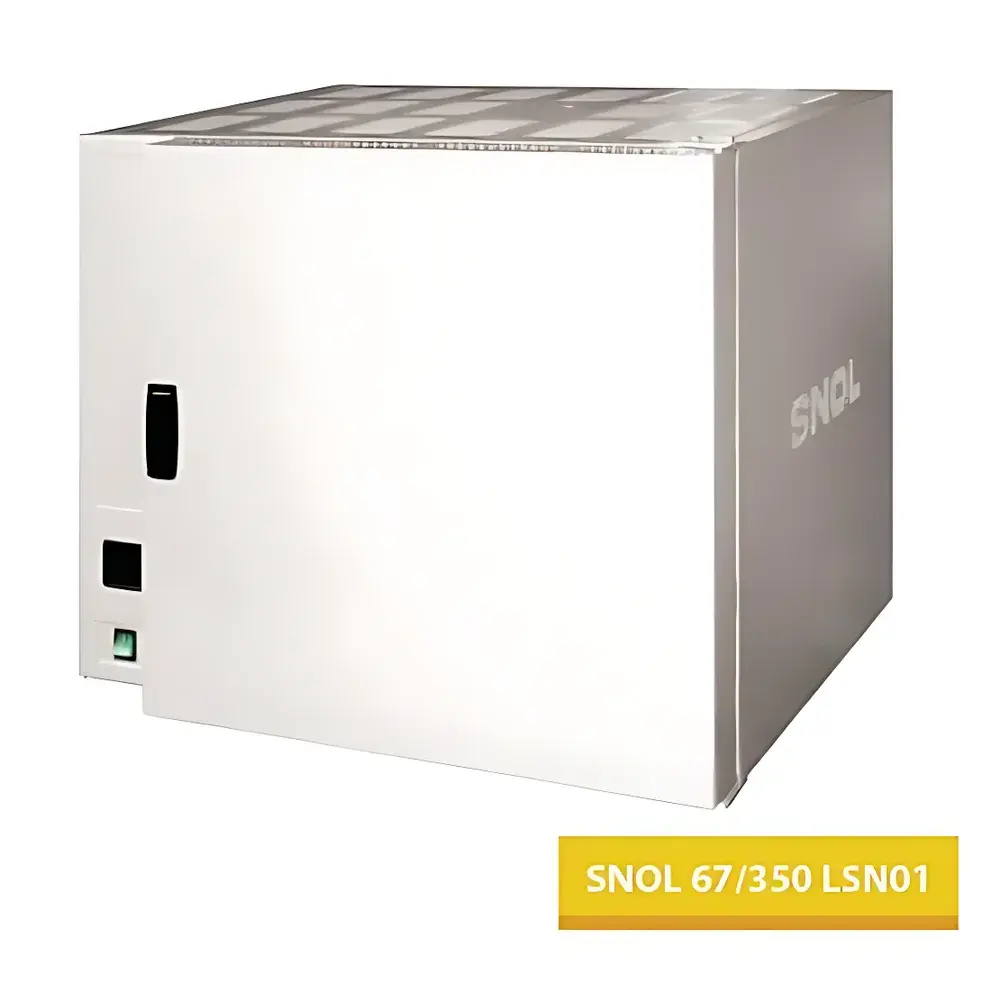
SNOL SNOL 350 Series Benchtop Forced-Air Drying Oven (350 °C)
| Origin | Imported |
|---|---|
| Manufacturer Type | Authorized Distributor |
| Model | SNOL 350 Series |
| Temperature Range | 20–350 °C |
| Temperature Uniformity | ±0.5 °C |
| External Dimensions | 685 × 625 × 615 mm |
| Internal Chamber Dimensions | 390 × 445 × 390 mm |
| Chamber Volume | 67 L |
| Power Consumption | 2.2 kW |
| Construction | Stainless Steel or Mild Steel Interior |
| Air Circulation | Forced-air (optional natural convection) |
| Control System | Microprocessor-based PID temperature controller with digital display |
| Safety Features | Independent over-temperature protection, audible alarm, door seal integrity monitoring |
| Compliance | Designed to meet general laboratory safety and thermal stability requirements per IEC 61010-1 and EN 60529 (IP20) |
Overview
The SNOL 350 Series is a precision-engineered benchtop forced-air drying oven designed for reliable thermal processing in research laboratories, quality control environments, educational institutions, pharmaceutical manufacturing, and industrial R&D settings. Operating within a calibrated temperature range of 20 °C to 350 °C, the unit employs a robust axial fan-driven air circulation system to ensure uniform heat distribution across the entire chamber volume—critical for consistent drying, curing, annealing, moisture removal, and pre-conditioning of samples. Its thermally insulated chamber, constructed from high-density eco-friendly refractory material and clad in either stainless steel (grade AISI 304) or electrogalvanized mild steel, minimizes thermal loss and supports rapid heating and cooling cycles. The microprocessor-based PID controller delivers stable setpoint maintenance with ±0.5 °C temperature fluctuation under steady-state conditions—validated per ASTM E2203 for laboratory oven performance verification.
Key Features
- Forced-air convection system with adjustable airflow velocity for enhanced thermal homogeneity and reduced processing time
- Digital microprocessor PID controller with real-time temperature display, programmable ramp/soak profiles, and password-protected parameter settings
- Independent mechanical over-temperature cut-off (OTC) circuit with visual and audible alarm activation
- High-integrity double-lip silicone door gasket ensuring chamber sealing and minimizing ambient air infiltration
- Standard configuration includes three adjustable stainless steel wire shelves; optional reinforced shelves, solid metal trays, and extended-duty floor plates available
- Exterior finish: RAL 7035 light gray powder coating for corrosion resistance and cleanroom-compatible surface durability
- RS-232 and RS-485 serial interfaces as standard; USB interface optional for direct connection to data acquisition systems or LIMS
- Factory-installed temperature calibration certificate traceable to NIST standards; optional on-site recalibration service available
Sample Compatibility & Compliance
The SNOL 350 Series accommodates a broad spectrum of sample types—including polymer pellets, ceramic green bodies, metal components, filter papers, biological substrates, pharmaceutical excipients, and electronic assemblies—without risk of cross-contamination or oxidative degradation at elevated temperatures. Chamber interior materials are selected per application: stainless steel variants comply with ISO 14644-1 Class 5 cleanroom compatibility when operated under controlled humidity conditions; mild steel interiors are suitable for non-corrosive industrial thermal treatments. The oven conforms to IEC 61010-1:2010 for electrical safety in laboratory equipment and meets structural requirements of EN 60529 (IP20) for ingress protection. While not intrinsically rated for hazardous locations, it may be integrated into GLP/GMP workflows where documented validation (IQ/OQ/PQ) and audit-ready calibration records are maintained.
Software & Data Management
The integrated controller supports time-stamped logging of temperature setpoints, actual chamber readings, and alarm events—stored internally for up to 30 days. Optional data logger modules provide continuous recording at user-defined intervals (1 s to 60 min), exportable via CSV format through RS-232/USB. When connected to laboratory network infrastructure, the oven can feed real-time telemetry into centralized SCADA or MES platforms using Modbus RTU protocol. All firmware updates and configuration backups are performed via secure USB transfer. Audit trail functionality—including operator ID tagging, parameter change logs, and calibration history—is available upon activation of the FDA 21 CFR Part 11-compliant software module (sold separately).
Applications
- Moisture content determination per AOAC 950.46 and ASTM D2298 for polymers and composites
- Pre-drying of analytical crucibles, glassware, and filtration media prior to gravimetric analysis
- Thermal aging studies of elastomers and adhesives under ISO 188 and ASTM D573 protocols
- Curing of powder coatings and epoxy resins in materials science labs
- Stabilization of reference standards and calibration artifacts in metrology laboratories
- Residual solvent removal from coated pharmaceutical tablets per USP
- Heat treatment of small-volume metal samples for metallurgical phase analysis
FAQ
What is the maximum recommended continuous operating temperature?
The SNOL 350 Series is rated for continuous operation up to 350 °C; prolonged exposure above this threshold may compromise sensor accuracy and insulation integrity.
Can the oven be validated for GMP compliance?
Yes—full IQ/OQ/PQ documentation packages, including installation checklists, operational test scripts, and performance qualification reports against ASTM E2203, are available upon request.
Is door-opening compensation enabled in the control algorithm?
The PID controller incorporates adaptive recovery logic that dynamically adjusts heater output following door opening to minimize temperature deviation and accelerate return-to-setpoint.
Are external temperature probes supported?
Optional PT100 probe inputs allow simultaneous monitoring of internal chamber air and sample surface temperature, with dual-display capability on the front panel.
What maintenance is required to sustain ±0.5 °C stability?
Annual verification of sensor calibration and fan motor performance is recommended; filter cleaning every 3 months ensures optimal airflow and thermal uniformity.



