
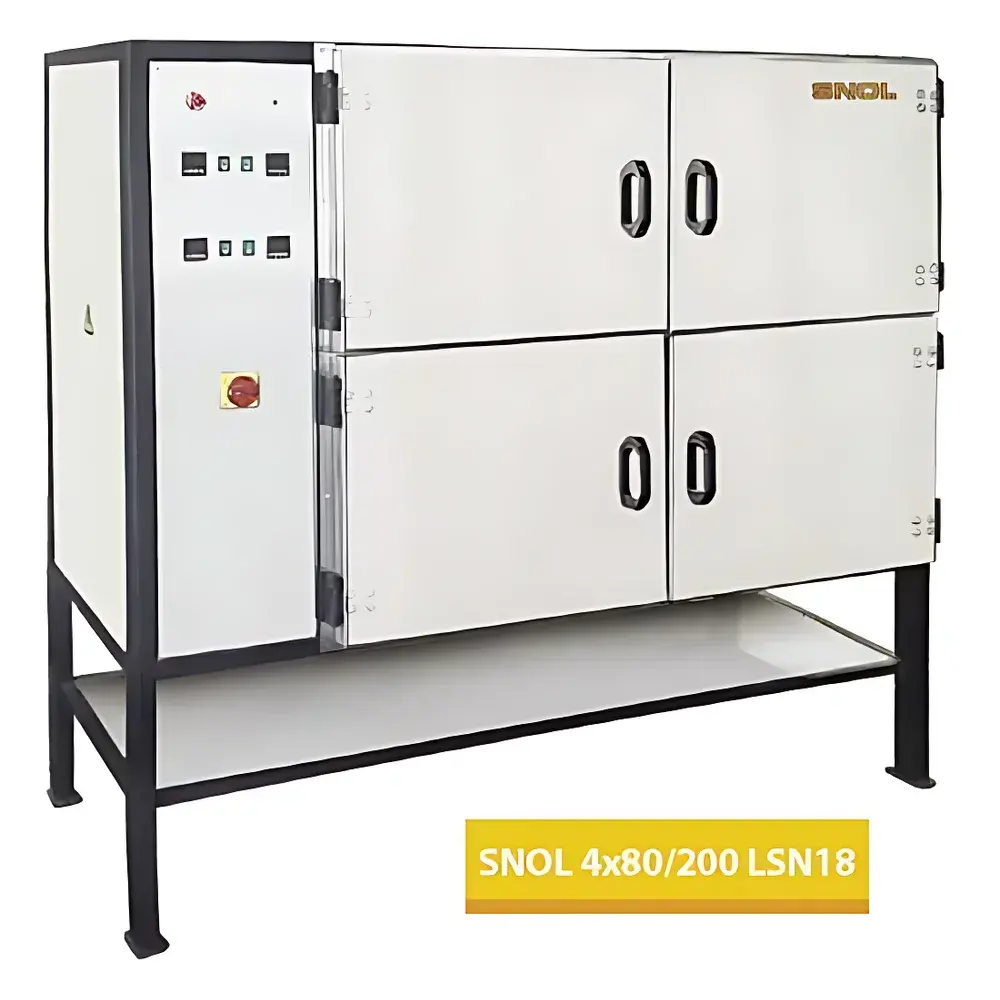
SNOL SNOL2*240/200LSN Multi-Chamber Electric Drying Oven
| Origin | Imported |
|---|---|
| Manufacturer Type | Authorized Distributor |
| Instrument Type | General-Purpose Forced-Air Drying Oven |
| Model | SNOL N*200 |
| Temperature Range | 20–200 °C |
| Temperature Uniformity | ±5 °C |
| External Dimensions | 1500 × 960 × 1715 mm |
| Internal Chamber Dimensions | 500 × 400 × 1200 mm |
| Chamber Configuration | Dual independent stainless steel chambers (2 × 240 L) |
| Power Consumption | 24 kW |
| Net Weight | 450 kg |
| Air Circulation | Horizontal forced convection with adjustable fan speed control |
| Heating System | Embedded resistive elements with PID-controlled microprocessor regulator |
| Construction | Exterior powder-coated steel (RAL 7035), interior 304 stainless steel chambers, high-efficiency ceramic fiber insulation |
| Compliance | Designed to meet general laboratory safety and thermal stability requirements per IEC 61010-1 |
Overview
The SNOL SNOL2*240/200LSN Multi-Chamber Electric Drying Oven is an engineered solution for laboratories and industrial quality control environments requiring simultaneous, independent thermal processing of multiple sample batches under controlled ambient conditions. Operating on the principle of horizontal forced-air convection, the unit maintains stable temperature distribution across two fully isolated 240-liter stainless steel chambers—each equipped with dedicated heating circuits, airflow management systems, and digital thermal regulation. Unlike single-chamber ovens, this dual-cavity architecture eliminates cross-contamination risk and enables parallel processing of dissimilar materials at identical or differential setpoints (within 20–200 °C range), supporting reproducible drying, preheating, conditioning, and low-temperature thermal stabilization protocols. Its robust thermal insulation—comprising high-density ceramic fiber lining—and precision microprocessor-based PID controller ensure minimal energy loss and rapid thermal response, making it suitable for routine use in ISO/IEC 17025-accredited labs, pharmaceutical QC suites, academic research facilities, and electronics manufacturing support labs.
Key Features
- Dual independent stainless steel chambers (304 grade), each 500 × 400 × 1200 mm (W × D × H), offering total internal volume of 480 L
- Horizontal forced-air circulation system with variable-speed fans and optimized venting layout for ±5 °C temperature uniformity across entire chamber volume
- Microprocessor-based temperature controller with real-time display, programmable ramp/soak profiles, and manual override capability
- High-efficiency thermal insulation using low-conductivity ceramic fiber—reducing standby heat loss and enabling faster cooldown cycles
- Exterior housing finished in RAL 7035 light gray epoxy powder coating for corrosion resistance and cleanroom-compatible surface integrity
- Integrated overtemperature protection circuitry compliant with IEC 60519-2 safety standards, plus audible/visual alarm activation on thermal deviation
- Standard equipment includes four adjustable stainless steel shelves per chamber, reinforced floor plate, and door-mounted viewing window with heat-resistant glass
Sample Compatibility & Compliance
The SNOL2*240/200LSN accommodates a broad spectrum of non-volatile, non-explosive samples—including polymer films, metal components, ceramic substrates, filter media, pharmaceutical excipients, and analytical reference standards—without degradation or unintended volatilization below 200 °C. Chamber geometry supports both flat-panel and stacked-container configurations up to 440 mm height clearance. All wetted surfaces are electropolished 304 stainless steel, facilitating cleaning validation and residue-free operation in GMP-aligned environments. While not certified to UL or CSA as a standalone appliance, the oven’s electrical architecture adheres to IEC 61010-1 Edition 3 for laboratory equipment safety. Optional factory calibration documentation (traceable to NIST or PTB standards) and 21 CFR Part 11–compatible data logging modules (via RS-485 or USB) support audit-ready process validation in regulated sectors.
Software & Data Management
The oven operates via embedded firmware with local interface only; however, optional connectivity modules enable integration into centralized lab monitoring networks. The RS-485 serial interface supports Modbus RTU protocol for bidirectional communication with SCADA or LIMS platforms, permitting remote setpoint adjustment, real-time temperature streaming, and event-triggered data capture. An external USB port permits direct export of time-stamped temperature logs (CSV format) for post-run analysis. When paired with the optional digital data logger, users gain access to configurable sampling intervals (1–60 s), automatic alarm logging, and electronic signature-enabled report generation—fully aligned with ALCOA+ data integrity principles. Firmware updates are performed offline via USB stick, ensuring operational continuity during routine maintenance cycles.
Applications
- Moisture content determination per ASTM D2298 and ISO 1183-2 in polymer and composite material testing
- Bulk drying of glassware, ceramic crucibles, and filtration apparatus prior to gravimetric analysis
- Pre-conditioning of test specimens for tensile, impact, or dimensional stability assessments (e.g., ISO 291, ASTM D618)
- Stabilization of calibration standards and reference materials in metrology laboratories
- Low-temperature curing of adhesives, coatings, and encapsulants in electronics assembly QA
- Residual solvent removal from coated pharmaceutical tablets prior to dissolution testing (USP <701>)
FAQ
Is the oven supplied with calibration certificates?
Standard delivery includes a factory-assembled unit with basic operational verification. Traceable temperature calibration reports (per ISO/IEC 17025) are available as a paid option, including as-found/as-left data and uncertainty budgets.
Can both chambers operate at different temperatures simultaneously?
Yes—the dual-chamber design features independent heating zones, controllers, and airflow systems, allowing asynchronous operation within the full 20–200 °C range.
What maintenance is required for long-term reliability?
Routine inspection of door gaskets, fan motor lubrication (every 12 months), and periodic verification of thermocouple drift using a calibrated reference probe are recommended. No consumables are required beyond standard shelf liners or replacement fuses.
Does the oven meet fire safety requirements for installation in shared lab spaces?
It complies with IEC 61010-1 Clause 10.3 for fire hazard prevention, including thermal cut-off redundancy and flame-retardant insulation. Local building codes may require additional ventilation or fire suppression integration depending on room classification.
Are software upgrades provided free of charge after purchase?
Firmware updates released within 24 months of delivery are provided at no cost. Extended support contracts include priority update deployment and technical advisory services.



