
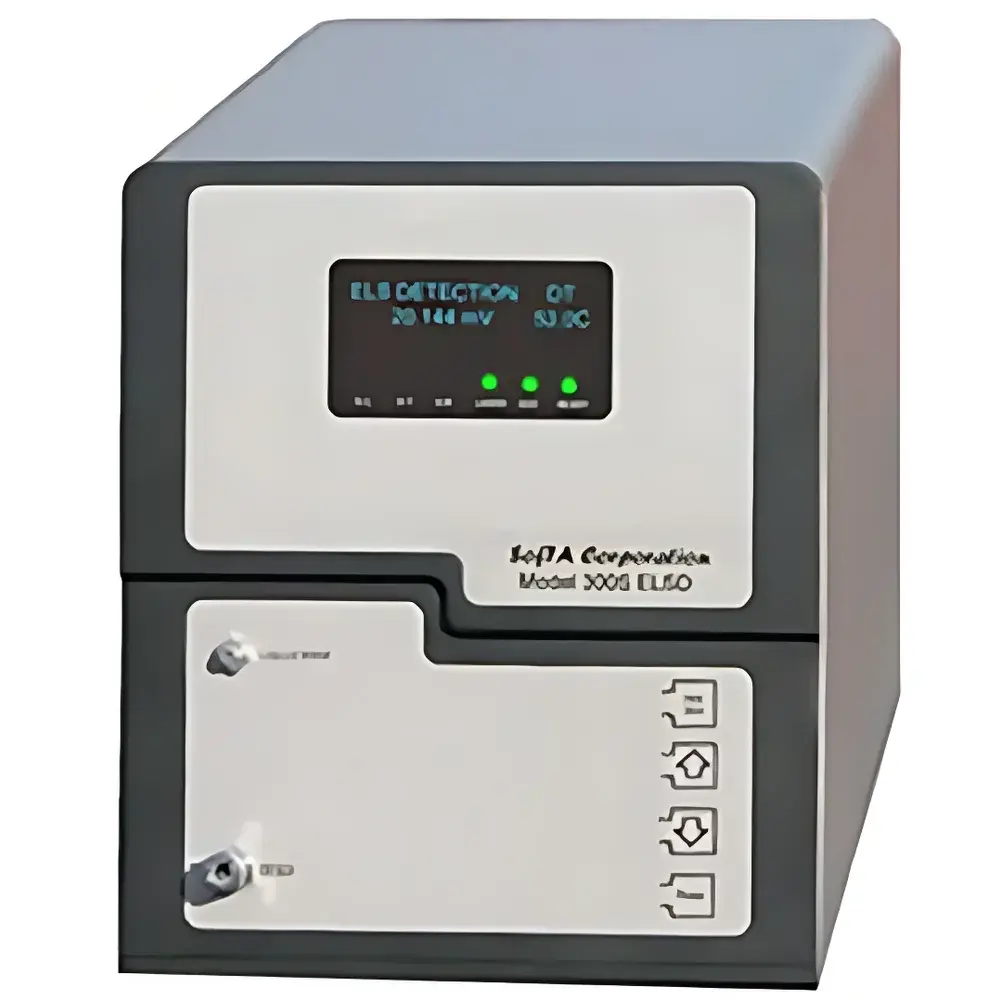
SofTA M300s ELSD Evaporative Light Scattering Detector
| Brand | SofTA |
|---|---|
| Model | M300s ELSD |
| Detector Type | Evaporative Light Scattering Detector (ELSD) |
| Light Source | Deuterium Lamp |
| Wavelength Range | 200 nm |
| Detection Mode | Dual-Beam |
| Nebulizer Material | PTFE (Teflon) |
| Drift Tube Temperature Range | Ambient to 120 °C |
| Nebulization Zone Temperature Range | 10–70 °C |
| Light Source Wavelength | 650 nm (Near-Infrared Laser, <5 mW, FCC Eye-Safe) |
| Detection Element | Sealed Large-Area Silicon Photodiode with Built-in High-Gain Amplifier |
| Sensitivity | 100 pg Glucopyranoside (Micro-HPLC, 2 µL direct injection, peak width at 10% height = 3 s) |
| Dynamic Range | 3 decades (normal/low gain), extendable to 4–4.5 decades |
| Mobile Phase Flow Rate | Up to 5 mL/min |
| Gas Requirement | N₂ or other inert gas at 50 psi |
| Gas Consumption | ≤2.5 L/min |
| Fluidic Path Materials | PTFE, Stainless Steel, Alumina, Borosilicate Glass |
| User Interface | Vacuum Fluorescent Display (VFD), 4 multifunction buttons |
| Signal Output | Fixed 10 mV / 5 V |
| Communication | RS-232 rear-panel interface |
| Power | 120/240 V, 50/60 Hz, 600 W |
| Dimensions | 25 W × 45 D × 29 H cm |
| Weight | 15 kg |
Overview
The SofTA M300s ELSD is a high-performance evaporative light scattering detector engineered for integration with analytical and preparative liquid chromatography systems. It operates on the well-established ELSD principle: mobile phase eluent is nebulized into fine droplets, solvent is evaporated in a heated drift tube, and non-volatile analytes form dry particles that scatter light from a near-infrared laser source. The scattered light intensity—proportional to analyte mass—is detected by a sealed, large-area silicon photodiode with integrated high-gain amplification. Unlike UV-Vis detectors, the M300s provides universal, gradient-compatible detection of non-chromophoric compounds—including carbohydrates, lipids, surfactants, polymers, and natural products—without reliance on UV absorbance. Its dual-beam optical architecture enhances baseline stability and signal reproducibility across extended run times, making it suitable for regulated QC environments requiring consistent response characteristics.
Key Features
- Thermal分流 (Thermal Split) technology enables precise control over aerosol formation and particle drying kinetics via independent regulation of nebulization zone temperature (10–70 °C) and drift tube temperature (ambient to 120 °C).
- Cryogenic-capable operation supports low-temperature ELSD analysis with both organic and aqueous mobile phases, minimizing thermal degradation of labile analytes.
- PTFE-coated nebulizer nozzle ensures long-term resistance to clogging, corrosion, and mechanical wear—even under high-salt or viscous solvent conditions.
- Vacuum fluorescent display (VFD) offers high-contrast, wide-angle readability under laboratory lighting; real-time monitoring includes temperature, pressure, filter constant, and system self-diagnostic status.
- Onboard memory stores up to 10 user-defined method configurations, facilitating rapid reconfiguration between validated protocols—particularly advantageous for pharmacopeial compliance (e.g., Chinese Pharmacopoeia HPLC-ELSD methods).
- Integrated gas management system features automatic inlet valve shut-off with programmable delay, built-in pressure stabilization, and overpressure protection—eliminating manual regulator adjustments and reducing operator error risk.
Sample Compatibility & Compliance
The M300s ELSD demonstrates broad compatibility with reversed-phase, HILIC, and normal-phase chromatographic separations. Its universal detection mechanism accommodates compounds lacking chromophores or fluorophores, including glycosides, phospholipids, terpenoids, and synthetic polymers. The instrument’s design adheres to fundamental engineering principles aligned with ISO/IEC 17025 requirements for analytical equipment validation. While not pre-certified to FDA 21 CFR Part 11, its RS-232 interface, audit-ready parameter logging (via external software), and deterministic signal output support integration into GLP/GMP workflows when paired with compliant data acquisition systems. All fluidic contact materials—PTFE, 316 stainless steel, alumina, and borosilicate glass—are chemically inert and compatible with common LC solvents and buffers.
Software & Data Management
The M300s operates as a standalone detector with full local control via its embedded firmware and VFD interface. For centralized data handling, it communicates via RS-232 serial protocol to third-party chromatography data systems (CDS) such as Empower, Chromeleon, or OpenLab. Analog outputs (0–5 V or fixed 10 mV/5 V) enable seamless connection to legacy integrators or custom DAQ platforms. Signal filtering constants, gain settings, and temperature profiles are fully configurable per method. Though no proprietary acquisition software is bundled, the detector supports time-stamped signal export and retains method parameters in non-volatile memory—facilitating traceability during method transfer and instrument qualification (IQ/OQ/PQ).
Applications
- Pharmaceutical quality control: Quantitation of excipients (e.g., lactose, mannitol), active pharmaceutical ingredients (APIs) without UV chromophores, and degradation products per Chinese Pharmacopoeia monographs.
- Natural product analysis: Detection of saponins, flavonoid glycosides, and polysaccharides in herbal extracts where UV response is weak or variable.
- Lipidomics: Profiling of triglycerides, phosphatidylcholines, and ceramides in biological matrices using HILIC or APCI-coupled LC-ELSD workflows.
- Polymer characterization: Molecular weight distribution assessment of synthetic and biodegradable polymers via size-exclusion chromatography (SEC-ELSD).
- Food and beverage testing: Quantification of sweeteners (e.g., steviol glycosides), emulsifiers, and preservatives in complex matrices without derivatization.
FAQ
What mobile phase flow rates does the M300s support?
The detector accommodates flow rates up to 5 mL/min, covering standard analytical, semi-preparative, and microbore LC applications.
Is nitrogen the only acceptable carrier gas?
No—any inert, dry, oil-free gas (e.g., compressed air filtered to ≤0.01 µm, argon, or nitrogen) may be used at 50 psi inlet pressure.
Can the M300s be used with gradient elution?
Yes. Its thermal split design and stable dual-beam optics minimize baseline drift during solvent composition changes, enabling robust gradient-compatible detection.
How is sensitivity defined for ELSD performance?
Sensitivity is specified as 100 pg of glucopyranoside under micro-HPLC conditions (2 µL direct injection, peak width at 10% height = 3 s), reflecting practical detection limits in real-world separations.
Does the instrument include regulatory compliance features?
It provides foundational elements for compliance—parameter logging, method recall, analog/digital outputs, and stable hardware—but requires integration with validated CDS software to meet full 21 CFR Part 11 or Annex 11 requirements.
Related Products




