
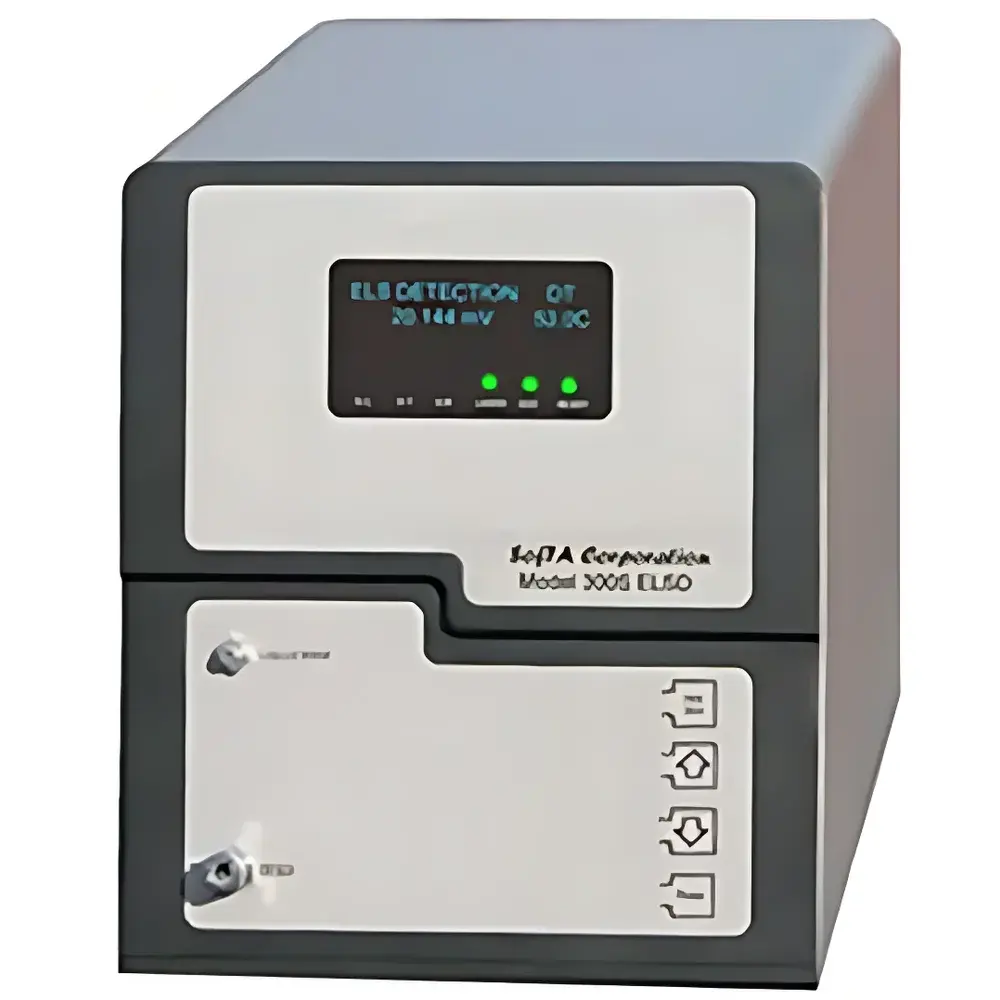
SofTA M300s Evaporative Light Scattering Detector (ELSD)
| Brand | SofTA |
|---|---|
| Origin | Imported |
| Manufacturer Type | Authorized Distributor |
| Model | M300s |
| Detection Principle | Evaporative Light Scattering |
| Compatible Systems | HPLC (Analytical & Preparative) |
| Wavelength Range | 195–600 nm |
| Optical Configuration | Dual-Beam |
| Light Source | Deuterium Lamp |
| Nebulizer Material | PTFE (Teflon®) |
| Drift Tube Temperature Range | Ambient to 120 °C |
| Nebulization Zone Temperature Range | 10–70 °C |
| Laser Source | 650 nm Near-Infrared, <5 mW (FCC Class I Eye-Safe) |
| Detector Element | Sealed, High-Gain Silicon Photodiode |
| Minimum Detectable Mass | 100 pg (Glucopyranoside, Micro-HPLC, 2 µL direct injection) |
| Peak Width (10% height) | 3 s |
| Dynamic Range (Normal/Low Gain) | 3 decades |
| Extended Dynamic Range | 4–4.5 decades |
| Mobile Phase Flow Rate Support | Up to 5 mL/min |
| Gas Requirement | N₂ or inert gas, 50 psi |
| Gas Consumption | ≤2.5 L/min |
| Fluidic Path Materials | PTFE, Stainless Steel, Alumina, Borosilicate Glass |
| User Interface | Vacuum Fluorescent Display (VFD), 4 Multifunction Keys |
| Onboard Method Storage | 10 Methods |
| Signal Output | Fixed (10 mV / 5 V) or Adjustable (0–5 V) |
| Communication | RS-232 (Rear Panel) |
| Power | 120/240 V, 50/60 Hz, 600 W |
| Dimensions (W×D×H) | 25 × 45 × 29 cm |
| Weight | 15 kg |
Overview
The SofTA M300s Evaporative Light Scattering Detector (ELSD) is a precision-engineered, thermally regulated detection system designed for universal, non-destructive quantification of non-chromophoric and semi-volatile analytes in liquid chromatography workflows. Unlike UV-Vis absorbance detectors, the M300s operates on the principle of nebulization, solvent evaporation, and light scattering—making it particularly suitable for carbohydrates, lipids, surfactants, polymers, and natural product fractions that lack strong or consistent UV absorption. Its dual-beam optical architecture compensates for source drift and ambient fluctuations, ensuring high baseline stability and measurement reproducibility across extended run times. The detector integrates SofTA’s proprietary thermal分流 (thermal split) technology to dynamically control aerosol formation and particle size distribution within the nebulization zone—a critical factor governing detection sensitivity and response linearity. Designed for seamless integration with both analytical and preparative HPLC systems, the M300s delivers rapid equilibration (<5 min warm-up), robust inter-method transferability, and compliance-ready operation in regulated environments.
Key Features
- Thermally controlled nebulization zone (10–70 °C) enabling precise aerosol splitting—optimized for gradient elution, high-boiling solvents (e.g., DMSO, glycerol), and low-volatility mobile phases.
- Cryogenic-capable drift tube (ambient to 120 °C) with active cooling support, permitting stable ELSD operation with aqueous, acetonitrile-, or methanol-based eluents without condensation artifacts.
- Chemically inert fluidic path constructed entirely from PTFE, 316 stainless steel, alumina, and borosilicate glass—resistant to corrosion, clogging, and carryover, even with aggressive buffers or high-salt mobile phases.
- Class I eye-safe 650 nm near-infrared laser source (<5 mW), coupled with a sealed, high-gain silicon photodiode detector—delivering sub-nanogram sensitivity (100 pg glucopyranoside, micro-HPLC conditions) and low-noise signal output.
- Vacuum fluorescent display (VFD) with intuitive 4-key navigation, real-time diagnostics, and on-board storage for up to 10 user-defined methods—including temperature profiles, gain settings, filter constants, and auto-zero protocols.
- Integrated gas management: self-regulating inlet valve with programmable auto-shutoff delay, built-in pressure stabilization, and overpressure protection—eliminating manual regulator adjustments and minimizing gas waste.
Sample Compatibility & Compliance
The M300s supports broad sample class compatibility—including carbohydrates, terpenes, fatty acids, phospholipids, saponins, oligosaccharides, and synthetic polymers—without derivatization. Its universal detection mechanism avoids wavelength-specific limitations inherent to UV or fluorescence detectors. The instrument meets mechanical and electrical safety requirements per IEC 61010-1 and complies with electromagnetic compatibility standards (IEC 61326-1). For regulated laboratories, its RS-232 interface enables integration into validated chromatography data systems (CDS); audit trail generation, electronic signature support, and 21 CFR Part 11–compliant data handling are achievable when paired with compliant CDS software. Method parameters—including drift tube temperature, nebulizer temperature, gain, and filter time constant—are fully recordable and exportable, supporting GLP/GMP documentation and method transfer validation per USP , ICH Q2(R2), and ISO/IEC 17025 frameworks.
Software & Data Management
While the M300s operates autonomously via its embedded firmware and front-panel interface, it provides native RS-232 serial communication for bidirectional control and data streaming. Detector status (temperature, pressure, signal baseline, error flags), analog output values, and real-time self-test reports are accessible via ASCII protocol. When interfaced with third-party CDS platforms—including Empower, Chromeleon, OpenLab CDS, or custom LabVIEW applications—the detector supports synchronized method loading, remote parameter adjustment, and timestamped signal acquisition. All operational parameters are logged with millisecond resolution and can be archived alongside chromatographic runs for full traceability. Firmware updates are delivered via serial upload and include version-controlled release notes, change logs, and revision history—essential for maintaining instrument qualification status in quality-controlled environments.
Applications
- Quantitative analysis of herbal extracts and traditional Chinese medicine (TCM) formulations per Chinese Pharmacopoeia monographs requiring HPLC-ELSD detection.
- Stability-indicating assays for excipients and active pharmaceutical ingredients (APIs) lacking chromophores—particularly in lyophilized formulations and lipid-based delivery systems.
- Characterization of polymeric drug conjugates, dendrimers, and nanoparticle surface coatings where UV response is weak or inconsistent.
- Quality control of food-grade emulsifiers (e.g., mono- and diglycerides), sweeteners (e.g., steviol glycosides), and prebiotic oligosaccharides (e.g., FOS, GOS).
- Method development for preparative HPLC purification of natural products, where fraction collection is triggered by ELSD signal thresholds rather than UV peaks.
FAQ
Does the M300s require column heating or post-column derivatization for carbohydrate detection?
No. The M300s detects analytes based on light scattering after solvent evaporation—eliminating the need for derivatization or specialized columns.
Can the M300s operate with aqueous mobile phases containing >20% water?
Yes. Its cryogenically assisted drift tube and optimized thermal split allow reliable detection with high-water-content gradients, including TFA- or ammonium acetate–buffered systems.
Is the detector compatible with UHPLC systems running at 15,000 psi?
The M300s interfaces downstream of the column outlet and accepts flow rates up to 5 mL/min; it is pressure-agnostic and fully compatible with UHPLC, provided appropriate post-column flow splitting is applied if needed.
How is calibration performed, and is it traceable to NIST standards?
Calibration is performed using certified reference materials (e.g., sucrose, maltose, or triolein) and documented per laboratory SOPs; while the detector itself does not contain NIST-traceable internal standards, its analog output and digital signal integrity support external calibration traceability.
What maintenance intervals are recommended for routine operation?
Nebulizer cleaning every 50–100 hours of use; drift tube inspection quarterly; gas filter replacement every 6 months; annual verification of temperature accuracy and signal linearity per IQ/OQ protocols.





