
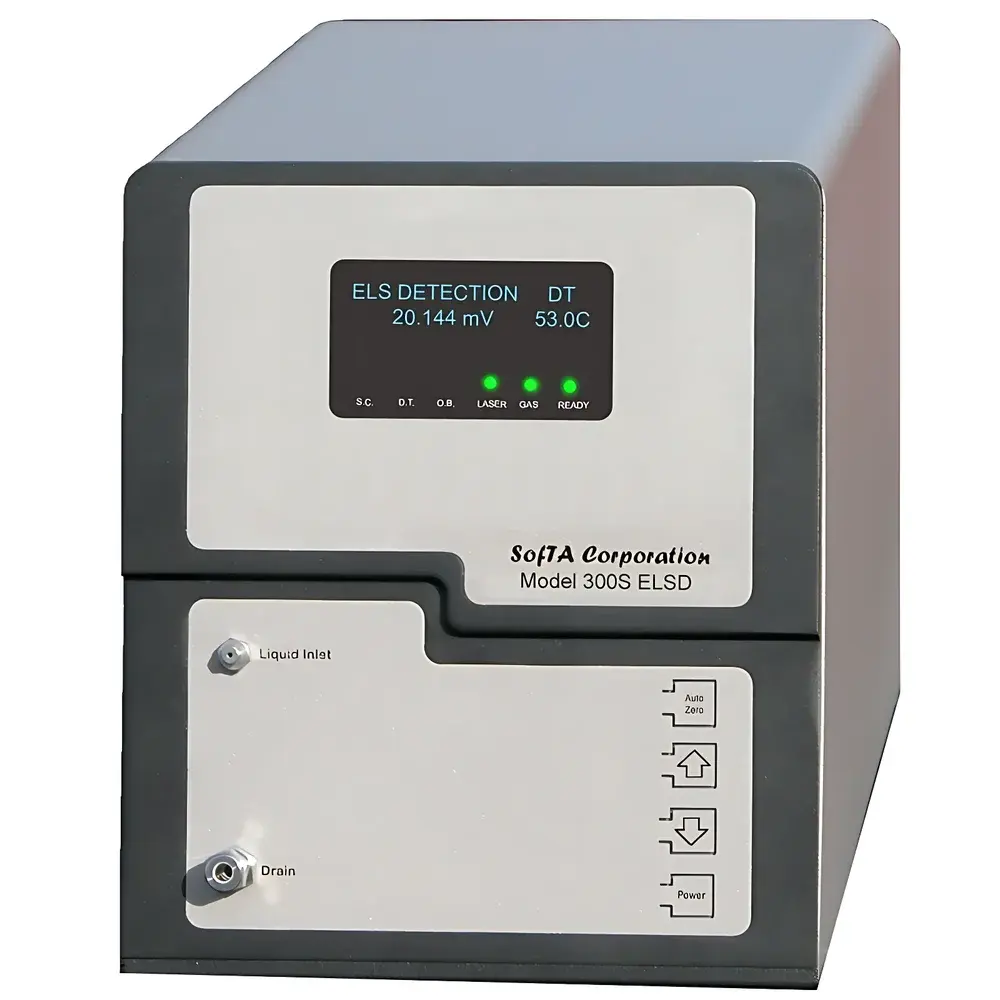
SofTA M300S Evaporative Light Scattering Detector (ELSD) for Traditional Chinese Medicine Analysis
| Brand | SofTA |
|---|---|
| Origin | Imported |
| Manufacturer Type | Authorized Distributor |
| Model | M300S |
| Detection Principle | Evaporative Light Scattering |
| Compatible Systems | HPLC (Analytical & Preparative) |
| Wavelength | 195 nm (Deuterium Lamp, Dual-Beam Configuration) |
| Nebulizer | PTFE-Coated Stainless Steel |
| Drift Tube Temperature Range | Ambient to 120 °C |
| Nebulization Zone Temperature Control | 10–70 °C |
| Light Source | Near-Infrared Laser (650 nm, <5 mW, FCC Class I Eye-Safe) |
| Detector | Sealed High-Gain Silicon Photodiode |
| Minimum Detectable Mass | 100 pg (Glucopyranoside, Micro-HPLC, 2 µL direct injection) |
| Peak Width (10% height) | 3 s |
| Dynamic Range (Standard Gain) | 3 decades |
| Extended Dynamic Range | 4–4.5 decades |
| Mobile Phase Flow Rate | Up to 5 mL/min |
| Gas Requirement | N₂ or inert gas, 50 psi |
| Gas Consumption | ≤2.5 L/min |
| Liquid Path Materials | PTFE, 316 Stainless Steel, Alumina, Borosilicate Glass (Optics) |
| User Interface | Vacuum Fluorescent Display (VFD), 4 Multifunction Keys |
| Onboard Method Storage | 10 Protocols |
| Signal Output | Fixed (10 mV / 5 V) or Adjustable (0–5 V) |
| Communication | RS-232 (Rear Panel) |
| Power | 120/240 V AC, 50/60 Hz, 600 W |
| Dimensions (W×D×H) | 25 × 45 × 29 cm |
| Weight | 15 kg |
Overview
The SofTA M300S Evaporative Light Scattering Detector (ELSD) is an engineered solution for universal, non-destructive detection in liquid chromatography workflows—particularly critical for the quantitative analysis of non-chromophoric, semi-volatile, and thermally labile compounds prevalent in Traditional Chinese Medicine (TCM) extracts. Unlike UV-Vis detectors, the M300S operates on the principle of nebulization, solvent evaporation, and light scattering from dried analyte particles. This makes it inherently mass-sensitive and independent of optical absorbance or fluorescence, enabling consistent response across diverse compound classes—including saponins, polysaccharides, glycosides, terpenoids, and alkaloid salts—that often lack strong chromophores or exhibit variable UV extinction coefficients. The detector integrates SofTA’s proprietary thermal split-flow technology to precisely regulate droplet drying kinetics within the nebulization zone, ensuring reproducible particle formation and minimizing baseline drift during gradient elution—a key requirement for pharmacopoeial compliance (e.g., Chinese Pharmacopoeia ChP 2020 Vol. IV, General Chapter 0512).
Key Features
- PTFE-coated nebulizer nozzle: Resists clogging, corrosion, and wear—even with high-salt, viscous, or particulate-laden TCM matrix extracts.
- Independent temperature control of both nebulization zone (10–70 °C) and drift tube (ambient to 120 °C): Enables method optimization for volatile solvents (e.g., acetonitrile/water) and high-boiling modifiers (e.g., isopropanol, ethyl acetate), supporting robust gradient compatibility.
- Cryogenic-capable operation: Maintains stable baseline and sensitivity under refrigerated conditions, essential for preserving thermally sensitive phytochemicals and reducing solvent vapor noise.
- FCC Class I eye-safe near-infrared laser (650 nm, <5 mW): Provides stable, low-noise illumination with minimal photothermal interference and long-term diode lifetime.
- Sealed, high-gain silicon photodiode with integrated amplification: Delivers signal stability and low electronic noise across the full dynamic range.
- Vacuum fluorescent display (VFD) with real-time diagnostics: Shows temperature setpoints, gas pressure, filter constants, self-test status, and error codes—enabling rapid troubleshooting without external software.
- Onboard storage for up to 10 user-defined methods: Includes all temperature profiles, gain settings, filtering parameters, and zeroing routines—ensuring method portability and audit-ready configuration consistency.
Sample Compatibility & Compliance
The M300S is routinely deployed in QC laboratories validating herbal monographs per ChP, USP , and EP 2.2.29. Its universal detection capability eliminates the need for derivatization or compound-specific calibration—reducing method development time and improving inter-laboratory reproducibility. All wetted materials (PTFE tubing, 316 stainless steel manifolds, alumina heater blocks, and borosilicate optical windows) comply with USP Class VI biocompatibility standards and resist degradation from acidic or basic mobile phases common in reversed-phase and HILIC separations of TCM fractions. The instrument supports GLP/GMP workflows through configurable RS-232 logging, hardware-based zeroing controls, and deterministic signal output—facilitating integration into validated LIMS or CDS platforms compliant with FDA 21 CFR Part 11 (electronic records/signatures) when paired with appropriate audit-trail-enabled software.
Software & Data Management
While the M300S operates autonomously via its front-panel interface, it provides full RS-232 serial communication for bidirectional control and data streaming. Compatible with third-party chromatography data systems (CDS) including Empower, Chromeleon, and OpenLab CDS, the detector transmits analog voltage output (0–5 V or fixed 5 V/10 mV) synchronized with acquisition clocks. Internal firmware implements hardware-level signal filtering (adjustable time constant), automatic baseline correction, and real-time pressure/temperature compensation algorithms—minimizing post-run data smoothing artifacts. All parameter changes—including gain, drift tube ramp rates, and nebulizer zone offsets—are timestamped and stored in non-volatile memory, satisfying traceability requirements for regulatory submissions.
Applications
- Quantitation of ginsenosides (Rb1, Rg1), astragalosides, and notoginsenosides in Panax ginseng, Astragalus membranaceus, and Panax notoginseng extracts.
- Stability-indicating assays for polysaccharide degradation products in processed herbal decoctions.
- Method transfer between analytical and preparative HPLC systems without re-optimization—leveraging identical detection physics and linear response characteristics.
- Residual solvent monitoring in purified active fractions using low-UV mobile phases (e.g., THF/water).
- Multi-component fingerprinting of complex TCM formulae (e.g., Liuwei Dihuang Wan) where UV-absorbing co-elutions obscure minor actives.
FAQ
Does the M300S require column heating or post-column derivatization for carbohydrate detection?
No. ELSD detection is inherently insensitive to chromophore presence; carbohydrates, glycosides, and oligosaccharides generate strong, reproducible scattering signals without chemical modification.
Can the M300S be used with aqueous mobile phases containing >20 mM ammonium acetate or formate?
Yes—provided the drift tube temperature is set ≥80 °C and the nebulization zone is maintained at ≥50 °C to ensure complete volatile salt removal prior to light scattering measurement.
Is nitrogen gas mandatory, or can compressed air be substituted?
Nitrogen or other inert gases (e.g., argon) are required. Compressed air introduces oxygen and moisture that promote oxidation of labile analytes and increase background scatter noise.
How does the M300S handle gradient elution with increasing organic content?
The thermal split-flow architecture dynamically adjusts droplet drying efficiency across solvent composition changes, maintaining constant particle size distribution and thus linear detector response—eliminating the need for post-run signal normalization.
What validation documentation is provided with the instrument?
Each unit ships with a Factory Calibration Certificate (traceable to NIST standards), IQ/OQ protocol templates aligned with ISO/IEC 17025, and a Material Compliance Declaration covering RoHS, REACH, and electrical safety (IEC 61010-1).





