
Soil-Watch Soil Ecological Monitoring System
| Origin | Australia |
|---|---|
| Manufacturer Type | Authorized Distributor |
| Origin Category | Imported |
| Model | Soil-Watch |
| Pricing | Upon Request |
Overview
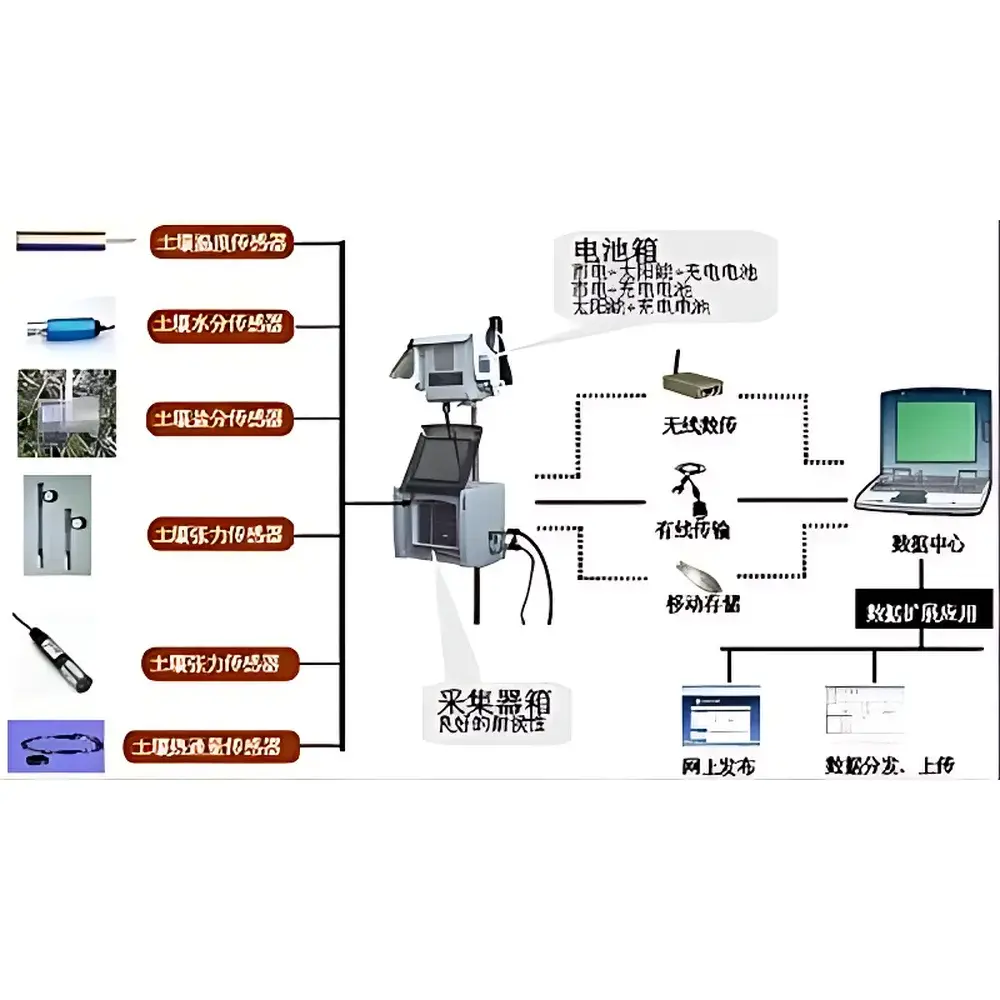
The Soil-Watch Soil Ecological Monitoring System is a modular, field-deployable telemetry platform engineered for long-term, unattended monitoring of critical soil physical and biogeochemical parameters. It operates on a distributed sensor architecture grounded in precision analog signal acquisition, SDI-12 digital protocol interoperability, and robust environmental data logging. The system implements standardized measurement principles—including time-domain reflectometry (TDR) for volumetric water content, thermistor-based resistance for soil temperature, four-electrode conductivity for electrical conductivity (EC), tensiometric and ceramic matrix equilibrium for soil water potential, and differential thermopile sensing for soil heat flux—ensuring traceable, physically meaningful outputs aligned with ISO 11274, ASTM D5859, and FAO guidelines for soil moisture characterization. Designed for deployment across heterogeneous terrain—from agricultural plots and forested watersheds to arid rangelands and restored wetlands—the system supports ecological process modeling, irrigation scheduling validation, carbon flux partitioning, and climate resilience assessment.
Key Features
- Modular sensor configuration: Users select from validated, calibrated probes—including STS (soil temperature), MP406 (volumetric water content), SEC5000 (electrical conductivity), EQ2 (water potential), 2725 (tensiometer), CN3 (heat flux), and ETG (evapotranspiration)—to match site-specific research objectives.
- High-fidelity data acquisition: 16-channel analog input with 18-bit resolution; sampling interval programmable from 10 ms to 24 hours; 32 MB internal memory (~5 million data points); onboard mathematical engine supporting real-time derivation (e.g., matric potential conversion, thermal diffusivity estimation, evapotranspiration integration).
- Flexible power architecture: Dual-mode operation—AC mains or solar-rechargeable battery system (12 V DC nominal), integrated photovoltaic charge controller with overcharge/overdischarge protection, stainless-steel mounting mast (1 m height), and weather-resistant cabling.
- Multi-protocol telemetry: Optional GPRS module with embedded TCP/IP stack (RS232/RS422 interface, 110–57600 bps, SIM card support); SMS-based threshold alerts and on-demand value polling; USB mass storage mode for local data retrieval via standard flash drive.
- Field-hardened mechanical design: IP67-rated data logger enclosure; ceramic-tipped tensiometers with replaceable O-ring seals and extendable rods (15–60 cm); corrosion-resistant stainless-steel hardware for multi-year deployment under UV exposure and freeze-thaw cycling.
Sample Compatibility & Compliance
The Soil-Watch system accommodates diverse soil textures (sand to clay loam), organic matter contents (0–25% w/w), and salinity regimes (0–50 dS/m). All sensors are factory-calibrated against NIST-traceable reference standards and certified per ISO/IEC 17025 procedures. Data integrity complies with GLP-aligned audit trails: timestamped records include sensor ID, calibration coefficients, environmental metadata (battery voltage, internal temperature), and CRC-16 error-checking. Software-generated reports meet USDA-NRCS, EU-JRC, and FAO-AGL requirements for soil hydrological monitoring. Optional GPRS transmission supports secure TLS 1.2 encryption and configurable data retention policies compliant with GDPR Article 32.
Software & Data Management
The Soil-Watch Visualization Suite (Windows-based, English-language GUI) provides full lifecycle data management: real-time dashboard with synchronized multi-parameter time-series plots (up to 12 variables simultaneously), interactive zoom/pan navigation, configurable alarm thresholds with email/SMS notification routing, and automated Excel export (XLSX format) with embedded metadata headers (ISO 8601 timestamps, sensor serial numbers, units). All datasets include version-controlled calibration history, user-defined site descriptors, and geotagging (optional GPS module integration). The software enforces write-once archival logic, maintains daily incremental backups, and delivers free lifetime updates—including new sensor drivers, statistical analysis modules (e.g., autocorrelation, spectral decomposition), and compatibility with third-party platforms (e.g., EnviroDIY, ThingSpeak, FIWARE NGSI-LD).
Applications
- Agricultural water productivity optimization: Real-time root-zone moisture and salinity feedback for deficit irrigation control and fertigation scheduling.
- Critical zone observatory (CZO) networks: Co-located measurements of heat flux, water potential gradients, and evapotranspiration to parameterize coupled land-surface models (e.g., CLM, ParFlow).
- Soil carbon sequestration studies: Correlating moisture dynamics, thermal regime, and redox conditions with CO2/CH4 efflux measurements.
- Restoration ecology monitoring: Tracking hydraulic redistribution, infiltration front propagation, and solute leaching in post-mining or wildfire-affected soils.
- Climate adaptation research: Long-term trend analysis of soil desiccation depth, hysteresis in water retention curves, and freeze-thaw cycle frequency under changing precipitation regimes.
FAQ
What communication protocols does the Soil-Watch system support?
The system natively supports USB mass storage, RS232 serial connection to PC, and optional GPRS (TCP/IP) or SMS-based telemetry. SDI-12 is implemented for digital sensor integration.
Can the data logger compute derived variables onboard?
Yes—it executes user-defined formulas using analog/digital channel inputs, including arithmetic operations, trigonometric functions, scaling, and logical conditionals (e.g., calculating thermal diffusivity from heat flux and temperature gradient data).
Is the system suitable for frozen soil conditions?
The STS temperature sensor operates from –20 °C to +60 °C; however, TDR-based water content measurement (MP406) exhibits reduced accuracy below 0 °C due to dielectric property shifts in ice-phase water. Alternative capacitance probes with freeze-compensation algorithms are available upon request.
How is sensor calibration maintained over multi-year deployments?
Each probe ships with NIST-traceable calibration certificates. Field recalibration is supported via reference soil samples and lab-grade verification fixtures. The software logs all calibration events with operator ID and timestamp, satisfying ISO 9001 documentation requirements.
Does the system comply with FDA 21 CFR Part 11 for regulated environments?
While primarily designed for environmental research, the audit trail functionality (user authentication, electronic signatures, immutable record storage) can be configured to meet Part 11 requirements for GLP-compliant field trials when deployed under validated SOPs.
Related Products







