
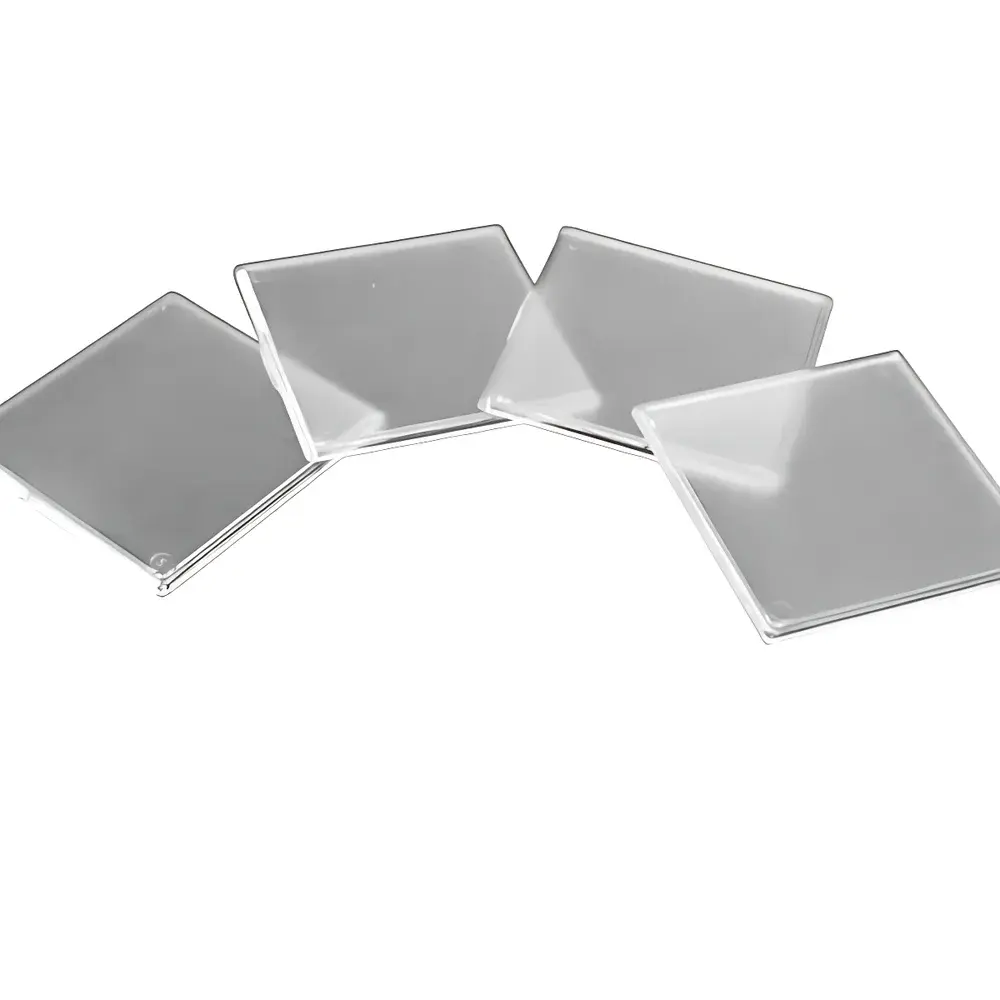
Solar Light 8-5105 Molded PMMA Diffuser Plate
| Brand | Solar Light |
|---|---|
| Origin | USA |
| Model | 8-5105 |
| Dimensions | 50.3 mm × 50.3 mm |
| Surface Roughness (Ra) | 5 µm |
| Surface Roughness (Sa) | 6 µm |
| Compliance | ISO 25178-2 |
| Packaging | 200 pcs per box |
| Category | Spectroscopy Accessory / Optical Diffuser Plate |
Overview
The Solar Light 8-5105 Molded PMMA Diffuser Plate is a precision-engineered optical component designed for rigorous spectral calibration, uniform light field generation, and radiometric validation in UV–VIS–NIR spectroscopic systems. Fabricated from high-purity polymethyl methacrylate (PMMA) via precision compression molding, this diffuser plate delivers stable, Lambertian-like scattering characteristics essential for photometric consistency across spectrophotometers, integrating spheres, solar simulators, and UV transmittance analyzers. Its surface topography—characterized by Ra = 5 µm and Sa = 6 µm per ISO 25178-2—ensures repeatable beam homogenization without introducing spectral artifacts or polarization bias. Unlike cast or extruded alternatives, the molded process minimizes internal stress, birefringence, and batch-to-batch variation in transmission profile (300–800 nm), making it suitable for applications requiring traceable optical performance under GLP-compliant laboratory workflows.
Key Features
- Precision-molded PMMA substrate with controlled surface texture per ISO 25178-2 specifications
- Optical-grade transparency: >92% average transmittance (300–800 nm), measured per ASTM E903
- Dimensional stability: Tolerance ±0.1 mm on 50.3 mm × 50.3 mm square format; flatness ≤15 µm over aperture
- Low fluorescence background: Certified for minimal UV-induced emission below 400 nm
- Thermal resilience: Stable up to 70 °C continuous exposure; no warping or haze development under standard lab conditions
- Non-hygroscopic formulation: No measurable water absorption after 24 h at 50% RH (per ISO 62)
Sample Compatibility & Compliance
The 8-5105 plate is compatible with standard cuvette holders, integrating sphere ports (e.g., Labsphere ISF-100 series), and collimated beam paths in benchtop UV-Vis spectrometers (e.g., Agilent Cary, PerkinElmer Lambda, Shimadzu UV-2700). It meets critical requirements for ISO 24444 (sunscreen SPF testing), ISO 17166/CIE S 017 (photobiological safety), and ASTM E2910 (spectral irradiance uniformity assessment). Each production lot undergoes spectral transmittance verification using NIST-traceable reference standards and is supplied with a Certificate of Conformance documenting Ra/Sa metrology, dimensional inspection, and UV-VIS spectral scan (300–800 nm, 1 nm resolution). The material complies with RoHS Directive 2011/65/EU and is free of plasticizers, UV stabilizers, or additives that could outgas in vacuum-compatible spectroscopy environments.
Software & Data Management
While the 8-5105 is a passive optical component, its use is fully supported within Solar Light’s proprietary software ecosystem—including SOLARLIGHT UV-Analyzer v5.2 and SPF Test Suite v4.1—for automated transmittance correction, spatial uniformity mapping, and drift-compensated baseline referencing. When integrated with Solar Light’s calibrated radiometers (e.g., Model PMA2100), the plate enables traceable irradiance normalization per NIST SP 800-137 guidelines. All measurement protocols generated using this diffuser comply with FDA 21 CFR Part 11 audit trail requirements when deployed on validated instrument platforms. Raw spectral data exported from compatible spectrometers retain EXIF-style metadata tags identifying the 8-5105 as the defined diffuser reference.
Applications
- Calibration of UV transmittance analyzers used in sunscreen and polymer UV-stability testing
- Beam homogenization in solar simulator output characterization (per IEC 60904-9 Class AAA requirements)
- Reference diffuser for spatial uniformity verification in imaging spectrometers and hyperspectral cameras
- Secondary standard for reflectance/transmittance ratio measurements in double-beam UV-Vis systems
- Diffusing element in custom-built integrating sphere accessories for LED and laser diode characterization
- Quality control benchmark for OEM optical module assembly lines producing photodiode-based UV sensors
FAQ
What distinguishes the molded 8-5105 from the sandblasted 8-5103 PMMA plate?
The 8-5105 uses compression molding to achieve isotropic surface texture with defined Sa and Ra values, ensuring superior repeatability across optical axes; the 8-5103 relies on abrasive blasting, yielding higher micro-roughness variability and reduced long-term stability under thermal cycling.
Is the 8-5105 plate suitable for vacuum UV (VUV) applications below 200 nm?
No—it is optimized for 300–800 nm operation; PMMA exhibits strong absorption and potential photodegradation below 200 nm. For VUV work, fused silica or MgF₂ diffusers are recommended.
Can this plate be cleaned with isopropanol or ethanol without affecting surface integrity?
Yes—routine cleaning with lint-free wipes and spectroscopic-grade isopropanol is approved; avoid acetone or chlorinated solvents, which may induce microcracking in molded PMMA.
Does Solar Light provide NIST-traceable calibration certificates for individual plates?
Certificates of Conformance (not full calibration) are provided per lot; NIST-traceable spectral transmittance data is available upon request for qualified research contracts.
How does the 50.3 mm dimension relate to industry-standard mounting fixtures?
This size matches the active aperture of Solar Light’s PMA2100 radiometer detector head and aligns with ANSI Z80.3-compliant filter holder dimensions used in ophthalmic UV testing systems.
Related Products




