
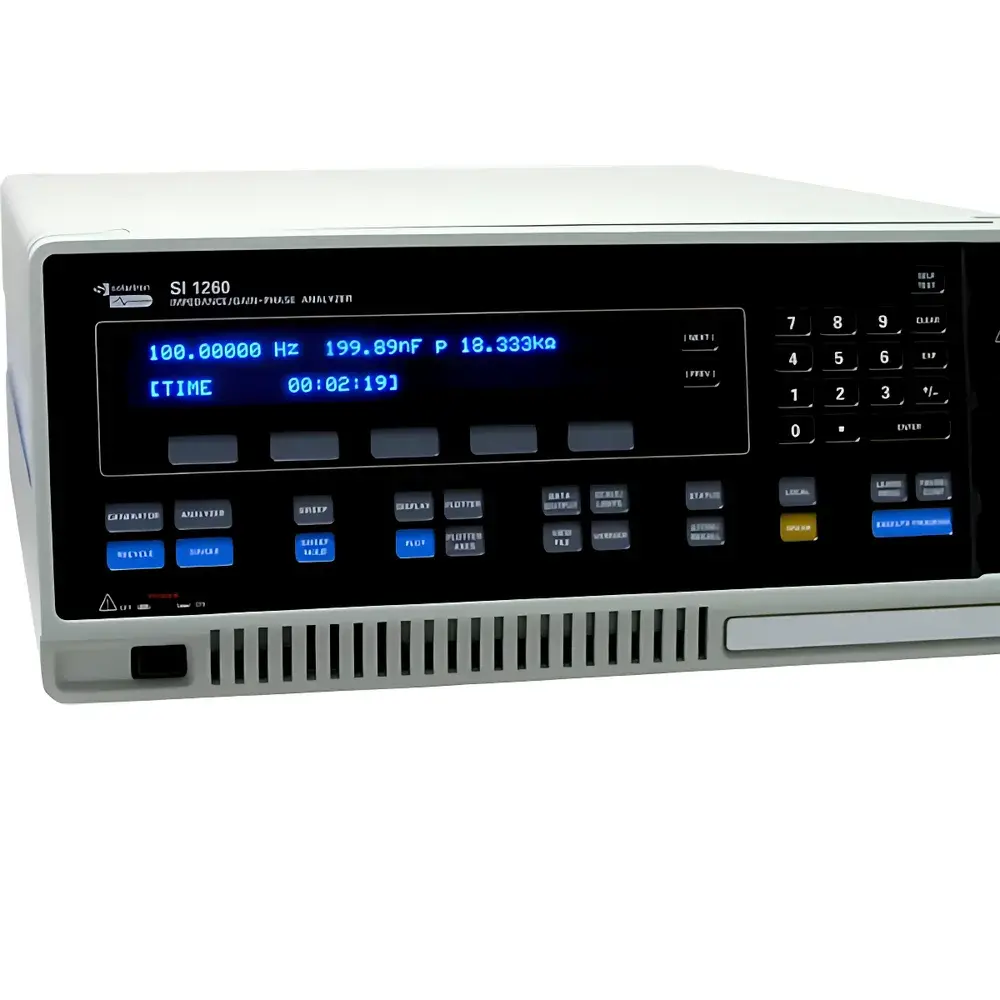
Solartron Analytical 1260A Frequency Response Analyzer with 1287 Potentiostat/Galvanostat for Solid-State Electrolyte Characterization
| Brand | Solartron Analytical |
|---|---|
| Origin | United Kingdom |
| Model | 1260A |
| Channel Count | Single-Channel Workstation |
| Current Range | 200 nA – 2 A |
| Current Accuracy | ±0.2% of reading + ±1% of full scale |
| Potential Accuracy | ±0.2% of reading + ±10 mV |
| Potentiostatic Range | ±14.5 V (when coupled with 1287) / ±40.95 V (1260A standalone) |
| AC Impedance Frequency Range | 10 µHz – 32 MHz |
| Voltage/Current Resolution | 1 µV / 1 pA |
| Frequency Resolution | 0.015 ppm |
| Phase Accuracy | ±0.1° |
| Magnitude Accuracy | ±0.1 dB |
| Electrode Configurations | 2-, 3-, and 4-terminal |
| Active Shielding | Yes |
| Floating Measurement Capability | Yes |
| Software | CorrWare & ZPlot v3.x |
Overview
The Solartron Analytical 1260A Frequency Response Analyzer (FRA), when integrated with the 1287 Potentiostat/Galvanostat, forms a high-fidelity electrochemical workstation engineered for rigorous characterization of solid-state electrolytes, battery interfaces, and corrosion-resistant materials. This system operates on the principle of single-sine correlation—a patented digital signal processing technique that isolates the fundamental excitation frequency from broadband noise and harmonic distortion. Unlike multi-sine or FFT-based methods, this approach delivers exceptional signal-to-noise ratio (SNR) at low-amplitude perturbations (down to millivolt-level DC bias), making it uniquely suited for impedance measurements in inherently resistive systems such as ceramic electrolytes, thin-film separators, and passivated metal oxides. The 1260A’s 32 MHz upper frequency limit enables resolution of interfacial charge-transfer kinetics, grain boundary effects, and dielectric relaxation phenomena across multiple length scales—critical for R&D in next-generation all-solid-state batteries (ASSBs), solid oxide fuel cells (SOFCs), and electrochemical sensors.
Key Features
- Single-sine correlation algorithm with 0.015 ppm frequency resolution—enabling precise identification of time constants spanning microseconds to kiloseconds.
- Simultaneous high-resolution voltage (1 µV) and current (1 pA) digitization via dual independent ADCs, ensuring integrity of both DC polarization and AC response data streams.
- True floating architecture with active cable shielding—eliminates ground-loop artifacts and parasitic capacitance errors during measurements in pressurized autoclaves, buried pipeline simulators, or grounded cell fixtures.
- Configurable 2-, 3-, and 4-terminal measurement modes: 2-terminal for bulk conductivity screening; 3-terminal for corrosion potential monitoring under coating degradation; 4-terminal (Kelvin sensing) for eliminating lead resistance in low-conductivity solid electrolytes (<10−5 S/cm).
- Wide dynamic range: ±40.95 V open-circuit potential control (1260A only) and ±14.5 V galvanostatic/potentiostatic compliance (1287), supporting aggressive polarization protocols without amplifier saturation.
- Integrated analog waveform synthesis: arbitrary AC perturbation superimposed on DC bias, enabling Mott-Schottky, phase-resolved EIS, and harmonic distortion analysis per IEC 62321-7-2 guidelines.
Sample Compatibility & Compliance
The 1260A/1287 platform supports standardized electrochemical cell geometries—including Swagelok-type, coin-cell adapters, and custom-designed symmetric/asymmetric solid-state test cells—with compatibility for inert atmospheres (Ar/glovebox integration) and elevated temperature stages (up to 200 °C). Its hardware and software architecture conform to regulatory frameworks governing analytical instrument qualification: data acquisition timestamps are hardware-locked; all parameter changes and measurement sequences are logged with user ID and system metadata; audit trails meet FDA 21 CFR Part 11 requirements when deployed with validated CorrWare/ZPlot configurations. The system satisfies ISO 17025 calibration traceability pathways through NIST-traceable shunt resistors and reference electrodes, and supports GLP-compliant reporting templates for battery cycling, SEI growth kinetics, and interfacial stability assessment per ASTM D1148 and IEC 62660-2.
Software & Data Management
CorrWare and ZPlot v3.x provide a unified environment for experiment design, real-time visualization, and advanced modeling—without requiring third-party scripting. The software implements Kramers-Kronig validation checks pre- and post-acquisition, enforces Nyquist stability criteria during model fitting, and exports impedance spectra in IMP format compatible with Thales, EC-Lab, and MATLAB-based equivalent circuit solvers (e.g., LEVM, Equivalent Circuit Fitter). Built-in modules support time-domain electrochemical noise analysis (ECN) per ASTM G199, distribution of relaxation times (DRT) deconvolution, and multi-sine EIS with phase synchronization locking. All raw datasets retain full metadata—including instrument firmware version, environmental sensor inputs (if interfaced), and electrode history tags—ensuring reproducibility across laboratories and longitudinal studies.
Applications
- Characterization of Li7La3Zr2O12 (LLZO), Na3Zr2Si2PO12 (NASICON), and sulfide-based solid electrolytes under variable temperature and humidity conditions.
- Quantification of interfacial resistance evolution at cathode|electrolyte boundaries in NMC–LLZO composite electrodes.
- In situ monitoring of dendrite nucleation onset via low-frequency impedance modulus inflection points (10 mHz–1 Hz).
- Dielectric spectroscopy of polymer-ceramic hybrid membranes for proton exchange membrane (PEM) applications.
- Corrosion inhibition efficiency evaluation of self-healing coatings on aluminum alloys using low-frequency EIS (<100 mHz) and breakpoint analysis.
FAQ
What distinguishes the 1260A’s single-sine correlation from conventional FFT-based impedance analyzers?
The 1260A performs real-time lock-in detection at each discrete frequency point, rejecting out-of-band noise and harmonics without spectral leakage—critical for measuring high-impedance solid electrolytes where signal amplitudes fall below 10 mV.
Can the system perform simultaneous potentiostatic EIS and galvanostatic intermittent titration (GITT)?
Yes—ZPlot supports hybrid technique sequencing: users define voltage-controlled EIS steps interleaved with constant-current pulses, with automatic data stitching and time-stamp alignment.
Is 4-wire impedance measurement supported for low-conductivity ceramics?
Yes—the 1287’s dedicated sense terminals enable true 4-terminal impedance acquisition, decoupling lead impedance contributions even at <100 Ω·cm² interfacial resistance values.
Does the software comply with 21 CFR Part 11 for pharmaceutical or medical device battery testing?
When deployed with password-protected user roles, electronic signatures, and immutable audit logs enabled, CorrWare/ZPlot meets baseline Part 11 requirements for electronic records and signatures.
How is thermal drift compensated during long-duration impedance sweeps?
The 1260A incorporates internal temperature-stabilized crystal oscillators and auto-zeroing DACs; ZPlot further applies real-time baseline correction using reference electrode drift tracking algorithms.
Related Products




