
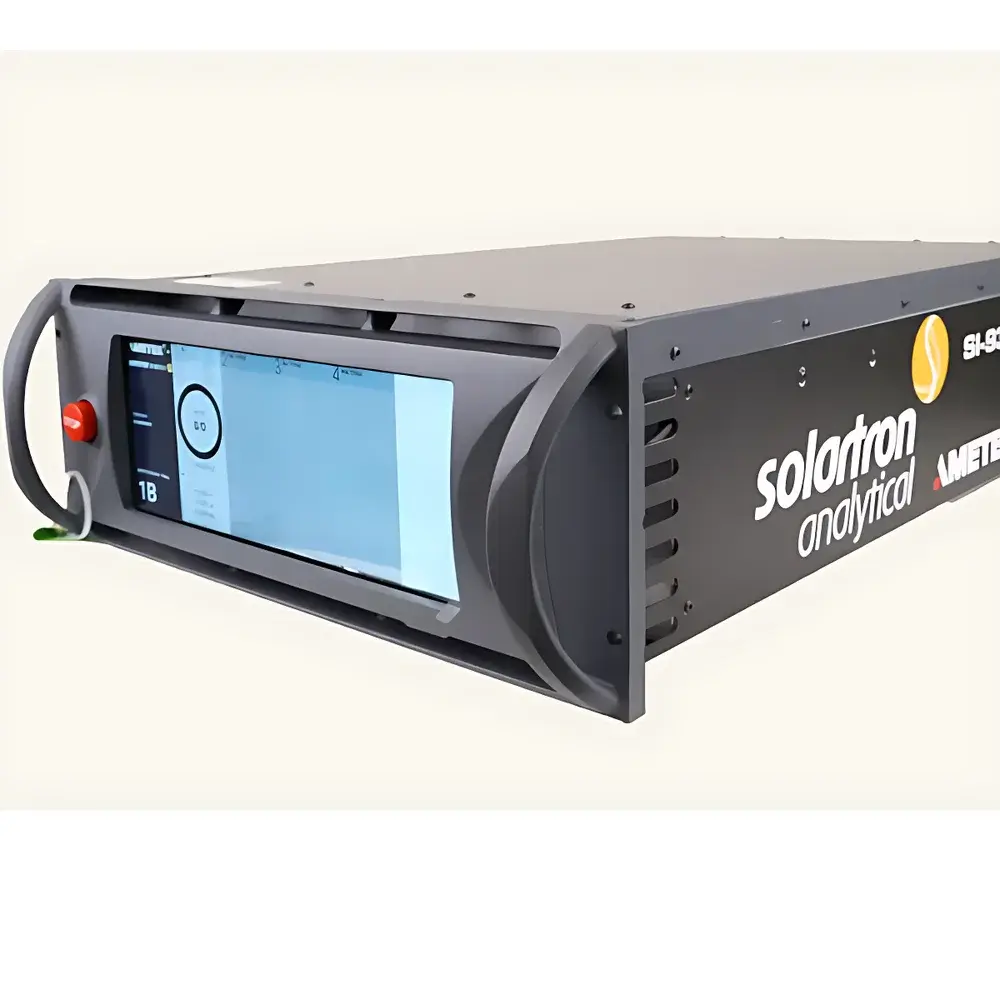
Solartron Analytical 9300R-SA High-Current AC/DC Integrated Electrochemical Test System
| Brand | Solartron Analytical |
|---|---|
| Origin | USA |
| Model | 9300R-SA |
| Instrument Type | Multi-Channel Electrochemical Workstation |
| Channel Count | 1–4 Configurable Channels |
| DC Current Range | ±200 A (300 A Pulse), Up to ±800 A with 4-Channel Parallel Operation |
| DC Current Accuracy | ±0.02 % of Reading |
| Potential Accuracy | ±30 µV |
| Potentiostatic Range | +300 mV to +10 V |
| EIS Frequency Range | 1 mHz to 10 kHz |
| Voltage Resolution | 20 µV (24-bit ADC) |
| Current Resolution | 2 µA (24-bit ADC) |
| DC Sampling Rate | 1 kS/s |
| Auxiliary Voltage Divider Inputs | 2 (for DC/EIS) |
| Temperature Monitoring | Optional External 16-Channel Synchronized Acquisition |
| Power Supply | 3-Phase 380 V, 5.5–11 kW |
Overview
The Solartron Analytical 9300R-SA is a high-current, multi-channel electrochemical test system engineered for rigorous evaluation of next-generation energy devices under realistic operational conditions. Unlike conventional potentiostats limited to milliamp- to amp-level currents, the 9300R-SA employs a modular, high-fidelity current source architecture capable of delivering up to ±800 A across four synchronized channels—enabling true in-situ and dynamic testing of large-format batteries, electrolyzers, and fuel cell stacks. Its core measurement principle integrates galvanostatic/potentiostatic control with real-time electrochemical impedance spectroscopy (EIS), implemented via dedicated on-channel analog front-ends and 24-bit precision ADCs. This architecture ensures traceable voltage and current fidelity during transient load steps, pulse charging, and low-frequency impedance sweeps—critical for capturing thermal-electrochemical coupling, interfacial degradation kinetics, and state-of-health evolution under representative duty cycles.
Key Features
- High-Current Scalability: Single-channel operation supports ±200 A continuous (±300 A pulsed); four channels can be paralleled to deliver ±800 A with phase-synchronized control and shared reference sensing—eliminating channel-to-channel drift during high-power cycling.
- Sub-Millisecond Dynamic Response: Fast current range switching (<1 ms), step response time <500 µs, and 1 kS/s DC data acquisition enable accurate capture of fast transients, including regenerative braking events and rapid charge termination signals.
- Integrated EIS per Channel: Each channel features a dedicated, isolated EIS engine operating from 1 mHz to 10 kHz with programmable excitation amplitude, waveform shape (sine, multi-sine, custom), and real-time Kramers–Kronig validation—supporting simultaneous dual-electrode (anode/cathode) impedance mapping.
- Multi-Parameter Synchronization: Hardware-triggered acquisition aligns voltage, current, temperature (via optional 16-channel external DAQ), and environmental chamber data at microsecond-level timestamps—essential for correlating electrochemical signatures with thermal runaway precursors or gas evolution profiles.
- Modular Expandability: System scales from 1 to 4 channels without firmware reconfiguration; additional channels can be added in-field with hot-swappable power modules and unified software licensing.
Sample Compatibility & Compliance
The 9300R-SA is designed for testing high-energy-density and high-power electrochemical systems—including prismatic and pouch lithium-ion batteries (up to 100 Ah), proton exchange membrane (PEM) electrolyzer cells, anion exchange membrane (AEM) water splitters, and polymer electrolyte fuel cell (PEFC) stacks. Its robust safety architecture includes overcurrent/overvoltage cutoffs, redundant thermal monitoring interfaces, and fail-safe grounding protocols compliant with IEC 61010-1 (Safety Requirements for Electrical Equipment for Measurement, Control, and Laboratory Use). All measurement firmware and data logging routines support audit trails and electronic signatures aligned with FDA 21 CFR Part 11 and GLP/GMP documentation requirements. Calibration certificates are traceable to NIST standards, and EIS validation follows ASTM E2698 and ISO 17025 procedures.
Software & Data Management
Control and analysis are performed via the modular CorrWare™ 9 platform, which provides scriptable experiment sequencing, real-time impedance Nyquist/Bode visualization, and automated parameter fitting using equivalent circuit models (e.g., Randles, transmission line). Raw data is stored in HDF5 format with embedded metadata (user, timestamp, hardware configuration, calibration ID), enabling FAIR (Findable, Accessible, Interoperable, Reusable) data practices. Optional NAS integration allows direct streaming to network-attached storage with RAID redundancy and role-based access control. The API supports Python, MATLAB, and LabVIEW for custom automation, third-party device orchestration (e.g., climate chambers, gas analyzers), and integration into digital twin workflows.
Applications
- Fast-charging protocol development for EV traction batteries, including dynamic EIS during CC/CV transitions and heat generation quantification.
- In-situ durability assessment of PEM electrolyzer catalyst layers and membrane electrode assemblies (MEAs) under variable current density and pressure cycling.
- Root-cause analysis of capacity fade and impedance rise in grid-scale flow batteries and sodium-ion systems.
- Thermal runaway propagation studies using synchronized voltage, current, surface temperature, and off-gas monitoring.
- Accelerated life testing with multi-parameter stop conditions (e.g., ΔRct > 15%, T-slope > 2°C/min, dV/dt threshold).
FAQ
What is the maximum sustainable current per channel, and how is thermal management handled?
Each channel delivers ±200 A continuously with forced-air and liquid-cooled heatsink options; thermal derating curves are provided in the technical manual based on ambient temperature and duty cycle.
Can the system perform galvanostatic EIS while applying a DC bias current above 100 A?
Yes—the 9300R-SA supports superimposed AC perturbation (up to 10% of DC current) across its full ±200 A range, with harmonic distortion <0.5% THD at 1 kHz.
Is third-party environmental chamber integration supported out-of-the-box?
Yes—native drivers for major chamber vendors (Weiss, ESPEC, Binder) are included, with bi-directional communication for synchronized ramping of temperature, humidity, and pressure alongside electrochemical protocols.
How is data integrity ensured during long-duration tests (e.g., 6-month cycling)?
Continuous checksum verification, automatic journaling, and periodic backup to redundant storage paths prevent data corruption; all files include SHA-256 hashes for post-hoc validation.
Does the system comply with ISO/IEC 17025 for accredited laboratory use?
Yes—full metrological traceability documentation, uncertainty budgets per measurement mode, and internal verification procedures are supplied with each system installation.





