
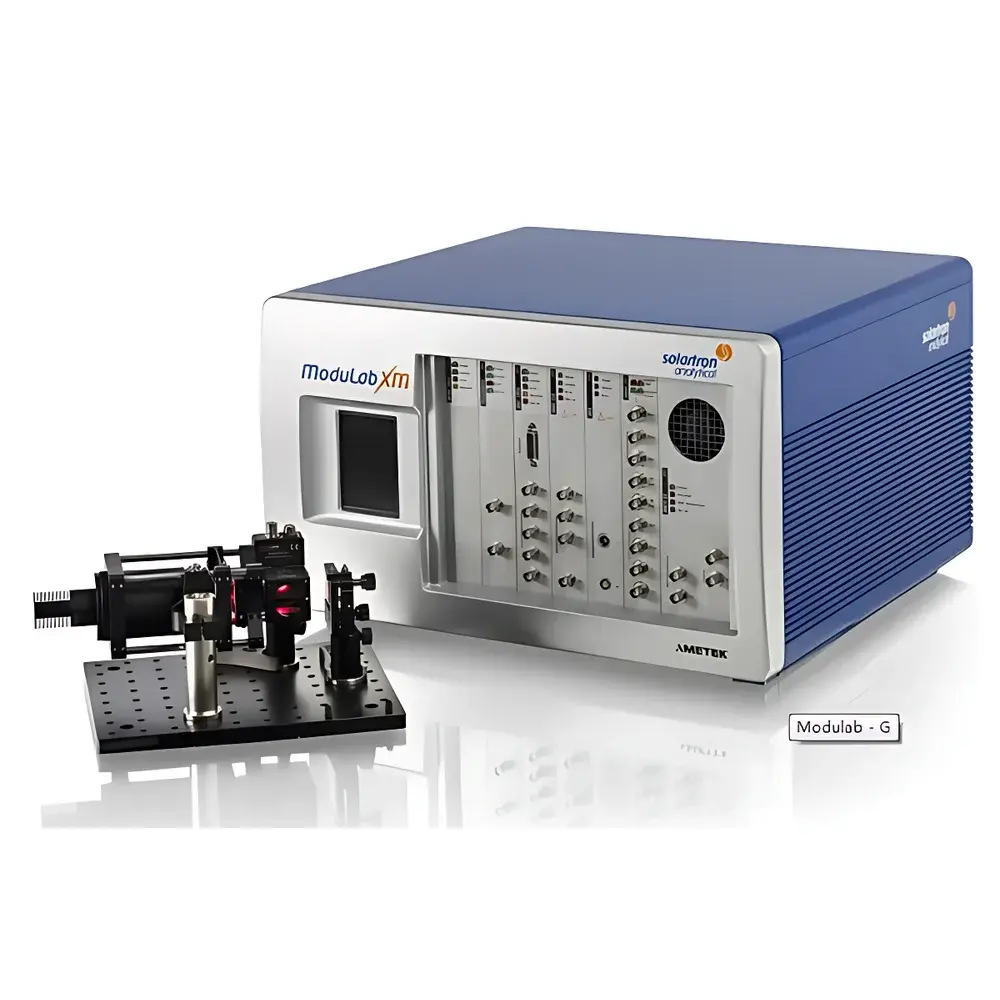
Solartron Analytical Modulab XM DSSC Photoelectrochemical Testing System
| Brand | Solartron Analytical |
|---|---|
| Origin | United Kingdom |
| Model | Modulab XM DSSC |
| Current Range | ±2 A |
| Current Accuracy | 0.1% reading + 0.05% range + 30 fA |
| Potential Accuracy | 0.1% reading + 0.05% range + 100 µV |
| Potentiostatic Range | ±100 V |
| EIS Frequency Range | 10 µHz – 1 MHz |
| Compliance | NIST-traceable light source calibration |
| Software Platform | ModuLab XM Control & Analysis Suite |
| Upgrade Path | Compatible with legacy Modulab and Modulab XM hardware modules |
Overview
The Solartron Analytical Modulab XM DSSC Photoelectrochemical Testing System is a purpose-engineered, integrated platform designed for quantitative characterization of dye-sensitized solar cells (DSSCs) and broader photoelectrochemical (PEC) processes—including water oxidation on metal oxide photoanodes such as hematite (α-Fe₂O₃). Built upon Solartron’s two-decade heritage in precision electrochemical instrumentation, the system combines high-fidelity potentiostat/galvanostat functionality with synchronized optical excitation and time-resolved signal acquisition. Its core measurement architecture integrates frequency-domain techniques (e.g., electrochemical impedance spectroscopy, intensity-modulated photocurrent/photovoltage spectroscopy—IMPS/IMVS) and time-domain methods (e.g., open-circuit voltage decay, charge extraction, transient I–V sweeps) under controlled illumination. The system operates on a modular, open-architecture framework compliant with IEEE 488.2 and SCPI command protocols, enabling interoperability with third-party data acquisition and environmental control units.
Key Features
- High-power, thermally stabilized broadband and monochromatic LED light sources—NIST-traceable, with in situ recalibration capability for irradiance uniformity and spectral output verification
- Dual-channel potentiostat architecture supporting simultaneous anode/cathode impedance and potential monitoring via auxiliary voltage divider interface
- Ultra-low-noise current measurement down to 30 fA residual offset, enabling accurate quantification of sub-nA photocurrents in low-illumination or high-impedance PEC configurations
- Extended DC potential range of ±100 V for compatibility with multi-junction devices and high-voltage electrolyte systems
- Frequency response analysis (FRA) engine supporting single-sine, multi-sine, and swept-sine EIS modes—with real-time FFT-based harmonic analysis and phase-lock detection
- Modular hardware expansion: seamless integration with existing Modulab XM chassis, including optional FRA add-on cards, auxiliary analog I/O, and temperature-controlled cell holders
Sample Compatibility & Compliance
The Modulab XM DSSC accommodates standard three-electrode electrochemical cells, custom-built PEC reactors with quartz windows, and solid-state DSSC test fixtures. It supports aqueous, non-aqueous, and ionic liquid electrolytes across pH 0–14 and temperature ranges from −10 °C to +80 °C (with external thermal control). All optical components meet IEC 60825-1 Class 1 laser safety standards; light source calibration certificates are traceable to NIST SRM 2241 and SRM 2242. The system complies with ISO/IEC 17025 requirements for measurement uncertainty reporting and supports audit-ready GLP/GMP workflows through timestamped metadata logging, user access controls, and electronic signature support in accordance with FDA 21 CFR Part 11.
Software & Data Management
The ModuLab XM Control & Analysis Suite provides unified experiment sequencing, real-time visualization, and post-acquisition modeling. Preconfigured “one-click” analysis templates automate calculation of electron lifetime (τₑ), effective diffusion coefficient (Dₑff), recombination resistance (Rrec), and charge collection efficiency (ηcc) from IMPS/IMVS and EIS datasets. Raw data is stored in HDF5 format with embedded metadata (instrument settings, calibration history, ambient conditions). Batch processing supports scripting via Python API (PyModulab), enabling integration into automated lab data pipelines. All software modules—including CV, CA, CP, EIS, and AC voltammetry—are validated per ASTM E2913-22 and ISO 12967-2 for electrochemical instrument software verification.
Applications
- Quantitative evaluation of charge transfer kinetics at TiO₂/dye/electrolyte interfaces in DSSCs
- Time-resolved investigation of photogenerated carrier dynamics in hematite, BiVO₄, and WO₃ photoanodes
- In-situ monitoring of interfacial degradation mechanisms under operational bias and illumination stress
- Development and validation of equivalent circuit models for PEC devices using distributed element fitting
- Correlation of incident photon-to-current efficiency (IPCE) spectra with EIS-derived recombination pathways
- Multi-parameter optimization of redox mediators (e.g., Co²⁺/³⁺ complexes) in solid-state hole transport layers
FAQ
Can the Modulab XM DSSC be upgraded from an existing Modulab XM potentiostat?
Yes—hardware upgrades include the DSSC optical module, FRA expansion card, and calibrated LED source assembly. Firmware and software updates are delivered via Solartron’s secure customer portal.
Is the light source intensity stable over extended testing periods?
Yes—the thermal management system maintains LED junction temperature within ±0.5 °C over 24-hour continuous operation, ensuring irradiance drift <0.3% per hour.
Does the system support Mott-Schottky analysis for semiconductor flat-band potential determination?
Yes—capacitance vs. potential scans (C⁻² vs. E) are fully supported, with automatic correction for series resistance and solution resistance compensation.
Are raw data files compatible with third-party modeling tools such as MATLAB or OriginPro?
Yes—HDF5 export includes standardized field naming conventions and SI-unit metadata, enabling direct import into MATLAB (via h5read), Python (h5py), and OriginPro (HDF5 plugin).
What documentation is provided for regulatory compliance in pharmaceutical or energy materials R&D?
Each system ships with a full validation package: IQ/OQ documentation templates, NIST-traceable calibration reports, uncertainty budgets per ISO/IEC 17025, and 21 CFR Part 11 configuration records.




