
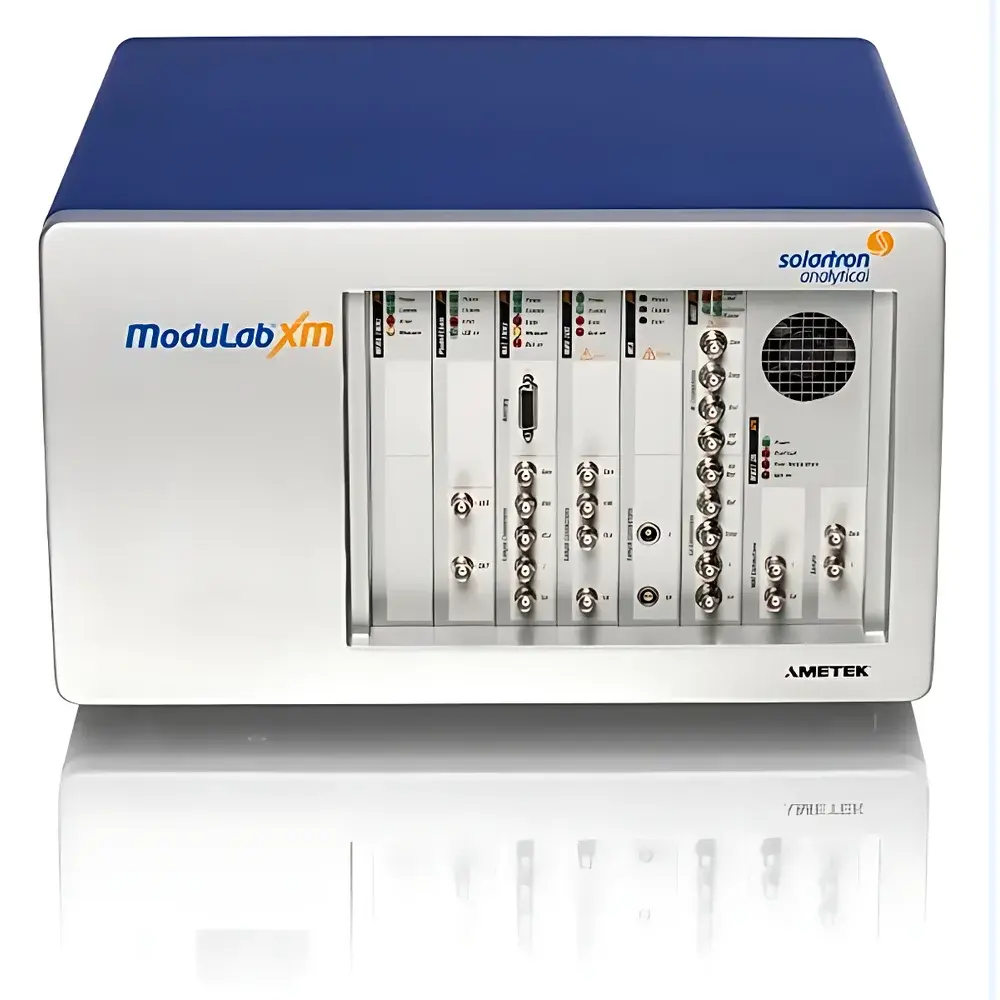
Solartron Analytical Modulab XM ECS Electrochemical Workstation
| Brand | Solartron Analytical |
|---|---|
| Origin | UK |
| Model | Modulab XM ECS |
| Current Range | ±2 A |
| Current Accuracy | 0.1% reading + 0.05% range + 30 fA |
| Potential Accuracy | 0.1% reading + 0.05% range + 100 µV |
| Potentiostatic Range | ±100 V |
| EIS Frequency Range | 10 µHz – 1 MHz |
Overview
The Solartron Analytical Modulab XM ECS Electrochemical Workstation is a high-performance, modular electrochemical measurement platform engineered for precision, scalability, and experimental flexibility in advanced research and industrial development environments. At its core lies a high-speed, low-noise potentiostat/galvanostat capable of simultaneous voltage and current control with sub-femtoampere resolution and microvolt-level potential fidelity. The system operates on a true digital signal processing (DSP) architecture with oversampling technology—enabling artifact-free linear sweep voltammetry (LSV), cyclic voltammetry (CV), and pulse techniques at scan rates exceeding 10 kV/s. Its design adheres to fundamental electrochemical principles including controlled-potential/current perturbation, impedance spectroscopy via frequency-domain analysis (EIS), and transient response characterization. This architecture ensures minimal phase lag, negligible step-response distortion, and intrinsic compatibility with rigorous electrochemical modeling frameworks such as Butler–Volmer kinetics, diffusion-controlled mass transport, and distributed-element equivalent circuit fitting.
Key Features
- Modular “plug-and-play” architecture: Field-upgradable hardware modules—including multi-channel potentiostats, high-current boosters (±25 A), ultra-low-current preamplifiers (100 aA resolution), and dedicated EIS modules—are independently calibrated and auto-detected upon insertion.
- 64 MS/s smooth-scan waveform generation: Eliminates staircase artifacts in LSV, CV, and LSP experiments without mode switching or hardware reconfiguration.
- Up to 1 MS/s real-time data acquisition: Supports high-fidelity capture of pulse shapes, rise/fall transients, and fast kinetic events in square-wave, differential pulse, and chronoamperometric measurements.
- Extended dynamic range: ±100 V compliance voltage; impedance measurement capability from 100 TΩ (insulator-grade dielectric analysis).
- Multi-instrument synchronization: Single-PC or distributed multi-PC control of up to 32 independent potentiostat channels across multiple chassis, enabling parallel battery cell testing, corrosion array monitoring, or combinatorial electrocatalyst screening.
- Integrated hardware-level safety protocols: Automatic overvoltage/overcurrent shutdown, galvanic isolation between channels, and programmable current/voltage limits per experiment step.
Sample Compatibility & Compliance
The Modulab XM ECS supports a broad spectrum of electrochemical interfaces—from aqueous and non-aqueous electrolytes to solid-state ion conductors, molten salts, and bioelectrochemical systems. It accommodates standard three-electrode cells, rotating disk electrodes (RDE), scanning electrochemical microscopy (SECM) probes, and custom microfluidic or in situ/operando cells. All analog front-end circuits meet IEC 61010-1:2010 safety standards for laboratory electrical equipment. Firmware and software architecture comply with GLP/GMP data integrity requirements, supporting full audit trails, electronic signatures (21 CFR Part 11 ready), and time-stamped raw data export in HDF5 and ASCII formats. Experimental methods align with ASTM G5, G59, G102, ISO 17475, and EN 13843 for corrosion testing, as well as USP and for pharmaceutical electrochemical assay validation.
Software & Data Management
ModuLab XM software provides a unified graphical environment for experiment design, real-time visualization, and post-acquisition analysis. Its intuitive interface displays live waveform previews—including applied potential/current profiles and expected cell connections—before execution, reducing wiring errors. Users define multi-step sequences (e.g., open-circuit stabilization → CV → EIS → chronoamperometry) with conditional branching, parameter sweeps, and automated data logging. The embedded curve-fitting engine supports nonlinear regression of EIS spectra using Randles, transmission-line, and user-defined equivalent circuits, with statistical error estimation (χ², confidence intervals). Raw datasets are stored with full metadata (instrument configuration, calibration history, environmental conditions) and support batch processing, scripting (Python API), and export to MATLAB, Origin, or Excel. All data files are immutable after acquisition and include cryptographic hash verification for regulatory traceability.
Applications
- Fuel cell and electrolyzer R&D: In situ membrane resistance mapping, catalyst degradation profiling, and H₂ crossover quantification under dynamic load cycling.
- Battery materials science: Solid-electrolyte interphase (SEI) formation kinetics, Li-ion diffusion coefficient extraction, and dendrite nucleation detection via microsecond-scale current transients.
- Corrosion and coatings evaluation: Electrochemical noise analysis (ENA), localized pitting monitoring, and accelerated aging tests per ASTM D1141 and ISO 12944.
- Nanomaterial electrochemistry: Single-nanoparticle collision detection, graphene oxide redox state mapping, and plasmon-enhanced photoelectrochemical current quantification.
- Biosensor development: Amperometric enzyme kinetics, DNA hybridization impedance sensing, and label-free protein binding affinity determination.
FAQ
Can the Modulab XM ECS perform simultaneous multi-channel EIS measurements?
Yes—each installed potentiostat module operates independently with full-frequency-range EIS capability (10 µHz–1 MHz). Synchronized multi-channel EIS is supported via shared clock distribution and time-aligned data acquisition.
Is external shielding or Faraday cage integration required for low-current measurements?
For sub-picoampere work (e.g., 100 aA resolution), operation within a grounded Faraday enclosure is recommended to minimize electromagnetic interference; the system includes low-noise cabling and guarded input terminals to maximize signal integrity.
Does the software support automated method validation per ICH Q2(R2)?
While the software does not embed automated validation workflows, it provides all necessary raw data, metadata, and audit trail functionality required to document linearity, accuracy, precision, LOD/LOQ, and robustness per ICH Q2(R2) guidelines.
Can third-party sensors or actuators be integrated via analog I/O?
Yes—the optional Analog I/O Module provides 8 configurable analog inputs (±10 V, 16-bit) and 4 analog outputs (±10 V, 16-bit) with programmable triggering, enabling synchronized temperature, pressure, or flow control during electrochemical experiments.
What calibration standards are supplied with the system?
Each instrument ships with NIST-traceable calibration resistors (1 Ω–100 MΩ), precision voltage references (±100 mV, ±1 V), and certified low-current sources (1 pA–1 nA), along with documented calibration certificates and SOPs for user-performed verification.





