
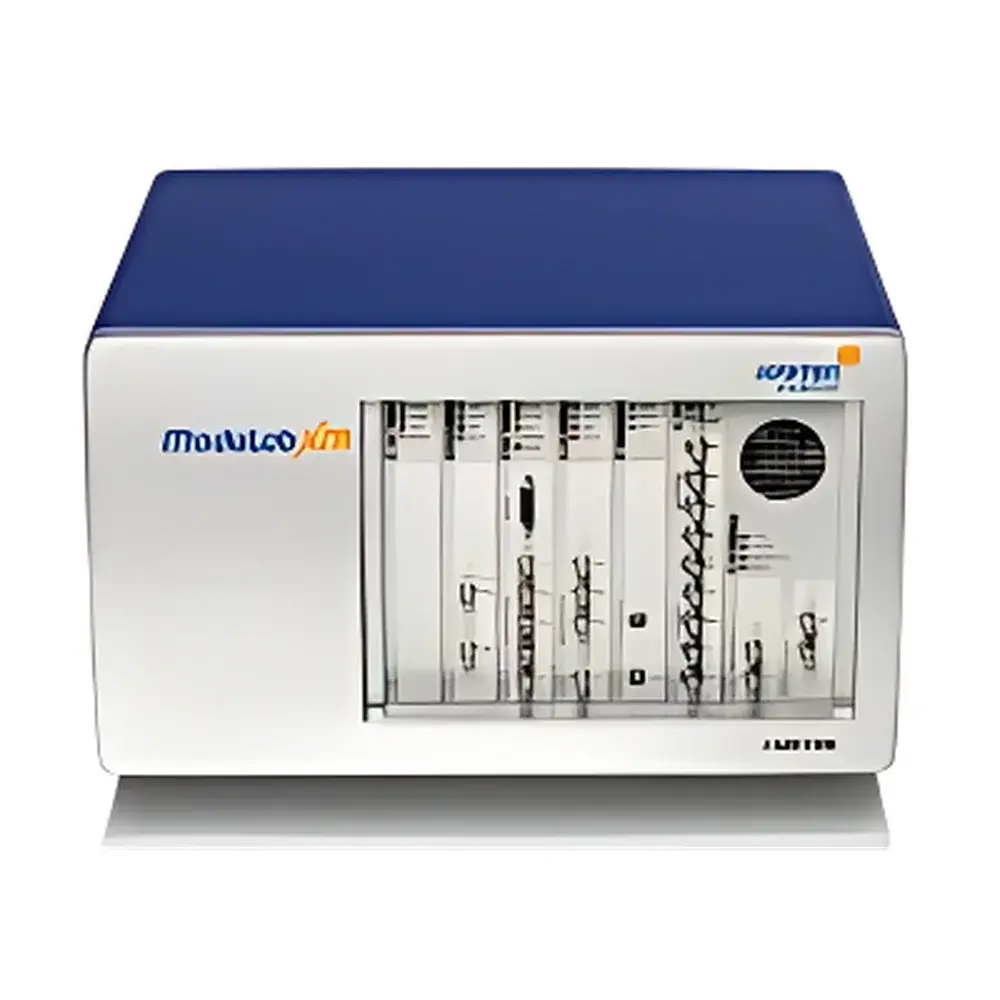
Solartron Analytical ModuLab XM MTS Modular Electrochemical Workstation
| Brand | Solartron Analytical |
|---|---|
| Origin | United Kingdom |
| Model | ModuLab XM MTS |
| Instrument Type | Electrochemical Workstation |
| Channel Count | Single-Channel |
| Current Range | ±1 A |
| Current Accuracy | ±0.2% of reading |
| Potential Accuracy | ±0.2% of reading |
| Potentiostatic Range | ±8 V |
| AC Impedance Frequency Range | 10 µHz – 1 MHz |
| Optional High-Impedance Interface | 1296A (Impedance Range: 100 Ω – 100 TΩ, 12 decades |
| Frequency | 10 µHz – 10 MHz |
| Optional Biomedical Interface | 1294A (IEC 601 compliant) |
Overview
The Solartron Analytical ModuLab XM MTS is a fully integrated, modular electrochemical workstation engineered for precision characterization of electrical and dielectric properties across an exceptionally broad material spectrum—from insulators and polymers to semiconductors, ionic conductors, and superconducting oxides. At its core, the system employs potentiostatic/galvanostatic control combined with frequency-domain electrochemical impedance spectroscopy (EIS), capacitance-voltage (C-V), Mott-Schottky analysis, and time-domain techniques including DC I-V sweeps, pulsed potential/current excitation, and controlled voltage ramping. Its architecture is built upon the industry-standard Solartron 1260/1255 Frequency Response Analyzer (FRA) platform, ensuring traceable, high-fidelity signal generation and acquisition. The ModuLab XM MTS is not merely a workstation but a scalable research infrastructure—designed to evolve alongside experimental complexity, supporting both fundamental solid-state physics investigations and applied materials development under regulated environments.
Key Features
- Modular hardware architecture enabling seamless integration of optional functional units: high-voltage interface (up to 1000 V DC bias with external amplifier), dual-reference electrode support, low-current preamplifier (fA-level resolution), and power amplifier modules.
- Single-channel potentiostat/galvanostat with ±1 A current range, ±8 V compliance, and calibrated accuracy of ±0.2% for both potential and current measurements—validated per ISO/IEC 17025 traceable procedures.
- Ultra-wide EIS frequency coverage from 10 µHz to 1 MHz (extendable to 10 MHz with 1296A interface), supporting long-timescale relaxation processes in polymers, coatings, and biological membranes.
- Dual-interface capability: 1296A Ultra-High-Impedance Interface for sub-picoampere current detection and impedance measurements up to 100 TΩ (10¹⁴ Ω), and 1294A Biomedical Interface certified to IEC 601 safety standards for in vitro and ex vivo tissue-electrolyte interface studies.
- Thermal compatibility with commercial cryostats (4 K–300 K) and high-temperature furnaces (up to 1000 °C), coupled with custom sample holders for thin films, pellets, liquid cells, and microelectrode arrays.
Sample Compatibility & Compliance
The ModuLab XM MTS accommodates diverse sample geometries and electrochemical configurations—including two-, three-, and four-electrode cells, interdigitated electrodes, and guarded electrode setups for leakage-sensitive dielectrics. Its measurement fidelity meets ASTM D257 (resistivity of insulating materials), ISO 2577 (dielectric constant and loss tangent of plastics), and USP (analytical instrument qualification) requirements. When equipped with the 1294A interface, the system satisfies IEC 60601-1 essential performance criteria for biomedical impedance applications. Data integrity is maintained via audit-trail-enabled software compliant with FDA 21 CFR Part 11 and GLP/GMP documentation workflows.
Software & Data Management
Operation is managed through the ModuLab XM Control & Analysis Suite—a Windows-based application supporting script-driven automation, real-time parameter monitoring, and multi-technique sequence programming (e.g., simultaneous EIS + C-V + DC polarization). Raw data are stored in HDF5 format with embedded metadata (timestamp, instrument configuration, calibration history), ensuring FAIR (Findable, Accessible, Interoperable, Reusable) principles. Built-in equivalent circuit modeling (ZView-compatible) and distribution-of-relaxation-times (DRT) analysis enable mechanistic interpretation of heterogeneous conduction pathways. Export options include CSV, MATLAB .mat, and IMPEDANCE.NET-compatible formats for third-party validation.
Applications
- Dielectric spectroscopy of polymer electrolytes, ionomers, and battery separators—quantifying ionic conductivity, glass transition dynamics, and interfacial space-charge effects.
- Corrosion science: EIS-based coating degradation assessment (e.g., pore resistance, delamination kinetics) per ASTM G106 and ISO 16773.
- Perovskite and oxide semiconductor characterization: Mott-Schottky analysis for flat-band potential determination and carrier density profiling.
- Biointerface studies: Low-frequency impedance mapping of cell monolayer barrier function (TEER), hydrogel swelling kinetics, and enzymatic biosensor response modeling.
- Fundamental studies of hopping conduction, Maxwell-Wagner polarization, and grain boundary vs. bulk contributions in ceramic composites.
FAQ
Can the ModuLab XM MTS perform true four-terminal (Kelvin) impedance measurements?
Yes—when configured with the optional four-wire probe interface and appropriate cell design, it eliminates lead resistance errors for low-impedance samples (<1 Ω).
Is the 1296A interface compatible with older Solartron FRAs such as the 1250 or 1287?
No—the 1296A requires firmware and bus protocol compatibility only available on the 1260/1255 FRA platforms integrated into the ModuLab XM MTS architecture.
Does the system support temperature-controlled EIS with automatic thermal compensation?
Yes—via analog temperature feedback input from external sensors (Pt100, thermocouple), enabling real-time correction of impedance magnitude/phase for Arrhenius or Vogel-Fulcher-Tammann modeling.
How is calibration traceability maintained across modules and over time?
Each module undergoes factory calibration against NIST-traceable standards; user-accessible calibration routines (including open/short/load verification) are logged with digital signatures and timestamped metadata.
Can the 1294A interface be used for chronic in vivo measurements?
No—it is validated only for in vitro and acute ex vivo tissue preparations per IEC 60601-2-57; chronic implantation requires additional biocompatibility certification beyond the scope of this interface.





