
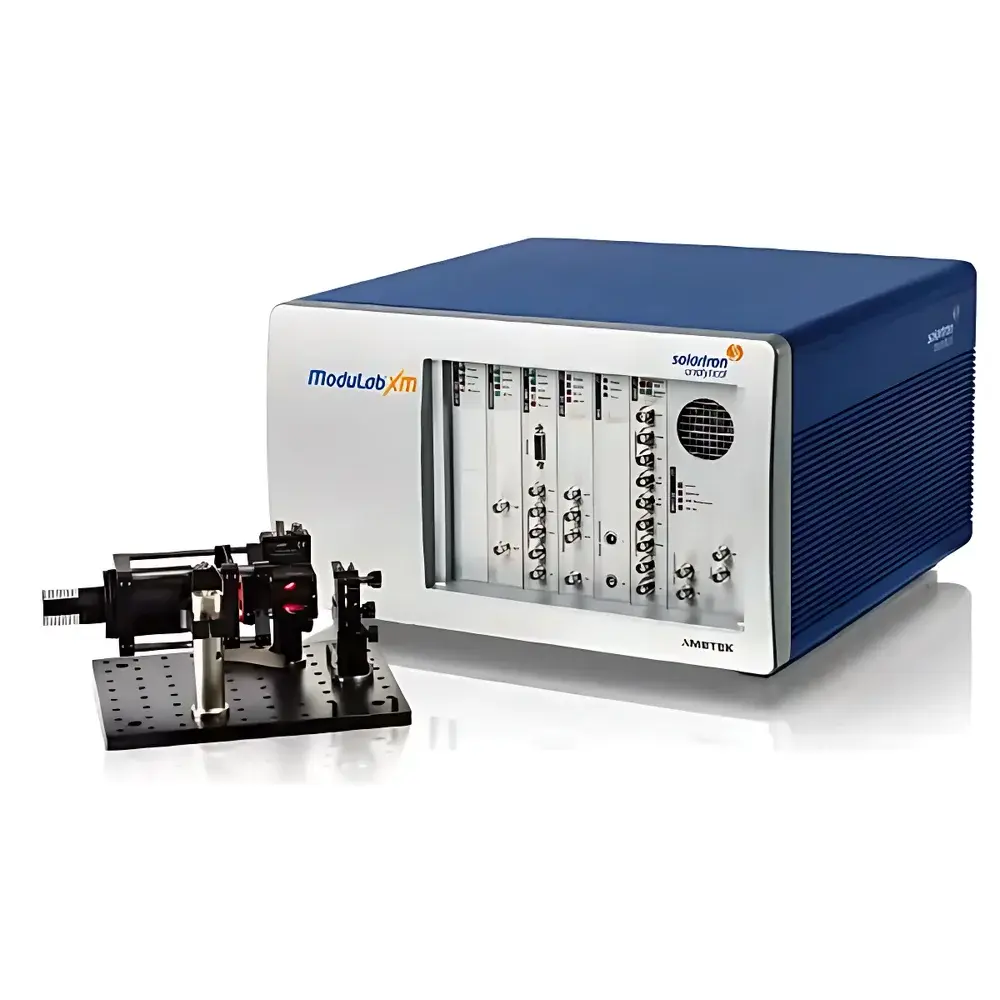
Solartron Analytical ModuLab XM PhotoEchem IPCE Electrochemical Workstation
| Brand | Solartron Analytical |
|---|---|
| Origin | United Kingdom |
| Model | ModuLab XM PhotoEchem IPCE |
| Instrument Type | Electrochemical Workstation |
| Current Range | ±2 A |
| Current Accuracy | 0.1% reading + 0.05% range + 30 fA |
| Potential Accuracy | 0.1% reading + 0.05% range + 100 µV |
| Potentiostatic Range | ±100 V |
| EIS Frequency Range | 10 µHz – 1 MHz |
Overview
The Solartron Analytical ModuLab XM PhotoEchem IPCE Electrochemical Workstation is a purpose-built, modular instrumentation platform engineered for quantitative photoelectrochemical (PEC) characterization of semiconductor-based energy conversion devices. It integrates high-fidelity potentiostat/galvanostat circuitry with precision optical stimulation and synchronized data acquisition to support time-domain and frequency-domain techniques including intensity-modulated photocurrent spectroscopy (IMPS), intensity-modulated photovoltage spectroscopy (IMVS), incident photon-to-current efficiency (IPCE) mapping, transient photocurrent/voltage decay, charge extraction, and steady-state I–V analysis. The system operates on a dual-core architecture—combining Solartron’s industry-proven ModuLab XM potentiostat hardware with an optically coupled, NIST-traceable LED-based illumination module—enabling rigorous correlation between electrochemical response and photon flux under controlled spectral, intensity, and temporal conditions. Designed for laboratories engaged in solar fuel generation, photoelectrocatalysis (e.g., Fe₂O₃-driven water splitting), dye-sensitized solar cells (DSSCs), and perovskite photovoltaic interface studies, the platform delivers metrologically traceable measurements compliant with ISO/IEC 17025-aligned calibration practices.
Key Features
- Modular dual-channel potentiostat/galvanostat with ±2 A current range and <100 µV potential resolution, supporting four-quadrant operation for unbiased photoelectrode polarization.
- NIST-traceable, thermally stabilized LED light source array covering 365–850 nm, with calibrated irradiance output (W/m²) and programmable intensity modulation (DC + AC superposition) up to 10 kHz.
- Integrated frequency response analysis (FRA) engine supporting single-sine, multi-sine, and swept-sine EIS acquisition from 10 µHz to 1 MHz with phase accuracy <0.1°.
- Dedicated “one-click” analytical workflows for electron lifetime (τₑ), effective diffusion coefficient (Dₑff), recombination resistance (Rrec), and surface state density (Nss) derived from IMPS/IMVS and transient decay datasets.
- Simultaneous dual-potential monitoring via auxiliary voltage divider inputs, enabling independent bias control and impedance measurement at both working electrode and counter electrode interfaces.
- Fully upgradeable architecture: Existing ModuLab XM systems can be retrofitted with the PhotoEchem optical module, FRA firmware license, and application-specific software suite without hardware replacement.
Sample Compatibility & Compliance
The ModuLab XM PhotoEchem supports standard three-electrode PEC cells (working, counter, reference), microfluidic electrochemical cells, and custom optically transparent thin-layer cells (OTTLE). Compatible with aqueous and non-aqueous electrolytes, solid-state hole-transport layers, and gas-diffusion electrodes. All optical components meet IEC 61215 and ASTM E927-20 spectral irradiance standards for solar simulator classification. Electrical safety complies with IEC 61010-1:2012 (CAT II, 300 V). Calibration certificates include NIST-traceable uncertainty budgets for current, potential, and irradiance channels. System design supports GLP/GMP environments through audit-trail-enabled software logging and user-access controls aligned with FDA 21 CFR Part 11 requirements.
Software & Data Management
The system is operated via CorrWare™ and MPlot™ software suite (v7.5+), providing unified experiment sequencing, real-time visualization, and post-processing modules. Experimental protocols—including IMPS, IMVS, IPCE, and potentiodynamic I–V sweeps—are preconfigured as validated method templates, each with embedded metadata tagging (wavelength, intensity, scan rate, temperature). Raw data are stored in HDF5 format with embedded instrument configuration, calibration history, and timestamped environmental logs. Batch processing scripts support automated calculation of quantum efficiency spectra, carrier transport parameters, and equivalent circuit fitting (using ZView®-compatible EIS models). Export options include CSV, MATLAB (.mat), and standardized CITS (Common Instrument Test Specification) XML for LIMS integration.
Applications
- Quantitative evaluation of photoanode kinetics in metal oxide semiconductors (e.g., α-Fe₂O₃, BiVO₄, WO₃) under simulated solar illumination.
- Interface engineering of dye-sensitized and quantum dot-sensitized solar cells via recombination pathway mapping using IMVS-derived τₑ vs. applied bias.
- In situ monitoring of photocorrosion onset potentials and passivation layer stability during prolonged illumination in acidic/alkaline media.
- Development of tandem PEC devices by correlating wavelength-resolved IPCE with band-edge positions determined via Mott–Schottky analysis.
- High-throughput screening of co-catalyst deposition effects on charge transfer resistance (Rct) using multi-frequency EIS under modulated illumination.
FAQ
What illumination sources are supported beyond the standard LED array?
The system accepts third-party monochromators and xenon arc lamps via TTL-triggered synchronization; optical fiber coupling ports enable integration with tunable lasers or broadband sources equipped with calibrated photodiodes.
Is the IPCE measurement fully automated across wavelength ranges?
Yes—software-controlled wavelength stepping, auto-gain adjustment for photocurrent amplification, and integrated reference diode normalization ensure traceable, reproducible IPCE spectra without manual recalibration.
Can the system perform simultaneous EIS and IMPS under illumination?
Yes—the dual-channel FRA architecture permits concurrent acquisition of low-frequency EIS (e.g., 10 mHz–1 Hz) and high-frequency IMPS (up to 10 kHz) using independent excitation signals, with phase-coherent sampling.
How is thermal drift minimized during long-duration photoelectrochemical experiments?
The LED module incorporates active Peltier cooling and real-time junction temperature feedback; potentiostat electronics feature oven-controlled reference voltage sources and low-drift analog front-ends optimized for sub-picoampere dark current stability.
Does the software support custom scripting for advanced experimental sequences?
Yes—Python API access (via PyCorrWare) enables programmatic control of all hardware parameters, stimulus waveforms, and data streaming, facilitating machine learning–driven experiment optimization and closed-loop adaptive testing.




