
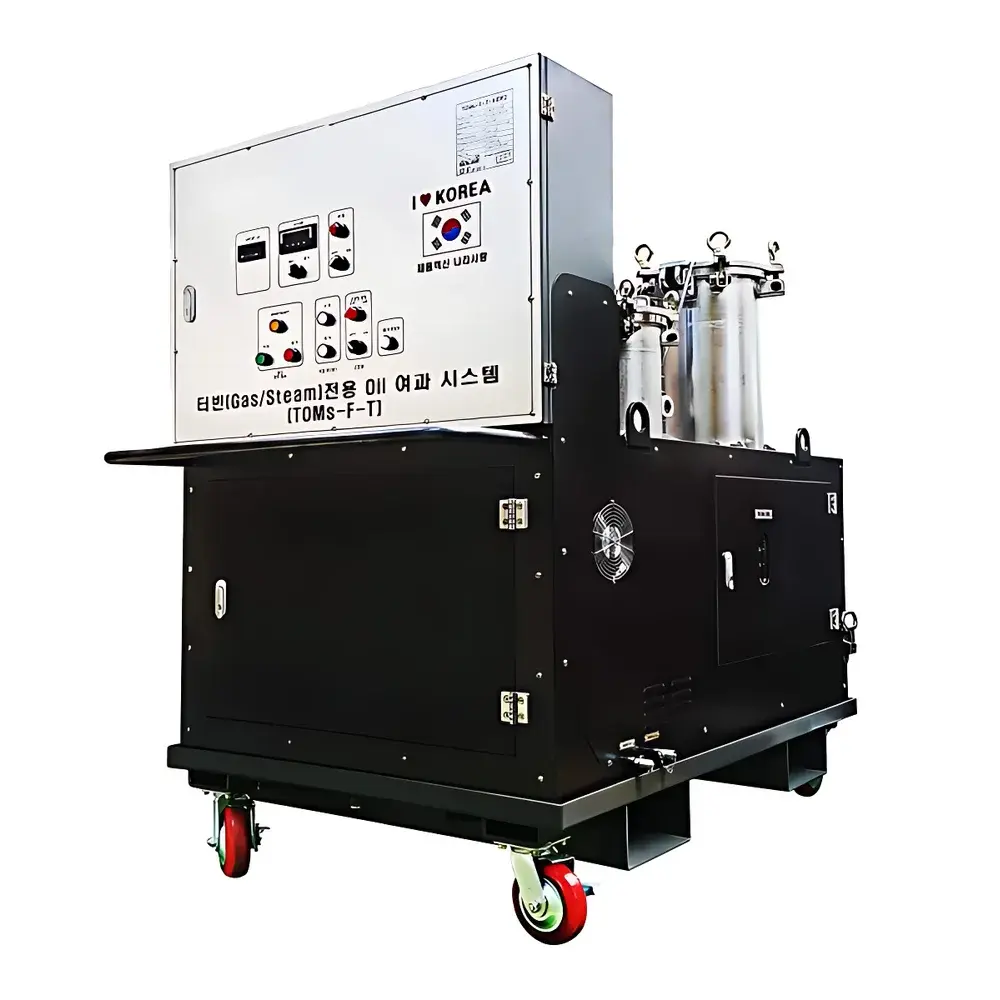
SOLGE TOMs-F (T/PE) Integrated Oil Purifier
| Brand | SOLGE |
|---|---|
| Origin | South Korea |
| Model | TOMs-F (T/PE) |
| Flow Rate | 46 L/min |
| Operating Temperature | 40–65 °C |
| Viscosity Range | 0–220 cSt (@ 40 °C) |
| Compatible Fluids | Mineral Oils, Synthetic Lubricants, Fire-Resistant Hydraulic Fluids (e.g., Phosphate Esters) |
| Power Supply | 480 V AC, 3 HP, 3-Phase (Optional) |
| Particle Removal Efficiency | β ≥ 1000 (at rated particle size) |
| Water Removal | Free & Dissolved Water via Membrane + Dry Nitrogen Purge |
| Acid Number Reduction | Yes, via Ion-Exchange Media |
| Optional Condition Monitoring | Particle Count, Water Content, Viscosity, Colorimetry, Temperature |
Overview
The SOLGE TOMs-F (T/PE) Integrated Oil Purifier is an engineered solution for in-service oil reconditioning in critical hydraulic and lubrication systems. Designed around a multi-stage, parallel-path purification architecture, it simultaneously addresses five primary degradation pathways in industrial oils: particulate contamination, water ingress (both free and dissolved), acidic oxidation byproducts (e.g., carboxylic acids), insoluble sludge, and varnish precursors. Unlike single-function filtration units, the TOMs-F (T/PE) integrates three distinct purification mechanisms—mechanical depth filtration, ion-exchange adsorption, and membrane-assisted dehydration—within a compact, portable chassis. Its operation is grounded in established physicochemical principles: particle capture follows ISO 16889-compliant beta-ratio testing methodology; water removal leverages selective hydrophobic membrane permeation coupled with dry nitrogen sparging to shift the water activity equilibrium; and acid neutralization occurs via reversible cationic exchange resins that bind low-molecular-weight organic acids without generating metallic soaps or altering base number unpredictably. This system is intended for offline (bypass) circulation during scheduled maintenance or continuous operation in high-reliability environments such as power generation turbines, aerospace test stands, and precision manufacturing hydraulics.
Key Features
- Multi-contaminant removal in a single pass: Particles (β ≥ 1000 at ≥ 5 µm), dissolved water (down to < 10 ppm), varnish precursors, sludge, and organic acids.
- Ion-exchange filtration module specifically formulated for phosphate ester (T/PE) fire-resistant hydraulic fluids—maintains fluid compatibility while reducing acid number (AN) without catalyzing hydrolysis.
- Membrane-based dehydration stage combined with regulated dry nitrogen purge ensures consistent removal of both free and dissolved water, even from highly polar synthetic fluids where conventional vacuum dehydrators underperform.
- Modular, portable design enables rapid deployment across multiple assets; unit operates independently of host system pressure—no integration into main hydraulic loop required.
- Optional real-time condition monitoring package includes ISO 4406 particle counting, Karl Fischer coulometric water analysis, kinematic viscosity measurement (ASTM D445), colorimetric oxidation index (ASTM D1500), and temperature logging—all synchronized and timestamped per IEC 61508 functional safety guidelines.
Sample Compatibility & Compliance
The TOMs-F (T/PE) is validated for use with mineral-based turbine oils (ISO VG 32–68), polyalphaolefin (PAO) and polyol ester synthetics, and critically, phosphate ester (T/PE) fire-resistant hydraulic fluids commonly deployed in gas turbine control systems. All wetted materials—including housing, seals, membranes, and ion-exchange media—are chemically resistant to T/PE hydrolysis byproducts and conform to ASTM D6187 and OEM fluid compatibility protocols. The system meets CE marking requirements for electromagnetic compatibility (EN 61000-6-3/4) and low-voltage directive (2014/35/EU). When equipped with the optional monitoring suite, data acquisition complies with FDA 21 CFR Part 11 audit trail requirements and supports GLP/GMP traceability through encrypted SD card logging and configurable user access levels.
Software & Data Management
The integrated HMI interface provides local visualization of real-time purification metrics and historical trend logs (up to 30 days onboard storage). Optional Ethernet/Wi-Fi connectivity enables remote configuration and secure cloud upload via TLS 1.2–encrypted MQTT protocol. Data exports are structured in CSV and ASTM E2787-compliant XML formats, supporting direct ingestion into CMMS platforms (e.g., IBM Maximo, SAP PM) and predictive analytics engines. Firmware updates follow IEC 62443-2-4 change control procedures, with version history and SHA-256 checksum validation embedded in each release.
Applications
- Turbine lube oil reclamation in fossil-fuel and combined-cycle power plants
- Maintenance of servo-valve hydraulic systems in aviation ground test rigs
- Extended service life management of phosphate ester fluids in industrial gas turbine governors
- Pre-commissioning flushing and post-failure remediation of high-pressure hydraulic circuits
- Lab-scale oil aging studies requiring controlled contaminant removal prior to accelerated oxidation testing (ASTM D2443)
FAQ
Can the TOMs-F (T/PE) be used with non-phosphate-ester synthetic fluids, such as polyol esters?
Yes—the ion-exchange media and membrane chemistry are compatible with common synthetic base stocks, though regeneration intervals may vary based on acid generation rate.
Does the system require external vacuum or compressed air sources?
No—dry nitrogen is supplied via standard industrial-grade N₂ cylinders (CGA-580 fitting); no vacuum pump or shop air connection is needed.
How often must the filter elements be replaced?
Particle filters typically last 500–800 operating hours depending on inlet cleanliness; ion-exchange and membrane cartridges are monitored via differential pressure and conductivity decay—replacement triggered automatically when saturation thresholds are reached.
Is calibration of the optional sensors traceable to NIST standards?
Yes—particle counter certified to ISO 21501-4, viscometer calibrated per ASTM D445 Annex A2, and moisture sensor verified using NIST-traceable standards (SRM 2890).
Can the unit operate unattended for extended periods?
Yes—equipped with thermal cutouts, flow interlocks, and automatic shutdown on high ΔP or low N₂ pressure; fully compliant with UL 508A industrial control panel requirements.




