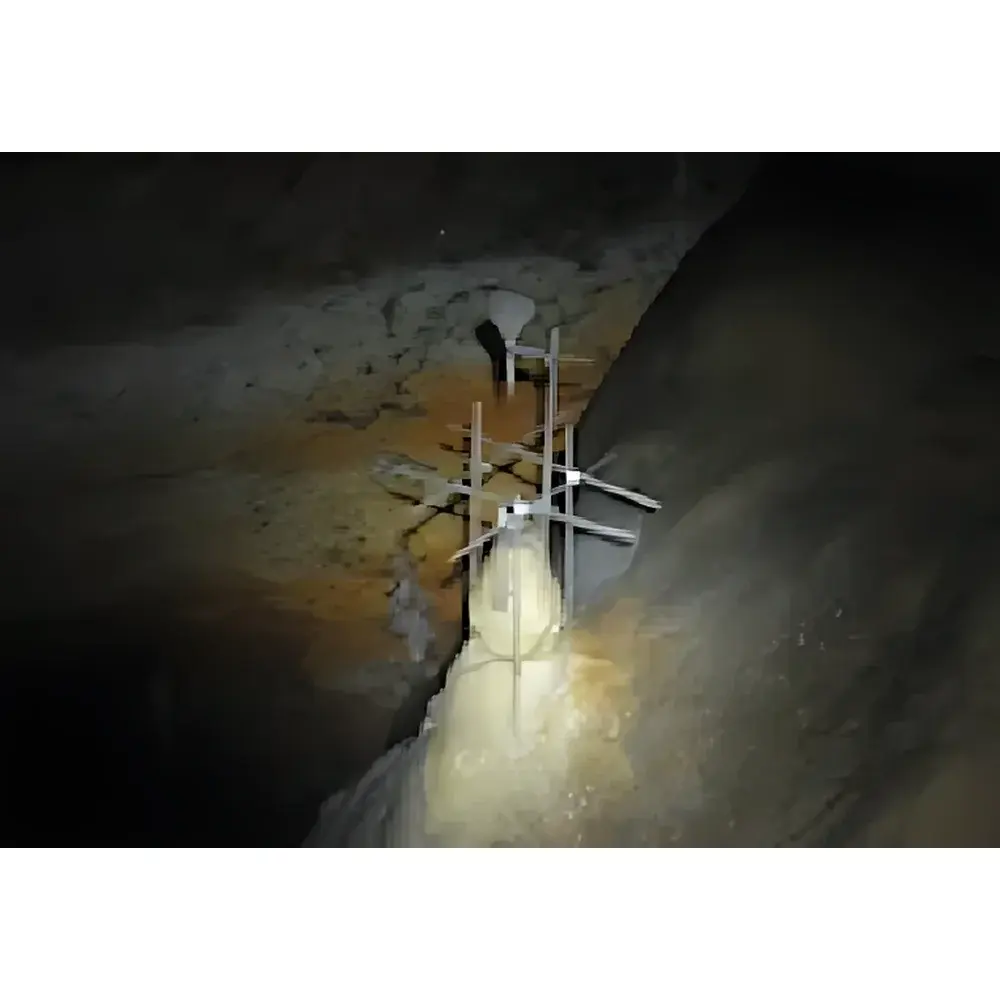
Solinst Driptych Drip Counter for Speleothem Monitoring
| Brand | Solinst |
|---|---|
| Origin | Canada |
| Model | Driptych |
| Type | Acoustic Drip Counter |
| Power | Lithium Thionyl Chloride 1/2 AA 3.6 V |
| Dimensions | 55 × 55 × 65 mm |
| Weight | 300 g |
| IP Rating | IP65 (short-term submersion to 0.3 m) |
| Sensitivity | Detects ≥0.15 mL water droplets falling from ≤200 mm height |
| Max Drip Rate | 5 drops/s |
| Recording Interval | Configurable from 1 s to 24 h |
| Events per Bucket | Up to 16,383 |
| Total Buckets | 32,767 |
| Battery Life | Up to 10 years in sleep mode |
| Data Output | USB 3-pin interface |
| LED Indicators | Three status LEDs (power, activity, error) |
| Environmental Shielding | Acoustic noise rejection for false-trigger suppression (e.g., ambient sound, sheet flow) |
Overview
The Solinst Driptych Drip Counter is a purpose-built, autonomous acoustic sensing instrument engineered for long-term, high-fidelity monitoring of drip dynamics in karst cave environments—specifically targeting speleothem (stalactite/stalagmite) formation studies. Unlike radar-based or pressure-based water level sensors, the Driptych operates on a calibrated piezoelectric-acoustic detection principle: its sealed, waterproof housing incorporates a tuned diaphragm that functions as a passive mechanical transducer. When a water droplet impacts the sensor cap, it generates a transient mechanical impulse. This impulse is converted into a damped oscillatory signal, digitally conditioned to eliminate low-frequency drift and broadband environmental noise (e.g., wind, dripping sheet flow, or footfall vibrations), and translated into a clean TTL-compatible square pulse. Each validated pulse increments an onboard counter and timestamps the event within a user-defined temporal bucket—enabling precise reconstruction of drip timing statistics, inter-drip intervals, and transient hydrological responses to external forcing (e.g., rainfall infiltration, barometric pressure shifts, or seasonal recharge cycles).
Key Features
- True field-deployable autonomy: Powered by a single 3.6 V lithium thionyl chloride 1/2 AA cell, delivering up to 10 years of standby life and 4 years of continuous logging under typical cave conditions.
- Robust environmental sealing: IP65-rated enclosure with O-ring–sealed lid; validated for short-term immersion to 0.3 m—critical for high-humidity, condensation-prone cave ceilings and drip trays.
- Acoustically selective sensing: Factory-calibrated to reliably detect discrete droplets ≥0.15 mL falling from heights ≤200 mm while rejecting spurious triggers from ambient acoustic noise or laminar film flow.
- Configurable temporal resolution: Recording intervals programmable from 1 second to 24 hours per data bucket—supporting both high-resolution event capture (e.g., storm-response studies) and multi-year trend analysis (e.g., paleoclimate proxy calibration).
- High-capacity non-volatile memory: Stores up to 32,767 time-stamped buckets, each holding up to 16,383 discrete drip events—eliminating the need for frequent site visits in remote or logistically constrained caves.
- Real-time operational feedback: Three integrated LEDs provide unambiguous visual indication of power status, active counting, and system error—essential for rapid field verification without instrumentation software.
Sample Compatibility & Compliance
The Driptych is optimized for direct mounting beneath calcite-forming stalactites or integration with custom drip-collection plates (e.g., glass substrates for concurrent crystal growth imaging). Its compact 55 × 55 × 65 mm form factor and 300 g mass enable secure attachment to irregular cave surfaces using epoxy, clamps, or magnetic mounts. The device complies with IEC 60529 for ingress protection (IP65) and meets RoHS Directive 2011/65/EU for hazardous substance restrictions. While not certified to ISO/IEC 17025 for metrological traceability, its pulse-counting architecture delivers high reproducibility across units when deployed under consistent installation geometry and environmental conditions—making it suitable for comparative multi-site monitoring campaigns aligned with UNESCO cave monitoring protocols and national karst observatory frameworks.
Software & Data Management
Data retrieval is performed via a proprietary USB 3-pin cable interfacing directly with Windows-based host systems (XP, Vista, 7, 10, 11). The included Solinst Driptych Configuration & Download Utility enables full parameter setup—including interval selection, bucket reset, and firmware version check—as well as bulk export to comma-separated value (.csv) format. Each exported record contains: bucket start timestamp, elapsed duration, total drop count, and (if enabled) inter-drop interval histogram metadata. For field synchronization, the utility supports time-of-day correction using PC system clock reference. All data files are human-readable, ASCII-encoded, and fully compatible with MATLAB, Python (pandas), R, and GIS time-series analysis pipelines. No proprietary runtime or database engine is required; no cloud dependency or license activation is enforced.
Applications
- Speleothem hydrology: Quantifying drip rate variability as a proxy for epikarst recharge dynamics and vadose zone transmission times.
- Paleoclimate calibration: Correlating drip timing statistics with stable isotope (δ18O, δ13C) records from concurrently sampled calcite layers.
- Cave microclimate modeling: Validating numerical simulations of condensation–evaporation–drip coupling under controlled ventilation scenarios.
- Geomorphological process monitoring: Assessing the impact of anthropogenic disturbance (e.g., tourism, quarrying) on drip regime stability over decadal scales.
- Educational field instrumentation: Providing undergraduate and graduate students with hands-on experience in autonomous environmental sensor deployment, time-series statistics, and low-power embedded systems operation.
FAQ
How is the Driptych calibrated for different drip volumes or fall heights?
Factory calibration targets 0.15 mL droplets falling from 200 mm. Users may empirically verify sensitivity by controlled lab testing; no field recalibration is supported. Mounting height must remain ≤200 mm for specified performance.
Can multiple Driptych units be synchronized for spatially distributed monitoring?
No internal clock synchronization protocol exists. Temporal alignment across units requires post-hoc correction using GPS-synchronized timestamps from co-located reference loggers or manual offset adjustment based on known trigger events.
What happens when memory capacity is exceeded?
The device implements circular buffer behavior: once 32,767 buckets are filled, new data overwrites the oldest bucket. No data loss alert is generated—users must manage download frequency accordingly.
Is the sensor affected by temperature fluctuations common in deep caves?
Lithium thionyl chloride chemistry ensures stable voltage output between –40°C and +85°C. However, battery service life decreases significantly below 5°C; annual replacement is recommended in sub-zero environments.
Does the Driptych meet FDA 21 CFR Part 11 or GLP requirements for regulated research?
No. It lacks electronic audit trail, user authentication, or data integrity safeguards required for Good Laboratory Practice or clinical regulatory submissions. It is intended for environmental research and geological field studies only.