
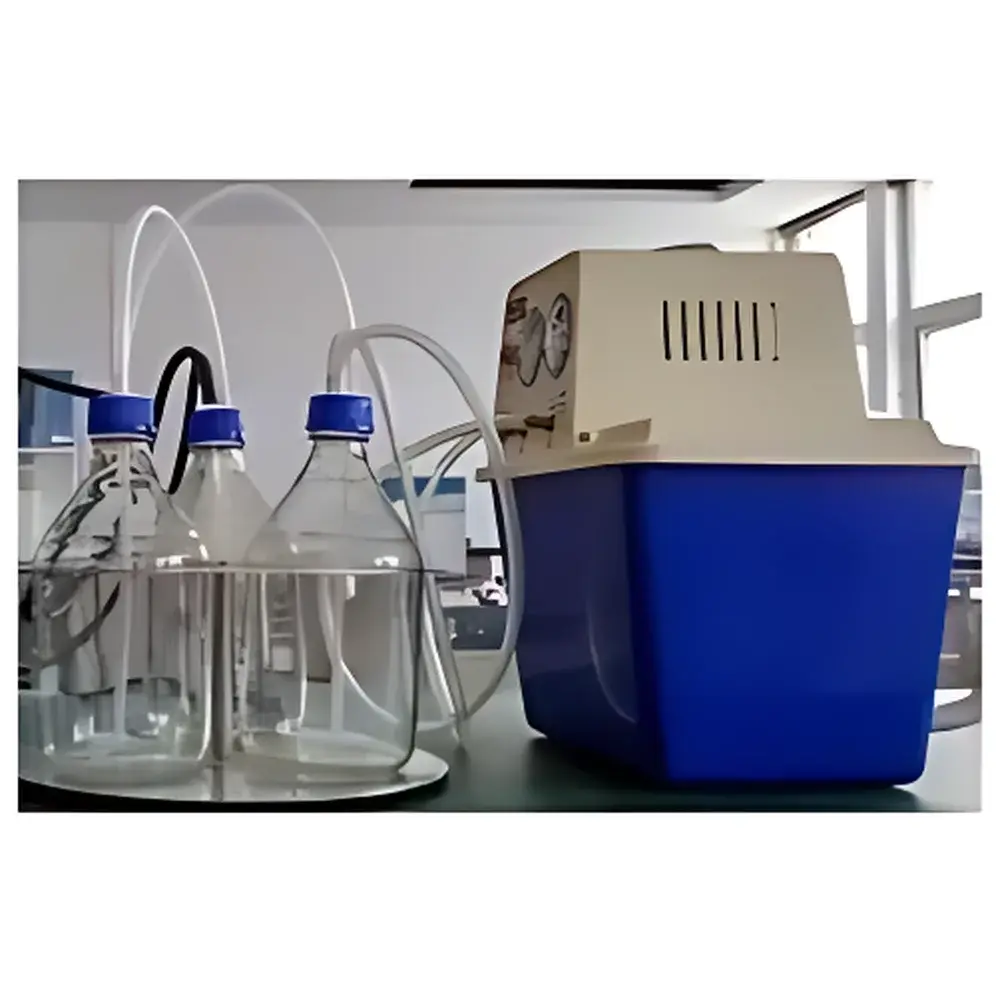
Sonnen ED20 Acid Gas Scrubbing System
| Brand | Sonnen |
|---|---|
| Model | ED20 |
| Origin | Shanghai, China |
| Application | Acidic corrosive gas absorption and neutralization in Kjeldahl digestion and wet chemical digestion processes |
| Sample Handling | Continuous waste gas treatment |
| Vacuum Flow Rate | 20 L/min (dual-head) |
| Ultimate Vacuum | 0.098 MPa |
| Construction Material | PTFE connectors throughout |
| Reagent Capacity | Up to 2 L |
| Power Consumption | 180 W |
| Electrical Supply | 220 V ±10%, 50 Hz |
| Water-Free Operation | Yes |
| Adjustable Vacuum Intensity | Yes |
Overview
The Sonnen ED20 Acid Gas Scrubbing System is an engineered laboratory-scale gas abatement device designed specifically for the safe, continuous removal of acidic, corrosive fumes generated during high-temperature acid digestion procedures—particularly Kjeldahl nitrogen determination, sulfuric acid–based sample mineralization, and other wet-chemistry oxidation protocols. Operating on a closed-loop, water-free vacuum-assisted principle, the ED20 employs a three-stage treatment sequence: forced convective cooling, alkaline neutralization in a liquid reagent chamber, and particulate/acid mist filtration. Unlike traditional water aspirator-based traps or passive scrubbers, the ED20 integrates a dual-head diaphragm vacuum pump capable of sustaining stable negative pressure (up to −0.098 MPa) independent of municipal water supply or pressure fluctuations—ensuring consistent gas draw rates and operator safety across variable lab environments. Its architecture conforms to core principles of ISO 17025-accredited laboratory environmental control and aligns with OSHA 29 CFR 1910.1200 (Hazard Communication) requirements for handling hazardous vapors.
Key Features
- Triple-stage gas treatment: Integrated cooling coil reduces gas temperature prior to neutralization; large-volume (2 L) alkaline reagent reservoir enables extended operation without frequent replenishment; final PTFE-coated glass fiber filter captures residual aerosols and fine acid mists.
- Corrosion-resistant fluid path: All wetted components—including inlet/outlet fittings, reagent chamber seals, and internal tubing—are fabricated from virgin polytetrafluoroethylene (PTFE), ensuring long-term compatibility with HCl, HNO₃, H₂SO₄, and mixed acid vapors at elevated temperatures.
- Water-free vacuum generation: Dual-head 180 W diaphragm pump delivers up to 20 L/min volumetric flow while eliminating dependence on tap water—reducing utility load, avoiding siphon-back risks, and enabling deployment in labs with unstable or restricted water access.
- Real-time vacuum regulation: Analog vacuum intensity control allows precise adjustment of suction force to match digestion vessel venting characteristics—preventing boil-over, foaming, or back-suction into reaction flasks.
- Modular service design: Reagent chamber, filter cartridge, and pump head are tool-free accessible; PTFE gaskets and standardized M12/M16 threaded connections simplify cleaning, replacement, and GLP-compliant maintenance logging.
Sample Compatibility & Compliance
The ED20 is validated for use with standard Kjeldahl digestion blocks (e.g., Gerhardt, Büchi, Foss), block digesters, and open-vessel hotplate systems operating at temperatures up to 450 °C. It accommodates common digestion acid mixtures including concentrated H₂SO₄ (with K₂SO₄/CuSO₄ catalyst), HClO₄–HNO₃ blends, and HNO₃–HF combinations—provided downstream neutralization reagents (e.g., 5–10% NaOH or Na₂CO₃ solution) are selected accordingly. The system meets material compatibility benchmarks per ASTM D543-20 (Resistance of Plastics to Chemical Reagents) and supports audit-ready documentation for ISO/IEC 17025 Clause 6.4 (Equipment Management) and USP Analytical Instrument Qualification protocols when integrated into validated digestion workflows.
Software & Data Management
The ED20 operates as a standalone hardware unit without embedded firmware or digital interfaces. However, its mechanical vacuum regulation and physical process indicators (e.g., reagent level sight gauge, audible pump tone consistency, visible condensate accumulation) support manual operational qualification (OQ) and routine performance verification (RPV). For laboratories implementing electronic lab notebooks (ELN) or LIMS integration, vacuum pressure trends may be logged externally using analog-to-digital transducers (e.g., 4–20 mA output sensors compatible with LabVIEW or DeltaV), satisfying FDA 21 CFR Part 11 requirements for attributable, legible, contemporaneous, original, and accurate (ALCOA+) data capture where required.
Applications
- Kjeldahl total nitrogen analysis in food, feed, soil, and environmental samples
- Heavy metal digestion (As, Cd, Pb, Hg) per EPA Method 3050B and ISO 11466
- Organic matrix decomposition for ICP-OES/MS sample preparation
- Pharmaceutical excipient and active ingredient residue testing under USP and
- Acid fume containment during microwave-assisted digestion method development
FAQ
Can the ED20 be used with hydrofluoric acid (HF) digestion?
Yes—provided the neutralizing reagent is calcium hydroxide or sodium carbonate (not NaOH alone), and the PTFE wetted path remains undamaged; HF exposure must be verified against ASTM D543 immersion test data for extended service life.
Is the reagent chamber drain port compatible with standard lab waste collection systems?
Yes—the bottom outlet features a 1/2″ NPT female thread, adaptable to common 12 mm or 16 mm waste tubing via PTFE-lined compression fittings.
Does the ED20 require calibration or periodic certification?
No formal calibration is specified; however, daily visual inspection of PTFE integrity, weekly reagent pH monitoring (target pH >12), and quarterly pump performance verification (flow rate at set vacuum) constitute recommended preventive maintenance per ISO/IEC 17025 Clause 6.4.3.
Can multiple digestion vessels be connected simultaneously?
Yes—using optional manifold kits (Sonnen Part No. ED-MAN-4), up to four independent digestion units may be daisy-chained with individual inline flow restrictors to ensure balanced vacuum distribution.
What is the expected service life of the PTFE filter element under continuous use?
Under typical Kjeldahl applications (8 h/day, 5 days/week), the standard PTFE-glass fiber composite filter demonstrates ≥6 months functional service life before pressure drop exceeds 15% of initial baseline—verified by manometric measurement per ASTM D1823.



